Case file 18
A month of doing exactly what the plan said
Name withheld
- Came in with
- Porn and masturbation, junk food, and other quick rewards the client wanted to give up
- Program
- 90-Day Behavior Control System, with a specialist
- Where it stood at last contact
- No relapse since starting; body changing at the gym; cravings still there but fading; the work on cravings and triggers due to start the next day
- On record
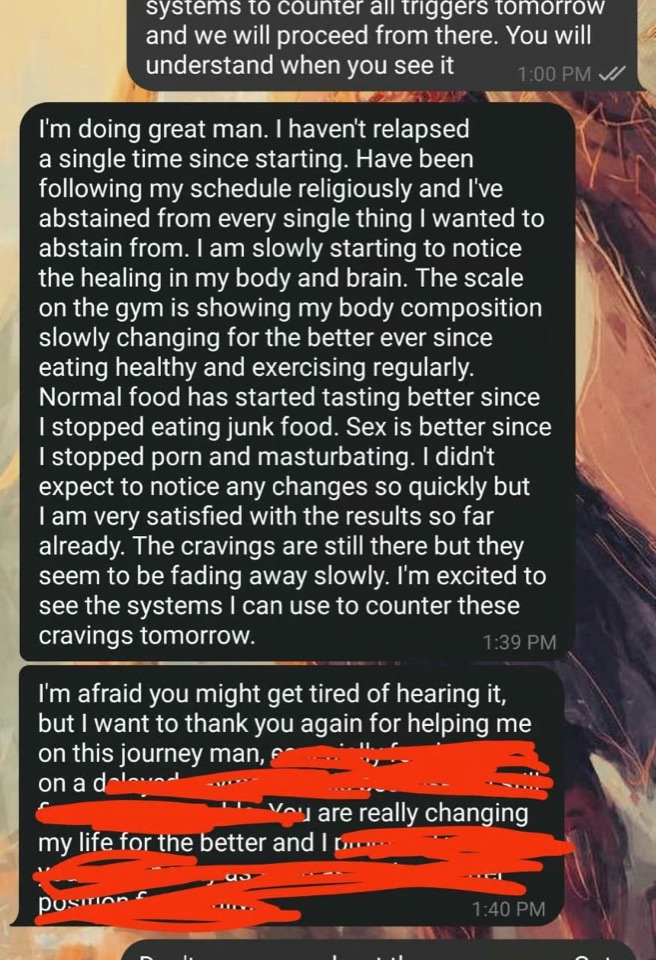
- Written update (screenshot): two messages sent a minute apart
At the end of their first month, on the day before we started work on their cravings, this client sent us an update. That update is the record we have. They'd come to us with porn, junk food and a list of other easy rewards they wanted out of their life, and by the time they wrote, they hadn't relapsed once. They'd kept to their schedule every day, and their body was already changing. The cravings hadn't gone, and the client said so plainly.
This file goes through that first month in detail: what we found, what we went after and why, and where it got hard. After that, it sets out the work that came next.
So many easy rewards that ordinary food and sex felt flat
The client's update says more about what life was like before than it first seems to. Look at what they noticed once things changed. "Normal food has started tasting better since I stopped eating junk food." And: "Sex is better since I stopped porn and masturbating."
Nobody notices that normal food tastes better unless it had stopped tasting of much. That was the life the client came in with. Porn was the main habit, but it was part of a wider pattern of reaching for quick, easy rewards: junk food, masturbation, and other things they later put on their list. Each one gave them a fast hit for no effort. And over time, each one made the ordinary version of the same thing feel like less. After a while, a home-cooked meal couldn't compete with junk food, and real intimacy couldn't compete with an endless supply of porn on a screen.
The cost showed up in the body too. The client doesn't say what their body or energy was like before the program. But the change on the gym scale was the first result they mentioned, and they were clearly pleased with it. We took that to mean their body had been slowly getting worse for a while.
We don't have the client's earlier attempts on record. One line suggests what they expected, though: "I didn't expect to notice any changes so quickly." People who've tried to stop before often expect a long, miserable stretch where they give things up and get nothing back for it. If that's what earlier attempts had felt like, it's easy to see why they didn't last.
What we found: every habit on the list came from the same place
On the first call, the specialist's job was to work out what was keeping the habit going. For this client, the answer was that porn didn't stand on its own. It was the biggest part of one wider habit: reaching for the quickest reward whenever there was a gap in the day, a low moment or a quiet evening. Junk food came from the same place, and so did everything else on the list.
That shaped the plan in three ways.
First, the body and the day had to be rebuilt before anything stopped, so that the client wasn't trying to give things up while tired, eating badly and sitting through empty evenings.
Second, when the time came, everything on the list had to stop together. If porn stopped and the junk food stayed, the habit of grabbing the quickest reward would still be there. It would just move over to food.
Third, the client needed to know from the start that ordinary pleasures come back slowly. When you take away the big easy rewards, the small real ones take a while to start feeling like anything. If you don't know that's coming, those weeks can feel like proof that nothing is working.
Before Day 1, the client wrote down a commitment to the start date.
Phase 1, Days 1 to 30: the schedule came first
The first phase doesn't ask anyone to stop. It's about getting sleep, food, exercise and the daily routine in order first, and this client took it more seriously than most. In their words: "Have been following my schedule religiously."
The first week. On Day 1 the client wrote an honest account of where they stood, something to look back at later and measure against. That night they sent their specialist the first of the short evening entries they'd send every night after.
Sleep came first: fixed times to go to bed and get up, light in the morning, low light at night. The phone was given a place to spend the night outside the bedroom, and for this client that mattered more than any other early change. Lying in bed late at night with a phone is where a porn habit usually happens, so moving it removed the easiest late-night chance before they'd even stopped. They found the first few nights strange, lying in the dark with nothing to reach for, and said so in their entry.
The gym. Daily walks went in next, and then training, and this is where the client took to the program fastest. They started using the gym regularly in the first week, and that's where the gym scale they mention in their update comes in. A short daily sitting practice for attention went in at the end of the week, with much less fuss.
Food. In the second week eating changed. Junk food went out and real meals came in. It was the first of the easy rewards to go, and for a few days the client missed it more than they expected. That week also set the shape of the whole day, with meals, training and the evening each given a fixed place, so there was no long empty stretch for a habit to fill. The schedule they'd later describe as followed "religiously" started here.
The list. Then came the honest written work. The client learned how the cycle of a habit runs and why the plan was full abstinence rather than cutting down. Then they wrote down everything in their life that gave them a hit of pleasure for no effort. That list is where their phrase "every single thing I wanted to abstain from" comes from. It went well past porn and junk food. They also traced the history of the habit from the start to the present day.
On Day 14 they read the rule that relapses tend to follow skipped daily habits and broken routines. For someone who'd already built their whole day around the schedule, this hit home, and they made sure they didn't skip anything.
Day 15: everything on the list stopped. On Day 15 abstinence started. Porn and masturbation stopped, and so did everything else the client had written down. Junk food was already gone. Their specialist went through the list with them first, so there was nothing left that they'd only half given up.
The first two weeks without it. The cravings came, and they came most days. The worst were late in the evening, when the day's structure ran out and the client was alone. On some days the craving was for porn. On others it was for food, especially on tired afternoons. The client didn't act on any of them. They didn't find it easy either, and they wrote about it in the log. "I haven't relapsed a single time since starting," they'd say later, and that was true. It was also true that "the cravings are still there."
Their specialist's job in those weeks was simple. They read the log, answered messages, and kept the client focused on the schedule. On the evenings when the craving was strongest, the client had someone who already knew where their evenings went wrong.
The rest of the month added cold and heat, a hobby with goals that kept getting harder, a calming practice and more attention work. Near the end of the month the lessons explained how cravings work, and how the brain stores the setting of every past use. That second lesson answered a question the client had been asking for two weeks: why the cravings were still turning up when the habit itself had stopped.
The client went over the month with their specialist on the Day 28 call, and two days after that they sent the update this file is built on.
The update at the end of the month
The update gets straight to the point. "I'm doing great man. I haven't relapsed a single time since starting."
Then it moves straight to the body: "The scale on the gym is showing my body composition slowly changing for the better ever since eating healthy and exercising regularly." The food and sex lines follow, and then the client describes their own surprise: "I didn't expect to notice any changes so quickly but I am very satisfied with the results so far already."
What makes the update worth reading is that it doesn't claim more than was true. "The cravings are still there but they seem to be fading away slowly." That's an accurate account of the end of the first month. The habit had stopped, the body was changing and the cravings were getting weaker. But the cravings were still there, and the client hadn't yet been given anything to use against them in the moment. They knew what came next: "I'm excited to see the systems I can use to counter these cravings tomorrow."
A minute later they sent a second message: "I'm afraid you might get tired of hearing it, but I want to thank you again for helping me on this journey man." And: "You are really changing my life for the better."
Phase 2, Days 31 to 60: answers for the moments that were still hard
Everything from here on came after the update, so none of it is in the client's own words. The second phase is where the client got the tools they'd been waiting for.
Day 31: their trigger map. The client wrote down every trigger they could find, including the ones they wouldn't have said out loud. Most of them had to do with being alone at home: in bed late at night, in the evening after a long day, in the bathroom with a phone, and in the hour after a workout when their energy dropped. Boredom and low moods were on it too, and so were certain apps and sites. A few food triggers sat alongside them: passing particular shops, and tired afternoons at home.
Day 32: the reset. Everything that could be removed was removed. The phone and every other screen were set up so that getting to porn took real effort. The kitchen was cleared of anything that had been part of the old pattern. The triggers that couldn't be removed got a plan.
Building the responses. Over the next three weeks the client built a planned response to each trigger that was left. Late evenings got a set end to the day. Low moods got something to do that wasn't a screen. Tired afternoons got a plan that didn't involve food.
The work on their thinking mattered a lot for this client. A person who's followed a schedule perfectly for a month is open to one particular thought: I've done so well, I've earned one. The client wrote down that thought, and the others like it that showed up when a craving did. Then, at a calm moment, they took it apart carefully in writing. So when the thought came back later, it was much easier to ignore.
An argument at home. The hardest night of the phase came from something that wasn't on the map at all. Around Day 40 the client had a row with their partner late in the evening. It ended the way rows often do, with one of them going to bed and the other left alone in the next room, upset and wide awake. Every old route was close at hand: a screen, and a kitchen they could have filled again with one trip to the shop. The client could feel both cravings at once.
They didn't have a planned answer for this, because conflict had never been on their list. What they had was a month of the schedule and a few weeks of the new tools. They put their shoes on and walked until they'd calmed down, came back and went to bed. They didn't message anyone that night. The next morning they wrote to their specialist and told them what had happened. Their specialist's first question was why an argument wasn't on the trigger map, and the honest answer was that it had never occurred to them. Their arguments had always seemed like a separate problem from the habit. It went on the map that day, and it got its own response alongside the others.
They also learned ways to handle a craving as it happened: a breathing practice, a way to release the tension a craving builds in the body, and a short practice for the peak. By Day 52 they had a personal set of responses, one for each trigger that couldn't be removed, conflict included. They spent the next week using the set for real and noting each craving and what they did with it, then talked the whole phase through with their specialist on the second call.
Phase 3, Days 61 to 90: someone who keeps their word to themselves
The last phase deals with how the client saw themselves. Before the program, they'd seen themselves as someone who gave in to whatever was easiest. The first month had already shown them a different person: someone who followed a plan to the letter and kept going when the cravings came. Phase 3 built on that evidence.
It started with an honest look back at past attempts and why they hadn't held. Then the client built a new picture of themselves from what they were actually doing every day: training, eating well, keeping their schedule, and getting through a row at home without the old escape. They picked a goal tied to what drives them and took the first step toward it. Late in the phase they went through the hardest moments in advance, as the person they were becoming: the late nights alone, the tired afternoons, a celebration with junk food on every table. They kept a written record of the changes as they happened. At the end they put the honest account from Day 1 next to how they saw themselves on Day 90, and set a plan for after the program.
In the client's words, at the end of the first month
Nothing later than this update is on record. Here's what the client wrote:
"I haven't relapsed a single time since starting. Have been following my schedule religiously and I've abstained from every single thing I wanted to abstain from."
"The scale on the gym is showing my body composition slowly changing for the better ever since eating healthy and exercising regularly. Normal food has started tasting better since I stopped eating junk food. Sex is better since I stopped porn and masturbating."
"The cravings are still there but they seem to be fading away slowly."
"You are really changing my life for the better."
Why the first month held
- The schedule was followed every day. The client's own word is "religiously". Relapses tend to follow skipped daily habits, and this client didn't skip.
- Everything on the list stopped together. Porn, masturbation and junk food came from the same habit of reaching for the easiest reward. Stopping all of them on Day 15 left that habit nothing to fall back on.
- The body gave early proof. A changing gym scale and food that tasted like food again gave the client something real to point to before the hard part was over.
- They expected the cravings. The client knew the cravings would outlast the habit, and knew the tools for them were coming. So when a craving came, they took it as part of the plan rather than a sign that the plan was failing.
- Someone read the log every night. On the late evenings when it was hardest, the client's specialist already knew the pattern and didn't need it explained. And when something came up that wasn't on the map, it was added the next day.
For anyone whose porn habit comes with junk food
If porn is your main habit and junk food sits right next to it, a lot of this case may sound familiar. The two are likely to come from the same place: reaching for the quickest reward in the gaps of the day. If you stop one and keep the other, that habit of reaching is still there.
It also shows what the end of the first month can honestly look like. No relapses, a body starting to change, ordinary things starting to feel good again, and cravings that are still there but getting weaker. That's what progress looks like at that stage, and the work on the cravings themselves was still ahead.