Case file 20
Willpower that kept losing, and the two weeks after the last relapse
Name withheld
- Came in with
- Porn
- Earlier attempts
- Willpower alone, which the client says gave them "no chance"
- Program
- 90-Day Behavior Control System, with a specialist
- Where it stood at last contact
- Two weeks after the last relapse: urges dealt with "within seconds", feeling in control, more energy and motivation
- On record
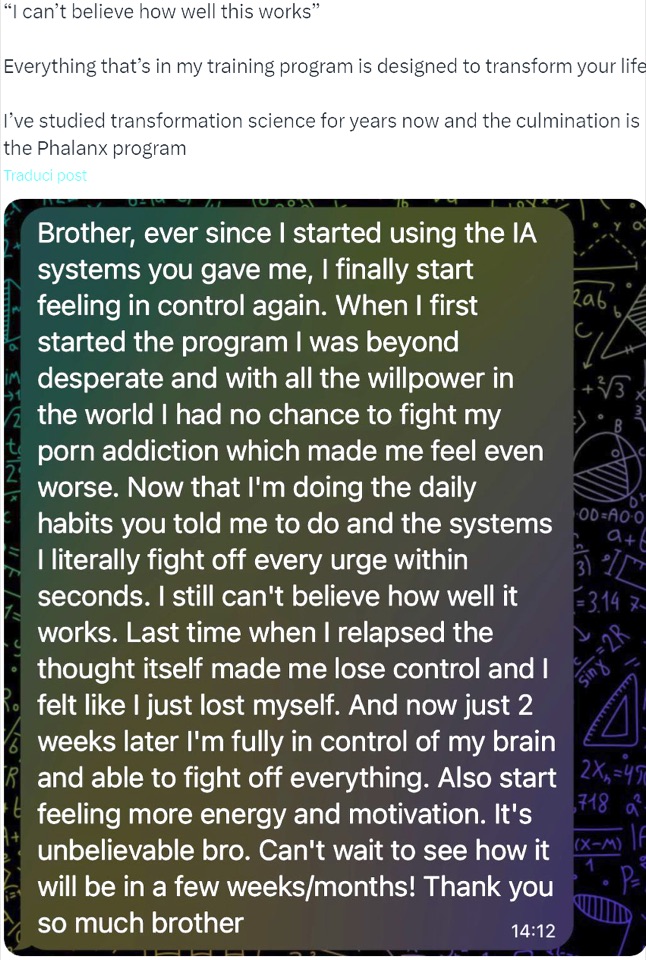
- Written update (screenshot of a message the client sent their specialist)
Porn had beaten this client again and again, and willpower was all they'd had to fight it with. In their own words, they started the program "beyond desperate". During the program they relapsed once more, and that relapse showed us exactly what we needed to work on. Two weeks later they wrote to their specialist that they could deal with every urge within seconds and felt in control again.
This file follows how they got from desperate to in control: what we found, what we built, and why the last relapse turned out to be useful.
Trying harder, and feeling worse each time
The client's description of where they started is short and very honest. "When I first started the program I was beyond desperate and with all the willpower in the world I had no chance to fight my porn addiction which made me feel even worse."
That sentence describes a trap most people with this habit know well. The client had plenty of willpower. They wanted to stop and they tried hard to stop, and each time they lost anyway. Losing made them feel worse about themselves. And feeling worse about themselves made the next time harder to resist, because the habit was the quickest way they knew to stop feeling that bad for a while. So every failed attempt made the next relapse more likely.
By the time they reached us, the trying itself had become part of the problem. Every attempt that failed added to the evidence that they couldn't do it. Willpower was the only tool they had, and it kept losing, so desperate was an accurate word.
What we found: the trouble started with a thought
The first call set out to answer one question: what keeps this habit going? Some of the answer was familiar. The client was often alone in the evenings, had a phone within reach, and was tired, stressed or low by the end of the day.
But the most important part of the answer was something the client would later put into words themselves: the habit usually started in the mind. A memory, an image or a passing idea would come up, often at a quiet moment. The client would try to push it away, and pushing it away made it louder. Before long the thought had taken up all their attention, and by then the fight was already lost. Willpower was being used at the worst possible moment, after the thought had grown too big to manage.
That shaped the plan. First, steady the body and the day with daily habits, so the client wasn't facing every evening tired and empty. Second, stop the habit on Day 15 and treat anything that went wrong in the weeks after as information. Third, and most important for this client, build specific responses for the moment a thought first shows up, so they'd have something better to do than just try to hold on.
They set a start date and committed to it in writing before Day 1.
Phase 1, Days 1 to 30: daily habits before anything else
The client later gave much of the credit to "the daily habits you told me to do". These are the habits the first phase is built from.
The first week. The client wrote an honest account of where they stood, and from then on sent their specialist a few lines about each day before bed. Sleep moved to fixed times, with daylight in the morning and low light in the evening. The phone no longer spent the night within reach of the bed, which for a porn habit takes away the easiest route at the worst time of night. The client found that one hard at first and kept reaching for a phone that wasn't there. Daily walks and training went in too.
A few minutes of attention a day. By the end of the week the client was also doing a short daily practice for attention. It looked like the least important thing on the list, and it turned out to matter most. A habit that starts with a thought is a habit that starts in the attention, and this was the first thing they'd ever done to train it. It would be a few weeks before the client saw why it was there.
The second week. Eating changed, and the day was given a timetable that ran right through the evening, the client's worst time. Lessons that week covered why a habit keeps repeating and why the plan was to stop it completely. The client wrote down every easy source of pleasure they leaned on, and wrote out the history of the porn habit from the first time to the present. For someone who'd spent a long time feeling ashamed of it, writing it all down plainly was uncomfortable. It also helped, because for the first time they could see a pattern, where before they'd only seen a list of failures.
Day 15. Abstinence started. The first days went better than the client had feared, with the routine full and the evenings planned.
The relapse, and what it showed us
Then, in the weeks after Day 15, the client relapsed. It started the way their relapses always had. A thought came up at a quiet moment. They tried to push it away, and it grew. In their words: "Last time when I relapsed the thought itself made me lose control and I felt like I just lost myself."
The program expects this can happen in those weeks, before the tools from the second phase are in place, and it's set up to make use of it. A relapse after Day 15 gets written down in detail as information for the second phase: what happened before it, what the client was thinking and feeling, and the exact point where they stopped being able to stop.
This mattered more for this client than for most. Their history was full of relapses followed by shame, and shame was part of what drove the next one. This time the specialist went through it with them the next day, step by step, without judging them. Together they looked at what it showed. The relapse had followed the same path as all the others, and the thought was where it started. That gave the second phase a clear target.
The rest of the first phase went on as planned, with cold and heat, a new hobby, a calming practice and more attention training. The month closed with how cravings work and how the brain links the habit to times, places and moods. That last lesson helped the client understand why a passing thought could be so hard to resist. On the Day 28 call, the relapse and what it had shown took up most of the time.
Phase 2, Days 31 to 60: a response for the moment the thought arrives
The second phase gave the client the tools they'd later call "the systems".
Day 31: the trigger map. When the client wrote down their triggers, thoughts came first: images that came to mind without warning, memories, and the old line in their head, just a quick look. Being alone in the evening was there, and so were lying in bed awake, stress after a hard day and feeling low. Certain apps and kinds of scrolling were on it too, because they tended to start the thought.
Day 32: the reset. The client cleared out what they could. Screens were set up so porn was much harder to get to, and the apps that tended to start the thought were changed or cut back.
The work on their thoughts. For this client, this was the most important part of the phase. They learned why trying to push a thought away tends to make it come back stronger, which matched what they'd lived through many times. They wrote down the thoughts that gave them permission and the low thoughts that came before a craving. They wrote a plain statement of what was true for them to check those thoughts against. Then they worked through the main thought behind their relapses on paper, at a calm moment, until they had a full answer to it. So when that thought came back, they'd already answered it.
Responses for the moment. The client also built responses for the first seconds of an urge: a way to break the pattern in the gap between the thought and the reach, something to settle their breathing wherever they were, something to ease the physical tension, and something for the worst few minutes. Each was matched to one of their triggers.
The thought comes back. The real test of all this was the first time the thought returned the way it had before the relapse. It came at the same kind of quiet moment, with nothing going on and nobody around, and it brought the same image with it. This time the client didn't try to push it away and lose. They did what they'd built for the first seconds, and it was over almost before it had started. They didn't message anyone about it, because there was nothing left to ask for help with. A few days later they sent the update below instead.
Two weeks after the relapse, they sent their specialist this update: "Now that I'm doing the daily habits you told me to do and the systems I literally fight off every urge within seconds. I still can't believe how well it works."
This message is the last thing on record. Everything after it, the rest of the second phase and all of the third, came later and isn't in the client's words. By Day 52 the client had matched a response to every trigger left on the map. They spent a week relying on the full set and keeping track of each craving, and the second progress call closed the phase.
Phase 3, Days 61 to 90: getting back the person they felt they'd lost
The client's description of the relapse ends with "I felt like I just lost myself". The third phase is about exactly that: who they are without the habit.
It opened with an honest look at past attempts and why they hadn't lasted. For this client, that meant seeing that every attempt had the same weak point: the effort always came too late, after the thought had already grown. Then came the part of the phase that mattered most for them, letting the old attempts go. They'd been carrying each one as proof they couldn't do it, and the last relapse had nearly joined the pile. Seeing it as the thing that showed what to build took away a lot of its weight.
There was already evidence for the person they were becoming. Their daily habits were holding, their responses worked, and their energy and motivation were coming back. They chose a goal that mattered to them and made a start on it. Near the end they walked through the situations most likely to catch them out, as the person they now were: a thought arriving late at night, a bad day, a long empty evening. They noted each sign of change as it came. The final step was to read their Day 1 account against how they saw themselves on Day 90, and to set a plan for after the program.
In the client's words, two weeks on
The update the client sent two weeks after the last relapse is where the record ends. This is what they wrote:
"I finally start feeling in control again."
"Now that I'm doing the daily habits you told me to do and the systems I literally fight off every urge within seconds. I still can't believe how well it works."
"And now just 2 weeks later I'm fully in control of my brain and able to fight off everything. Also start feeling more energy and motivation. It's unbelievable bro."
"Can't wait to see how it will be in a few weeks/months! Thank you so much brother"
Why willpower finally had help
- Willpower got help at the right moment. The client never lacked effort. What changed was that they had something to do in the first seconds of a thought, before it grew too big to manage.
- The relapse was used. Instead of starting another round of shame, the last relapse was written down, examined with the specialist, and turned into the target for the second phase.
- The daily habits made the evenings easier. The client names them first. Sleep, training, a full routine and attention practice meant the evenings were no longer tired and empty.
- The thought behind the relapses was answered in advance. It was taken apart in writing while the client was calm, so it didn't arrive with the same force in the moment.
For anyone losing to porn on willpower alone
If you've tried to stop porn with willpower alone and lost every time, this client's experience may be familiar: the harder you try, the worse you feel when you lose, and the worse you feel, the more you reach for it. Trying harder doesn't break that cycle. The client needed something to do at the moment the habit actually starts, and for many people that moment is a thought.
This case also shows that a relapse partway through doesn't have to end an attempt. This client relapsed during the program. Two weeks later they were dealing with urges in seconds, and the relapse was the thing that showed us what to build.