Case file 21
Five months without porn, and a plan to leave the 9-to-5
Name withheldWorked a 9-to-5 job
- Role and country
- Worked a 9-to-5 job
- Came in with
- Porn
- Program
- 90-Day Behavior Control System, with a specialist
- Where it stood at last contact
- Five months without a relapse; urges getting weaker every day; planning a gradual move out of the 9-to-5 to start a business
- On record
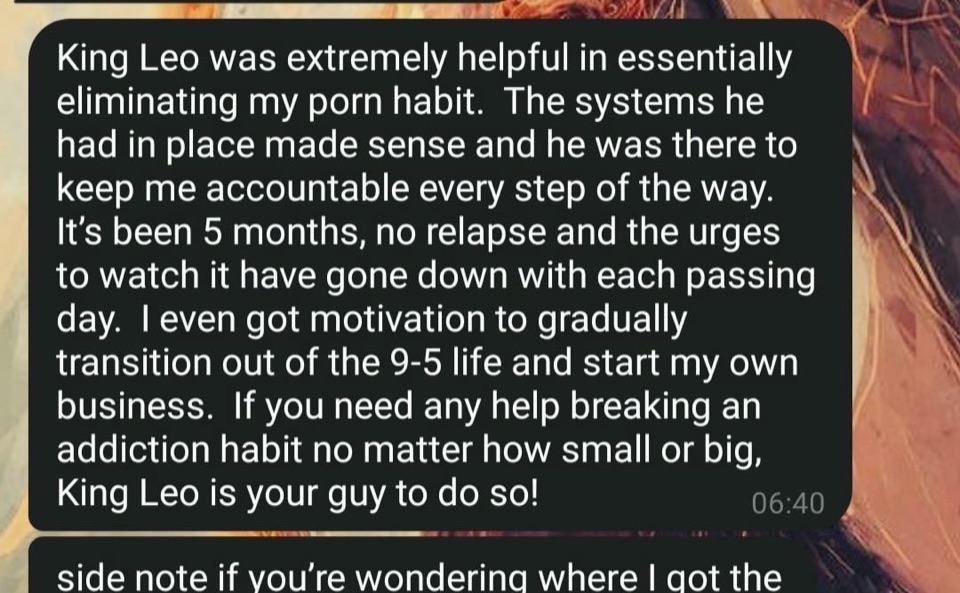
- Written update (screenshot): one message
Somewhere in the months after this client stopped watching porn, they started planning their way out of their job. They wrote to us five months in. There had been no relapse, the urges were weaker every day, and they had the motivation to move gradually out of "the 9-5 life" and build a business of their own.
The client gives two reasons it worked this time: the systems "made sense", and someone was "there to keep me accountable every step of the way". This file follows both through the 90 days.
A habit that seemed too small to bother anyone about
The client ends their message with advice for other people: get help "no matter how small or big" the habit is. People usually write that because they once wondered whether their own habit was serious enough to count. A porn habit is easy to talk yourself out of taking seriously. It's private and legal. It doesn't cost money or show up in a blood test, and it doesn't make you late for work. On paper, the client's life looked fine.
What it did cost was harder to see. The client worked a standard 9-to-5. The working day used up their energy, and the evening went to the habit. It usually happened late, alone, on a phone or laptop. The next morning started tired. Weekends with nothing planned were often worse than weeknights. And beneath all of it was something the client only said out loud later: they wanted more than the job, but they never had the energy or the drive to start. The motivation to build a business only came after the habit stopped. That tells us how much of their energy the habit had been using up.
The record doesn't describe earlier attempts. They called their result "essentially eliminating my porn habit", and people don't usually choose a word like that unless they'd tried to get there before.
What we found: tired evenings and an ambition with nowhere to go
On the first call, the specialist set out to find what was keeping the habit going. In this client's case, the habit was tied to the working week.
The habit lived in the gap between work and sleep. The client came home drained and wanted to switch off, and porn was the fastest way to do it. Late nights led to tired mornings, tired mornings led to long, flat working days, and long, flat days led to another evening of switching off. Underneath all that, the client wanted more from their working life and wasn't doing anything about it. Part of what the habit did was fill the time where their own plans should have been.
The client also had a particular need: they wanted to understand why each step mattered before they'd commit to it. On the first call they asked a lot of questions. Why fix sleep before stopping? Why stop everything at once? Why wait until Day 15? The specialist answered each one. The client later put it simply: the systems "made sense". That mattered for this client, because they'd only keep doing a step when it got hard if they understood why it was there.
The plan we set had three parts. First, rebuild sleep, energy and the daily routine around the client's real working week, before asking them to stop anything. Second, stop the habit on Day 15 and prepare in advance for the evenings after work. Third, give the client's ambition somewhere to go, so the time the habit had taken would be used for their own plans.
The client committed to a start date in writing, once the specialist had answered every question they had about it.
Phase 1, Days 1 to 30: a routine built around a working week
Much of the first phase is about routine, and this client already had one: the job. So we built the rest of the day around it.
The first week. Every evening from Day 1 the client sent their specialist a short account of the day. Sleep came first, at fixed times on weekdays and weekends alike. Screens stayed out of the bedroom at night, which mattered a lot for a habit that mostly happened late on a phone or laptop. Mornings got light. A daily walk went into the day, partly at lunch and partly after work. Training went in, scheduled around office hours, and so did a short daily practice for attention. Each of these came with its reason attached, because the client wouldn't keep doing something they didn't understand.
The evening, hour by hour. In the second week eating changed, and then came the part that mattered most for this client. The working day already had a shape. The hours between getting home and going to bed never had, and now each one had something set for it. They also learned the reasons behind full abstinence and the way a habit's cycle repeats, which suited someone who wanted the reasons first. They listed the easy rewards in their life, porn and the smaller ones around it, and wrote out how the habit had grown from the start.
Accountability that asked questions. In the second week the client quietly skipped training a few times, blaming a busy stretch at work. On the weekly call the specialist asked about it straight out. There was no lecture. They looked at the week together, decided what could move and what had to stay, and training went back in at a time that worked. It was a small moment, but it's what the client meant by "every step of the way". Someone was paying close enough attention to ask.
Day 15. Abstinence started. The first weeks were hardest in the hour after getting home, when the client was tired and the old way to switch off was the obvious one. The new evening routine carried most of it.
Over the following weeks the client took on regular cold and heat, a new hobby with steadily harder goals, a calming practice for the end of the working day, and more attention training. The lessons that closed the month explained why cravings rise and fall and why a habit becomes tied to particular times and places. For this client, that explained why walking through their own front door after work could set off a craving. On Day 28 they went over the month with their specialist on a call.
Phase 2, Days 31 to 60: the hour after work, and the thought that it was only porn
Day 31: the trigger map. Nearly everything on the client's trigger list was tied to the working week. There was the commute home, the first hour back, and the laptop open on the sofa. Late nights in bed came next, then Sunday evenings before the week started, and weekends with nothing planned. Feelings were on it too: being drained after a long day, feeling stuck in the job, and boredom.
Day 32: the reset. Devices were set up to keep porn well out of reach. The sofa, where the laptop had always come out, was rearranged. What was left on the list got a plan.
Building the responses. From there the work was to give every remaining trigger a planned answer. The commute home and the first hour back got a fixed replacement, so arriving home started something new. Sunday evenings got a plan for the week ahead. Weekends got something scheduled in them.
The thought that it was only porn. The most useful work in this phase was on the client's thinking. One thought kept coming back: it's only porn, it isn't hurting anyone, it isn't like it's a real addiction. It came most often after a hard day, when the client felt they'd earned a way to switch off. They wrote it down and, on a calm day, argued it out on paper, looking honestly at what the habit had actually cost them. After that, it was much easier to see through the thought when it came back.
For the cravings that still came, the client learned practices for breathing, for physical tension and for the peak of a craving, each one usable at a desk or on a train.
A week with no job to shape it. The hardest test of the phase came when the client took a week off work. Everything in their routine had been built around the job. Without it, the first morning had no commute, no lunch walk and no hour after work, and the whole day stretched out empty. An empty week at home was close to the worst setting the habit could ask for.
The client noticed it by mid-morning on the first day. This time they didn't wait to be asked. They sat down and wrote a plan for the week themselves: fixed times for the things that still applied, and something set in every afternoon. They sent it to their specialist, who changed one thing and sent it back. Some of those empty afternoons went on reading about how other people had built a business while still holding a job. They didn't think much of it then. The week passed without a relapse, and the client went back to work with a version of their routine that didn't depend on the office.
They brought everything together into a personal plan on Day 52, with a version for weeks off included. Then they used it for a week of ordinary days, kept track of each craving, and reviewed it all on the second progress call.
Phase 3, Days 61 to 90: from switching off to building something
The third phase is about who the client is without the habit. For this client, the old picture was of someone who got through the working week and then switched off. That person had ambitions but never started on them.
The phase began with an honest look at the past: why earlier attempts to change hadn't lasted, and what had stopped the client from acting on their own plans. Their new view of themselves rested on what they were already doing: sleeping properly, training, keeping their evenings and handling cravings when they came.
The goal the client picked fit them well, and it's where this phase spent most of its time. When the program asked them to set one goal tied to what drives them, they went back to the reading from their week off and chose to build something of their own. They were careful about it. The plan was a gradual move out of the job, with the first step taken during the program. The evenings the habit used to fill became the time they worked on it.
In the closing weeks they rehearsed the situations most likely to test them later: a bad week at work, an evening alone with nothing planned, a setback in the new business plans. They wrote down evidence of change as it showed up, compared the person on Day 90 with the one described on Day 1, and made a plan for the months after the program.
Five months on
The client's message came about five months in. That's well past the end of the 90 days, whether the five months are counted from the start or from the day the habit stopped. In their words:
"It's been 5 months, no relapse and the urges to watch it have gone down with each passing day."
"I even got motivation to gradually transition out of the 9-5 life and start my own business."
On what made it work: "The systems he had in place made sense and he was there to keep me accountable every step of the way."
And their advice to anyone reading: "If you need any help breaking an addiction habit no matter how small or big", ask for it.
Why it held for five months
- The client understood every step. They needed the reasons before they'd commit, and they got them. Because the systems made sense, the client kept using them when it got hard.
- Someone asked, and then the client asked themselves. Early on, the specialist asked about skipped training before it turned into a pattern. By the week off in Phase 2, the client was spotting the risk and writing the plan on their own.
- The hour after work got something new in it. The habit lived in the hour after getting home. That hour got a fixed replacement before it had a chance to go back to the old way.
- The thought that it was only porn was answered. The thought that made the habit seem harmless was taken apart in writing, while calm.
- The ambition got somewhere to go. The energy and time the habit used to take went into the client's plan to build something of their own.
For anyone who thinks their habit is too small
If you've ever wondered whether a porn habit is serious enough to get help for, this client wondered the same thing. Their advice is to get help "no matter how small or big" the habit is. What the habit costs often doesn't show on paper: tired mornings, flat days, and plans you never get around to starting.
This case also shows that the change doesn't have to stop at the habit. Five months on, the urges were weaker every day, and the client was using the time and energy the habit had taken to plan a different working life.