Case file 22
Ninety days without alcohol or drugs, and a promise that finally held
Name withheld
- Came in with
- Alcohol and drugs
- Program
- 90-Day Behavior Control System, with a specialist
- Where it stood at last contact
- Ninety days without alcohol or drugs, with his next call booked
- On record
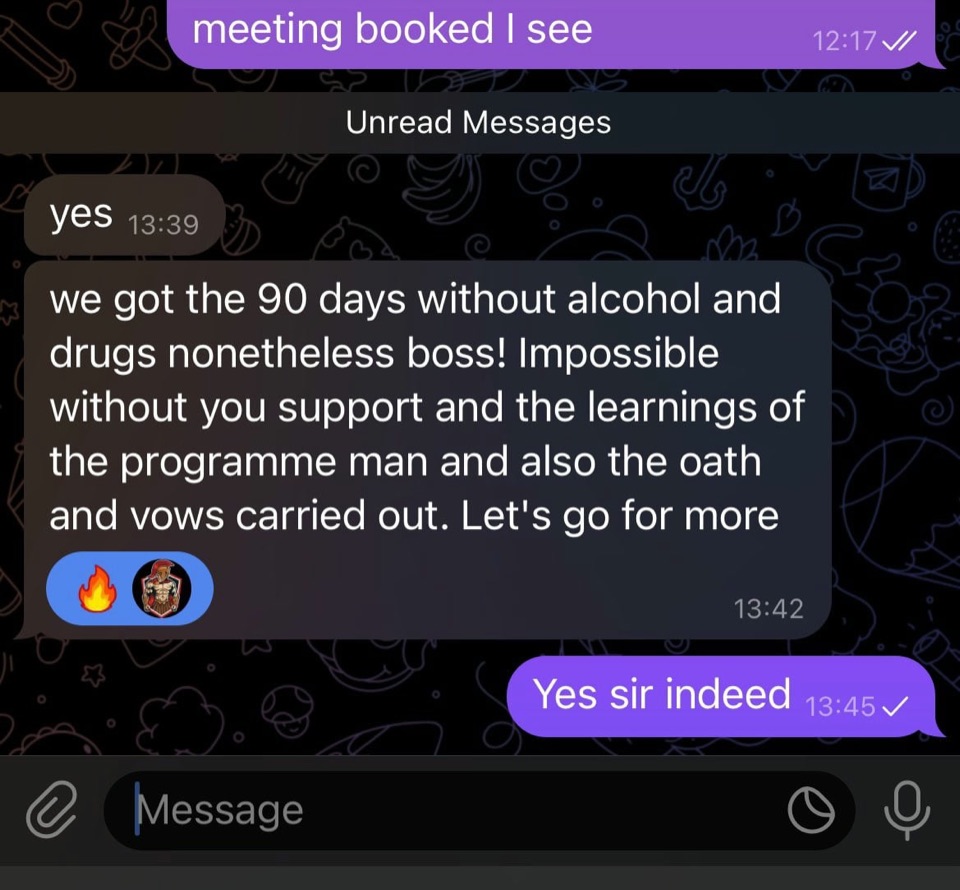
- One written update (screenshot)
On the day he booked his next call with his specialist, this client sent us a message that sums up his 90 days better than we could. He'd come to us drinking and using drugs, and this one message is the record of his that we can share: "we got the 90 days without alcohol and drugs nonetheless boss! Impossible without your support and the learnings of the programme man and also the oath and vows carried out. Let's go for more"
In that one message he gives the credit to three things: the support he had, what he learned, and the promises he made and then kept. What follows is how those three came together for him, and why he kept this promise after breaking plenty of others about drinking.
Promises made on the worst mornings
Before he came to us, every attempt to stop started the same way. He'd wake up after a heavy night, feel terrible about it, and promise himself that this was the last time. He meant it, every single time.
The trouble was where and when he made those promises. He made them alone, in his head, on the worst morning of the week. Stopping felt easy then, because the last thing he wanted was another drink. Nobody else knew about the promise, and he never wrote it down. Then it got tested a few days later, at the end of a long week, when he was tired and a drink was already in front of him. By then all he had left was the memory of how bad Sunday had felt, and that's not much to hold on to on a Friday night.
The drinking and the drugs went together, and the drink usually came first. A few drinks in, whatever he'd decided earlier in the week didn't feel so firm anymore, and the drugs followed later in the night. So he hardly ever started on the drugs with a clear head. By the time he did, he'd already been drinking.
It cost him more than the nights themselves. He lost whole days afterward, and he spent money he hadn't meant to spend. But what he minded most was what the broken promises did to him. Each one made the next promise a little harder to believe. After enough of them, he'd stopped trusting his own word, and that's a hard place to start any attempt from.
What we found: a promise with nothing backing it up
On the first call, his specialist's job was to find out what was keeping the habit going. For this client the answer had two parts.
The first was the order things happened in. The drinking was what led to the drugs. So any plan that went after the drugs and left the drinking alone would be stopping the wrong thing.
The second was the promise itself. He'd been expecting one decision, made on a bad morning, to hold up against tired evenings, social weekends and a habit he'd had for a long time. Nothing in his days was helping it. His sleep was all over the place, his weekends had no plan to them, and the hours when he usually drank had nothing else in them. He was relying on willpower for everything, and willpower is at its weakest at exactly the time of day his drinking started.
Before anything else, his specialist asked him plainly how much he drank and how often. Anyone who drinks heavily every day talks to a doctor before stopping, and the date he stopped was set with that rule in mind.
So we changed the way he made the promise before we changed anything else. He'd make it once, properly, in writing, before Day 1, with someone else holding him to it. Then we'd spend two weeks rebuilding his days, so the promise wasn't the only thing he had when it was tested. And when the time came, he'd stop both on the same day, because the drink would always lead him back to the drugs.
He made that written commitment before the start date. It's the oath he mentions in his message, and it was different from every promise he'd made before. He made it on a calm day instead of a day full of regret, he wrote it down, and his specialist knew about it.
Days 1 to 30: building days that would back the promise up
The first two weeks. On Day 1 he wrote an honest account of where he stood, and that night he made the first entry in his log. His specialist read each entry as it came in, and for the first time they both had a record of his days as they really were. Until then, all he'd had to go on was how he remembered them on a Sunday morning.
The first thing we went after was sleep. Late weekends had been throwing his whole week off, so he moved to fixed times to sleep and wake, seven days a week. The weekend part was the hardest. Going to bed at a set time on a Saturday felt strange to him, and he said so. But it changed his Sundays straight away, and his Mondays after that.
Walks, training, better meals and a few minutes of attention practice each day went in after that, and he took them in his stride. The piece he cared about came near the end of the second week, when we built the daily routine that runs through the rest of the program. His had set points through Friday and Saturday evenings. Those were the hours he'd always spent drinking, and for the first time in a long while he had a plan for them that he'd made himself.
Days 10 to 14. He learned how the cycle of a habit runs, from trigger to craving to the act and the guilt after it. He'd been going round that cycle for years without ever seeing it written out. Then he listed all the easy rewards in his life that he got without working for them, and the list was longer than he expected. He also traced the history of his drinking and drug use honestly, from the start to the day he joined.
Then came the rule that relapses follow skipped daily habits and broken routines. He'd always put everything on one big promise, so this changed the question he asked himself. Instead of wondering whether he'd be strong enough on Friday, he started asking whether he'd done today's things today.
Day 15: one date for both
On Day 15 he stopped drinking and stopped the drugs, both on the same day. He and his specialist had settled that on his weekly call the week before. If he'd stopped the drugs and kept drinking, the drinking would have led him straight back to them, and he knew that from experience.
The first few weeks were hard in the ways you'd expect. His evenings felt long and restless. His sleep was unsettled for a while, even with the new times, and some days his mood was flat for no reason he could name. The first weekend was the hardest part. On the Saturday night he messaged his specialist, who already knew from the log what his weekends used to look like, so he didn't have to explain anything.
He got through it. His routine meant the evening already had a plan in it, and for the first time he had people to answer to. He also had his written commitment. He'd made it on a calm day, and now he could read it on a hard one.
The rest of the month gave his weekends something to aim at: a new hobby whose goals rise as you get better at it. Alongside it came a calming practice and some work on his attention. The lessons that mattered most to him covered how dopamine and cravings work, and how the brain ties every past drink to the place and the moment it happened in. That explained why certain places and certain nights still felt risky even after he'd stopped. His first progress call, on Day 28, closed the month.
Days 31 to 60: taking his weekends apart
His trigger map. On Day 31 he wrote down every trigger he could find. Most of them came at the end of the week. There was the Friday feeling, when a hard week seemed to call for a reward. Certain friends were on the list, along with a certain kind of night out and certain places. So was being bored at home with nothing planned, and so was money arriving in his account. The strongest trigger on the page was the drink itself, because for him the first drink had always been the start of the drugs.
Day 32: the reset. Whatever was left in the house went. He deleted the contacts on his phone that he only ever used for one thing. The places he couldn't avoid went on a list to prepare for, so he wasn't just hoping for the best.
His responses. Over the next three weeks each trigger that was still standing got an answer. Social nights got decided before he went out, not halfway through the evening. The end of the working week got something fixed in place of the drink. For evenings bored at home, he'd already picked out what he'd do.
The work on his thinking mattered most. Over time he'd come up with a set of reasons that always showed up right on time: it's been a long week, I've earned this, I'll just have drinks and nothing else. That last one had fooled him more than any other, because the drink was exactly what brought on the drugs. He wrote it down and worked through it on a calm afternoon. So when it came back on a Friday, it no longer sounded like a reasonable plan.
For the craving itself he had three things he could use anywhere: one for his breathing, one for the tension it built in his body, and one for waiting it out until it faded. By Day 52 every trigger he couldn't remove had a response of its own.
The hardest evening of the phase. It came on a payday. Late in the second month his pay landed on a Friday at the end of a long week, and he had nothing planned that night. Money arriving had been on his trigger map since Day 31, and this time it turned up together with every other Friday trigger he had. Before the program, that combination meant a drink after work and the drugs by midnight. This time he messaged his specialist before he'd even left work, while the evening was still ahead of him. It wasn't a long exchange. He said what the night looked like, his specialist asked what his own plan for Fridays said, and he went home and spent the evening on the hobby he'd started in the first month. The next morning he did something he'd never done on a payday weekend. He put part of the money aside before the weekend could get to it.
In the last week of the phase he practiced the whole set and wrote up each craving as it happened. Then came his second progress call.
Days 61 to 90: becoming a man whose word holds
By now he'd stopped drinking and using, but he still saw himself the old way. For a long time he'd thought of himself as someone whose promises about drinking never lasted. If he kept believing that, the first bad week would tell him he'd been fooling himself all along.
So the last phase started with a post-mortem on his past attempts. When he looked at them together, they'd all gone the same way. Each promise had been made alone, out of regret, with nothing in his days to support it. Seeing that made him less ashamed of them. What had failed was the way he made his promises, and he could change that.
His new view of himself came from things he'd actually done. He'd kept his written commitment every day since Day 15. He'd had a payday Friday with money in his account and nothing planned, and he'd come through it sober. He'd changed how he spent his weekends. We put that record in front of him, had him take an honest look at his strengths, and asked him to show he was that man by how he acted, and not just by saying so. The goal he picked grew out of that payday: getting his money back in order after so many weekends had eaten into it. In a sense he'd already taken the first step.
In this phase he renewed his commitment, and this time he made it about who he was becoming instead of what he was giving up. Those are the vows he mentions. He went through the moments most likely to test him after the program, such as the first Friday without us, a wedding with a free bar and a month when money was tight, so none of them would feel new when they came. He kept a running note of what had changed, and he did the harder job of forgiving the old attempts.
On Day 90 he read the honest account he'd written on Day 1 and set it beside how he saw himself now. Then he made his plan for after the program, with six months of aftercare still ahead of him.
Where he stood when he wrote
His message came on the day he booked his next call: "we got the 90 days without alcohol and drugs nonetheless boss! Impossible without your support and the learnings of the programme man and also the oath and vows carried out. Let's go for more"
Two things in it stand out to us. The first is the word "we". He talks about the ninety days as something we did together, and that's how they felt from our side too. The second is the last line, which tells us ninety days isn't where he plans to stop. "Let's go for more."
Why this promise held
- He made the promise differently. Every earlier promise was made alone, out of regret, on a bad morning. He made this one on a calm day, wrote it down, and had someone holding him to it.
- The promise had help. By the time he stopped, his sleep, weekends and evenings had already changed. He wasn't relying on one decision to do all the work.
- Both stopped together. The drink had always led to the drugs. Stopping both on Day 15 took away the way back that his earlier attempts had left open.
- His Friday thought was taken apart before Friday. I'll just have drinks had led him back more reliably than anything else. He dealt with it in writing while he was calm.
- He reached out before the evening, not after it. On the first Saturday night, and again on that payday Friday, he had someone to message who'd read his log and knew what his weekends used to look like. On the payday he did it before he'd left work.
For anyone who keeps promising it's the last time
If you've promised yourself on a Sunday morning that you're done, and meant every word, and been drinking again by Friday, this client's story will sound familiar. Your promises probably weren't weak. You just made them at the wrong time, on your own, with nothing in your days to back them up.
If drinking is what leads you to drugs, be honest with yourself about the order. A plan that only goes after the drugs leaves the drinking in place, and the drinking is what brings them back.
And notice what he gives the credit to: support, what he learned, and promises he kept because he'd made them properly.