Case file 23
A walk to the office, and for once the head was clear
Name withheldWorks from an office
- Role and country
- Works from an office
- Came in with
- Weed, with brain fog and low energy alongside it
- Program
- 90-Day Behavior Control System, with a specialist
- Where it stood at last contact
- Woke with "astonishing energy levels"; the brain fog had "kind of disappeared"; a piece of written work "felt super liberating"
- On record
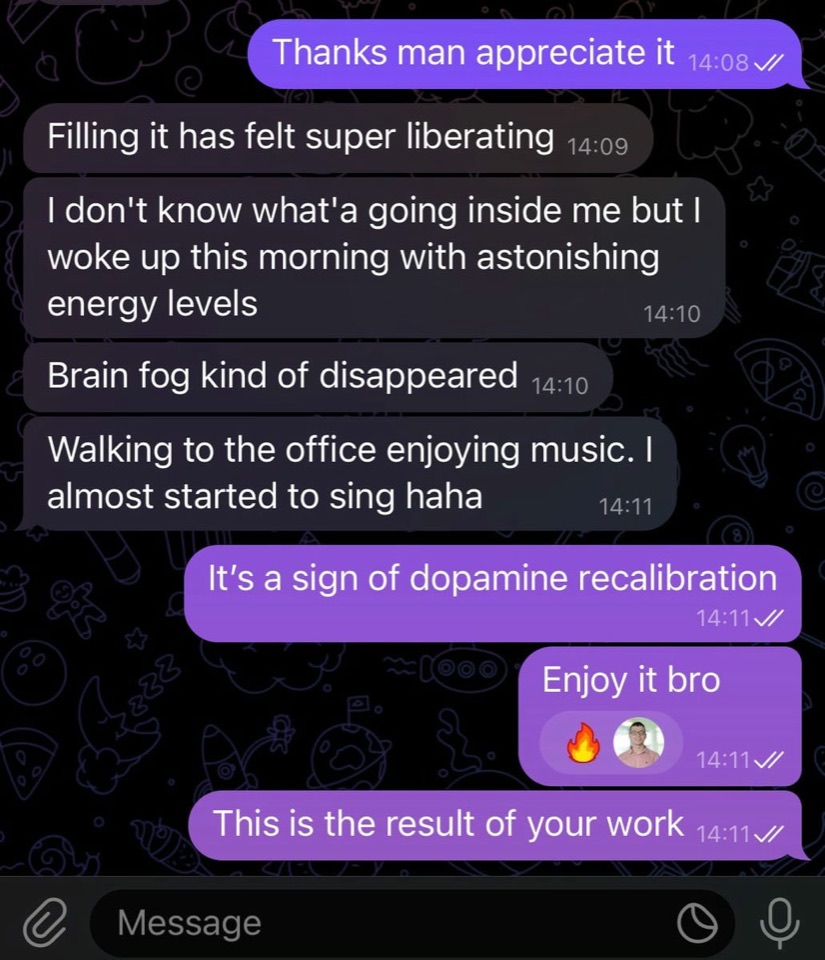
- One written update (screenshot, four short messages)
Brain fog was part of every day for this client. They felt slow and unclear from the moment they woke up, it got in the way of every task, and it had gone on for so long that it felt normal. They also smoked weed every night, and they'd been trying to stop. Partway through the program, on an ordinary working day, they sent their specialist four short messages. A piece of written work had felt "super liberating" to fill in. They'd woken up with more energy than they could explain. The fog was gone, and on the walk to the office they caught themselves nearly singing.
It's a small record, and this file stays close to it: what we worked on with this client, phase by phase, and what had to change before a morning like that one could happen.
A smoke to get to sleep, and a fog that lasted all day
Most people who come to us about weed talk first about the weed. People like this client often talk about something else first: they can't think straight. They describe mornings where it takes an hour to feel awake, emails read twice because the first read didn't go in, and afternoons spent getting through rather than getting anything done. The weed is part of the picture, but what they feel all day is the fog.
That's how it was for this client. Their smoking had settled into one fixed job: getting to sleep. Late each evening they smoked by the open bedroom window, and then they went to bed. On weekends it started earlier in the day. They'd come to believe they couldn't fall asleep without it.
They got up, got to the office and did the work, but it took more effort than it should have, and none of it felt like much. Music on the walk in was something to fill the silence. Nothing in the day felt good, so the smoke at night stayed one of the few things that did, and that kept it in place.
They'd tried to stop before, and each attempt ended the same way. The first nights without weed, they lay awake for hours, and when they did sleep the dreams were vivid and strange. That left them foggy and short on sleep at the same time, trying to do something very hard with almost no energy for it. Within a few nights they'd decided they needed it to sleep, and the attempt was over.
What we found: the weed and the fog were keeping each other going
On the first call, the specialist's job is to find what's keeping the habit going. With this client, the fog was part of the answer, and it ran in a circle.
The weed helped them fall asleep, but it didn't give them good sleep. They'd go to bed late, sleep poorly and wake up slow and foggy. A foggy morning meant a day that felt like hard work from the start. By the evening, after a day like that, a smoke was the easiest way to switch off and get to sleep, so they smoked, slept badly again and woke up foggy again. Each part kept the next one going.
That explained the earlier attempts too. Each one had taken the weed away at night with no other way to get to sleep. Rough nights are common in the first weeks off weed. The client had met them with no preparation, so each time they took them as proof that they needed it.
So the plan was to sort out the basics first. We'd fix their sleep times while they were still smoking, make the mornings and the walk to work the same every day, get their body moving, and only then, on Day 15, stop the weed. The written work in between would make sure that by the time they stopped, they knew exactly what they were stopping and why.
Phase 1, Days 1 to 30: sorting out the basics before stopping anything
The first week. The nightly log began on Day 1, and their specialist read every entry. The first ones said a lot about the fog without using the word. Most days were described as tiring, even quiet ones, and the worst ones followed late nights.
So sleep came first: the same bedtime and the same alarm every day, daylight early, a dim evening, and no phone in the bedroom. In the first days this felt like going to bed early for no reason, and the client said so. It took about a week before the fixed times started to feel normal.
The walk to the office. The program asks for a daily walk, used as thinking time. This client already walked to work, so their specialist built it into the plan: same route, no rush, the walk treated as part of the day rather than a gap in it. Training went in around it, with a short quiet sit each day for attention, and their eating changed. By the end of the first stretch the whole day had a shape, and the late evening, where the smoke by the window used to sit, had things planned in it.
The second week: writing it down. Next came the written part of Phase 1. The client wrote down everything that gave them a reward without effort: weed, and all the small things around it, like the late-night snacking and the shows they watched until they felt sleepy enough to smoke. Then they wrote an honest history of their smoking, from the first time to now.
They'd been carrying all of this around in their head for years, so putting it on paper was a relief in itself. Things they'd half thought a thousand times became a few lines on a page that they could read back and check. The specialist read every piece and sent back what stood out.
Day 15: stopping. On Day 15 abstinence started. The weed stopped first, and the smaller habits that went with it were named so they wouldn't quietly take its place. Their specialist talked it through with them beforehand, the nights in particular, because that's where every earlier attempt had ended. The point was that if anything went wrong in the next two weeks, it would be treated as information for Phase 2, not as proof they couldn't do it.
The first nights without it were what we'd told them to expect. Sleep came slowly and broke in the middle of the night. The dreams were vivid and odd, and some were about smoking. At the office they were short with people for a few days. This time it didn't end the attempt, because there was a routine around them: a fixed bedtime they'd already kept for two weeks, a walk the next morning and a log to write before bed. On the harder nights they messaged their specialist, who'd been reading their log and already knew what a bad night looked like for them.
The rest of the month added a hobby, a calming practice and the lessons on how cravings work. That included why the open window late at night still felt risky long after the weed had gone. Their first progress call followed on Day 28.
The morning it lifted
The four messages came in around the end of the first month, in the middle of a working day. The first was about the written work: "Filling it has felt super liberating." The client didn't explain what they'd been filling in, and they didn't need to. Their specialist knew which piece it was because it was on the list for that stretch of the program.
Then a minute later: "I don't know what's going inside me but I woke up this morning with astonishing energy levels."
And then: "Brain fog kind of disappeared."
And then the line that says the most: "Walking to the office enjoying music. I almost started to sing haha"
It was the same walk to work, on the same route, that used to be something to get through, and it was the same kind of music. The difference was in how the client felt. For the first time in ages, they'd had a morning where they felt awake and clear, and they were in a good mood without even trying.
The client said they didn't know what was going on inside them. Their specialist's reply was short: this was the result of their own work. It's worth saying why. The fixed sleep, the walk, the training, the steady routine and the weeks without weed had all been building underneath. None of it felt like much on any single day. Then one morning it all showed up together, and that's usually how it happens. A clear head doesn't come back slowly enough for you to notice it day by day. You notice it on the first morning you don't have to push through the fog.
Phase 2, Days 31 to 60: making sure the old nights couldn't catch them off guard
The four messages are the only part of this file in the client's own words. Everything from here on came after them.
The week the fog came back. The hardest moment of the program came straight after the best one. A week or so after that morning came a weekend that ran late on both nights, and the next two mornings were foggy again. After a morning like the one in their messages, that felt like losing everything, and their log that week read as if the good morning had been luck. One thought kept turning up in it: if I'm going to be foggy anyway, I might as well smoke and at least sleep. That kind of disappointment is dangerous, because it makes the weed look like the only thing that ever helped.
Their specialist didn't argue with the feeling. They pointed to the log instead. Both foggy mornings came after the late weekend, and every clear morning in the past two weeks had come after a night at the fixed time, without weed. So the fog had come back for a reason the client could see and do something about. The next night they were in bed on time. The morning after was clear, and so were most after it.
That was also the start of the work for the second month. A clear head makes the work easier, but the triggers were all still there.
Day 31: the full list of triggers. The client's list of triggers had to include the ones they'd never have said out loud. Theirs were mostly about the end of the day and being tired: the evening after a draining day at the office, the quiet stretch after getting home, and lying in bed not yet asleep. Friday evenings were on it, because that's when the weekend smoking used to begin. So was the smell of weed drifting out of a doorway on the way home. Some triggers were about feelings, mainly the flat, nothing-matters mood the fog used to bring.
Day 32: the reset. Everything to do with weed left their home, including the things that had always lived on the windowsill and the bedside table. The bedroom became a room for sleeping, with nothing in it that belonged to the old nights. The rest was rearranged or planned for.
The responses. Over the next few weeks they built a planned response for each trigger that was left. Lying awake got its own response, so a slow night no longer turned into a reason to smoke. The evening after a draining day got a plan, so being tired no longer led straight to the window. Friday evenings got something fixed in them. They also worked on the excuses that turn up when you're worn out. The main one was that they needed weed to sleep, and the client took it apart in writing on a calm day. The craving practices came in alongside, and the phase finished with its practice week and the second progress call.
Phase 3, Days 61 to 90: someone who wakes up clear
The last phase is about the picture people have of themselves. For years this client had seen themselves as someone who was always running on low battery and couldn't sleep without a smoke, and the weed fitted that picture. Phase 3 started with a look back at why earlier attempts hadn't lasted. Every time, they'd tried to stop from inside the fog, with no other way through the first nights.
The new picture came from what they were already doing: in bed at a fixed time, asleep without weed, up early, walking in, training and working with a clear head. The client picked a goal that fitted what drives them, took the first step and wrote down evidence of change as it happened. Late in the phase they went through, in advance, the one change they were most wary of: a vacation away from home, with late nights, a strange bed and no walk to the office to start the day. The program ended the way it does for everyone, with a look back at the Day 1 write-up and a plan for the months after.
The four messages, in full
The record is that one exchange from the first month, and it's all in the client's words:
"Filling it has felt super liberating"
"I don't know what's going inside me but I woke up this morning with astonishing energy levels"
"Brain fog kind of disappeared"
"Walking to the office enjoying music. I almost started to sing haha"
None of that can be measured, but the client noticed it all and thought it was worth writing down in the middle of a working day.
Why the fog lifted this time
- Sleep came before stopping. Earlier attempts took the weed away at night with nothing to replace it. This time the client had two weeks of fixed sleep times behind them before the first night without weed, so the rough nights didn't end the attempt.
- The walk they already took became part of the plan. Instead of adding something new, their specialist built on the walk to work, and that's where the change first showed.
- The writing took weight off. Getting the weed, its history and every small reward around it onto paper gave the client something to check instead of something to carry around. They called it "super liberating".
- Someone read the log every night. On the bad nights, the client messaged someone who already knew what those nights looked like. When the good morning came, that same person explained what it meant, and when the fog came back for a weekend, the log showed why.
For anyone who smokes to get to sleep and wakes up foggy
If you've smoked every night for years to get to sleep, you may have stopped noticing the fog. It just feels like how mornings are. This case shows that the fog can come from the weed itself, and that stopping while you're still foggy, with no other way through the first nights, is the hardest way to do it.
The first nights without weed are often rough, and that doesn't mean you need it to sleep. What changed for this client came from weeks of ordinary things done in the right order, and then one morning walk that felt different. Nobody can tell you which morning it'll be. What this case shows is the work that came before it.