Case file 25
One month and fourteen days, and he didn't have to look it up
Name withheld
- Came in with
- Alcohol
- Program
- 90-Day Behavior Control System, with a specialist
- Where it stood at last contact
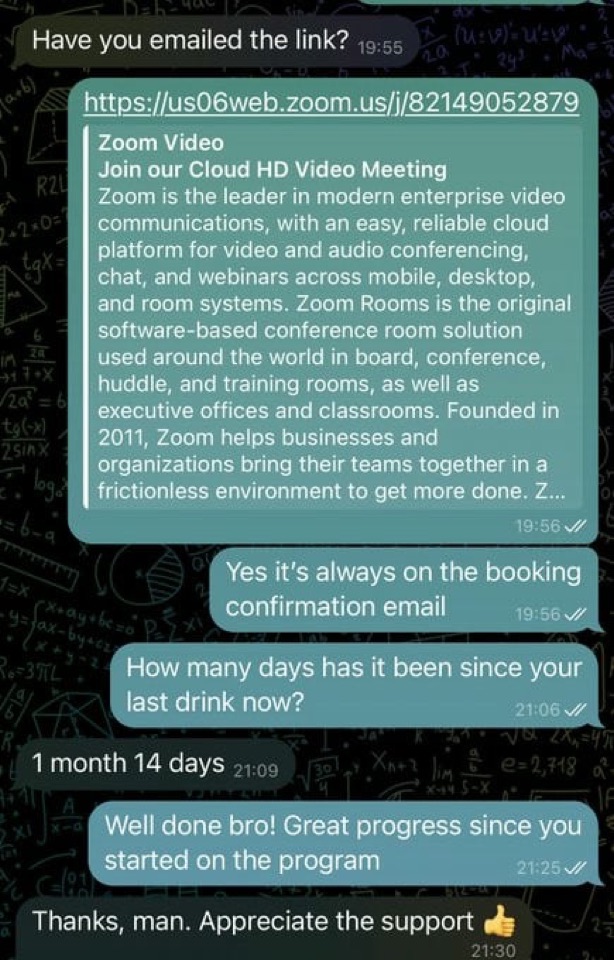
- "1 month 14 days" since his last drink
- On record
- One written update (screenshot)
When his specialist asked how long it had been since his last drink, this client didn't round it. It was the evening of one of his progress calls, and he answered within three minutes: "1 month 14 days". Then he added, "Thanks, man. Appreciate the support".
He's a quiet client, and his record with us is short, but that exact count says a lot. His evenings used to end with a drink every day, so every day in that count was an evening he'd handled differently. What follows is how he built those evenings.
A drink to end every workday
His drinking was quiet. He didn't go out and get into trouble, and the people around him might not have noticed much. He drank at home, mostly alone, at the end of the working day. The first drink was how he switched off. As far as he was concerned, work was over once he had a glass in his hand.
The trouble was that he rarely stopped at one. The first drink ended the workday, and the second settled him in for the evening. After that he wasn't really choosing anymore. Most nights he ended up drinking more, and going to bed later, than he'd meant to when he got home.
The cost built up slowly. Drinking helped him fall asleep, but he'd wake up in the early hours and lie there. His mornings were heavy, and he got through them on coffee. Weekends were the same, just with longer hours. And underneath it all was a worry he didn't often say out loud. He couldn't remember the last time he'd ended a day without a drink, and he wasn't sure he knew how.
His earlier attempts had been rules. He'd only drink at weekends. He'd stop at two. He'd have nothing on work nights. Each rule worked for a while. Then a hard day came along, and the rule bent a little, then a bit more. Within a few weeks he was back to drinking every evening, with one more broken rule behind him.
What we found: the drink was how he switched off
On the first call, his specialist went through his days hour by hour. One thing stood out: the drink was the only way he had of switching off. He had nothing else to mark the end of work, no other way to settle himself after a hard day, and nothing in his evenings that was just for him.
That explained why his rules kept failing. A rule takes something away and puts nothing in its place. Every time he cut back, his evening was exactly the same as before, only without the one thing he used to unwind. On a hard day, the rule never stood a chance.
Before setting any date, his specialist asked for an honest picture of how much he drank. Anyone who drinks heavily every day talks to a doctor before stopping, so his answer shaped how his stopping date was set.
So we didn't give him another rule. Before he stopped, we'd rebuild his days and give him other ways to end the workday. On Day 15 he'd stop completely, because every rule he'd tried had come with a way around it. And from then on we'd fill his evenings on purpose, so the hours after work had something in them that was his.
He wrote his commitment down before Day 1. For once it didn't have an exception built into it.
Days 1 to 30: a new way to end the day
The first week. His nightly log began on Day 1, and his specialist read it. For the first two weeks he was still drinking, because the program doesn't ask anyone to stop until Day 15. That made the log useful in its own way. He could see, in his own words, what the drinking was doing to his nights and his mornings.
Sleep came first. He went to bed and got up at the same times every day, got daylight early, kept his evenings dim and kept his phone out of the bedroom. Daily walks went in next, and for him the walk became the first new way to end the workday. He'd come home, change and go straight back out. By the time he got back, work felt further away than it ever had with a glass in his hand.
Training, better meals and a short attention practice went in after that without much fuss.
The second week. The daily routine we built in the second week had set points from morning to night, but only one of them really mattered to him: the hour after work. The hour when he'd always had his first drink now had something planned in it.
Then he listed all the easy rewards in his life that he got without working for them, and traced the history of his drinking from the start. He'd always thought of his drinking as fairly ordinary, so seeing all of it written out was hard. He told his specialist he'd been drinking every day for far longer than he'd admitted to himself.
Day 15: the first evenings without a glass
On Day 15 he stopped drinking.
More than anything, the first evenings felt strange. He'd get home and not know what to do with his hands. The walk helped, and so did the routine. Even so, the evenings felt long, and some nights he went to bed early just to end them. His sleep was rough for a while, as we'd told him it might be. Then it started to settle, and he stopped waking so often in the early hours, which he'd put up with for a long time.
The first hard day at work was where it counted. Before, a day like that would have ended with a drink, no question. That evening he sent his specialist a short message. It didn't need to be long. He just needed to tell someone who knew his log, and to hear back that this was exactly the evening his plan was for. He went for his walk and didn't drink.
The rest of the month gave his evenings something to work toward, a hobby that got more demanding as he improved, along with a calming practice and some attention work. He finished the month learning why cravings happen at all, and why the brain files away where and when every drink happened. That's why the sofa at the end of the workday still made him think of a drink. On Day 28 he and his specialist had the first of the program's progress calls.
Days 31 to 60: planning the hour after work
His trigger map. On Day 31 he wrote down every trigger he could find. Almost all of them came in the same hour: getting home, closing the laptop and finishing a hard day. The liquor store on the way home was on the list, and so were Friday evenings. So were the sofa and the TV, being alone in a quiet apartment, and getting bad news. A few were things he'd never have said to anyone, and he wrote those down too.
Day 32: the reset. He got all the alcohol out of his home. He changed his route home so it didn't pass the store he always stopped at. He rearranged his evenings so the sofa stopped being the place he drank. Between them, those changes dealt with every trigger he could remove.
His responses. Over the next three weeks he built a response to each trigger that was left. Closing the laptop was now followed by something fixed, so he had a new way to mark the end of work. He planned his Friday evenings in advance. And for bad news, he had a response he could use straight away, before the thought of a drink had time to settle in.
The thought he worked on hardest was the one his whole habit rested on: I need something to switch off. He worked through it on paper during a quiet week, and by then the evidence against it was in his own log. Since Day 15 he'd switched off night after night without a drink.
For the moment a craving actually hit, he learned to slow his breathing, to settle the tension a hard day leaves behind, and to sit through the worst of it. By Day 52 each trigger he couldn't remove had a response of its own.
The hardest stretch. It didn't come from work. Partway through the phase he came down with a heavy cold that kept him at home for most of a week, and it took away almost everything he'd built. He couldn't walk or train, the evening routine had nothing in it he could do, and he spent the days on the sofa in front of the TV, both of which were on his trigger map. By the third evening the old thought had found a new form: a drink would help him sleep through it. He messaged his specialist, mostly to say the plan wasn't working because he couldn't do any of it. His specialist's answer was to shrink the plan to fit the week. The walk became a few minutes outside at the time he'd normally have gone out. The evening became whatever he could do from the sofa that wasn't the TV, and bed came early. It was a dull week, and he didn't drink in any of it. Once he was well again they went through it on his weekly call. What he took from it was that the evenings had held with almost none of the plan left, so it wasn't only the walk keeping him off it.
The last week of the phase was for practice. He logged every craving, the ones he handled well and the ones he didn't.
The evening of the call
His record with us comes from the evening of a progress call. Before the call, he checked he had the link: "Have you emailed the link?" Afterward, his specialist asked how many days it had been since his last drink. He knew straight away: "1 month 14 days". Then: "Thanks, man. Appreciate the support".
When a client checks he has the link before a call and knows his count to the day, he's taking the work seriously. And the count meant something to him, because each day in it was an evening he'd got through.
Days 61 to 90: someone who knows how to end a day
His message is the last thing on record from him, so everything in this section came after it.
The last phase dealt with how he saw himself. For a long time he'd thought of himself as someone who needs a drink to unwind. As long as he still believed that, every hard week would come with the same suggestion: that he'd earned one.
Phase 3 opened by going back over his old rules: weekends only, two at most, nothing on work nights. Every one of them had broken down for the same reason: it took the drink away and left the evening empty. Once he saw that, he stopped blaming himself for breaking them.
His new view of himself rested on things he was already doing. He ended the workday with a walk. He trained, he slept through the night, and he had a hobby that was going somewhere. Phase 3 asked him to keep living that way, day after day, until it felt like who he was. He also chose a goal that suited what motivates him and took the first step toward it. He rehearsed the evenings most likely to test him after the program, like a hard Friday, a vacation with nothing planned and a run of bad news. He kept a note of what had changed as it came.
The program ended with him comparing his Day 1 account with how he saw himself now, and with a plan for what came next, backed by six months of aftercare.
The last word from him
The last update on record is the one above: "1 month 14 days" since his last drink, and his thanks for the support. He couldn't remember the last evening he'd ended without a drink, and by then he'd ended every day for more than six weeks without one.
Why the evenings held this time
- He had other ways to switch off before the drink went. His rules had only ever taken the drink away. This time, by Day 15, he already had other ways to end the workday.
- He stopped completely. Every rule he'd tried had come with a way around it. Stopping completely left nothing to bend.
- The hour after work was planned. Almost all of his triggers came in one hour of the day, and that hour got more planning than any other.
- He tested his main belief against his own record. The idea that he needed something to switch off was taken apart using weeks of evenings he'd switched off without one.
- When illness took the plan away, the plan got smaller. His specialist cut the evening down to what he could still do, and it held.
For anyone who drinks to switch off
If you drink quietly, at home, at the end of the day, it's easy to tell yourself it isn't a real problem. If that sounds like you, ask yourself a simpler question: can you end a day without it?
If you've tried rules like weekends only or just two, and they've bent and then broken, that may not be down to a lack of willpower. A rule takes the drink away and leaves the evening exactly as empty as it was.
What got him to his count was giving his evenings something else to do.