Case file 27
Three days short of six months, and setting personal bests
Name withheld
- Came in with
- Alcohol and cocaine
- Program
- 90-Day Behavior Control System, with a specialist
- Where it stood at last contact
- Three days short of six months clean from alcohol and cocaine; personal bests in pull-ups and squats; training for a half marathon
- On record
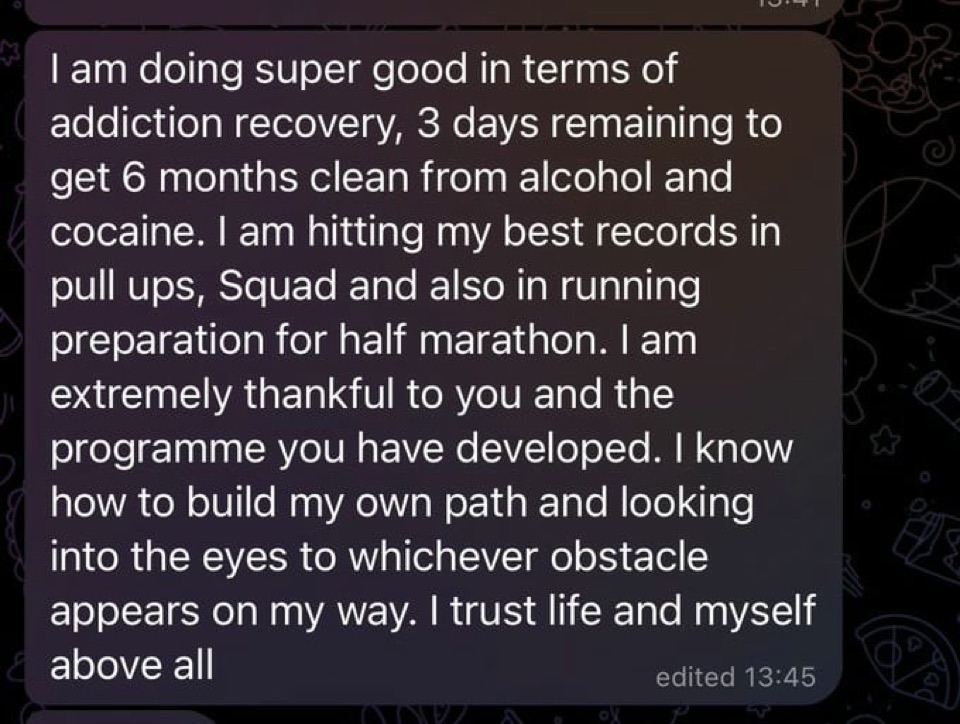
- One written update (screenshot)
Three days before reaching six months clean from alcohol and cocaine, this client wrote to tell us they'd set personal bests in pull-ups and squats and were training for a half marathon. When they first came to us, the drinking and the cocaine had been feeding each other for a long time. They used to lose whole weekends, and now they were setting records.
The message ends with a line that matters more to us than any of those numbers: "I trust life and myself above all". After so many attempts that fell apart, the client had stopped trusting their own plans, so that line is the result we care about most. Here's how they got from one to the other.
Dry months that ended in a celebration
Before the program, the client's attempts to stop usually went the same way. They'd take a month off, with no drinking and no cocaine for four weeks, and get through it on willpower alone. Those months often went well. The client felt better, slept better and got more done.
Then the month ended, and that felt like something to celebrate, so they'd go out. The night out started with drinks, and a few drinks in, the cocaine came back. Within a week or two, everything was back where it had started. The dry month had only ever been a break.
The two habits worked together. Drinking made it easier to say yes to cocaine, and cocaine let them keep drinking long after their body would otherwise have had enough. A night that started with a couple of drinks could run well past anything they'd planned, into the early morning. Then came the days after, which were flat, anxious and low, and those low days made the next drink feel like the answer.
The cost showed up everywhere. Weekends disappeared, and so did the days after them. The client's body was worn out. They'd sleep badly, eat badly and stop training whenever a rough patch came. Money went in ways they found hard to look at. And underneath all of it, they felt less and less able to trust their own plans. After enough dry months that ended the same way, even a good plan felt like it would fail sooner or later.
What we found: each one kept the other going
On the first call, the client's specialist went through the dry months one by one, and the same thing had happened every time. They'd stopped both habits but changed nothing else. The same evenings, the same people and the same tired body were all still there. And every attempt had an end date built in. The plan was to hold on for a month, and the month always finished with a night that brought everything back.
So the two habits had to be dealt with as one. Drinking led to cocaine, and cocaine kept the drinking going, so stopping one and keeping the other would leave the whole pattern in place. The low days after a heavy night were part of that pattern too. Feeling low was one of the main reasons the next drink happened.
There was a safety question to settle first. Anyone who drinks heavily every day talks to a doctor before stopping, so the specialist got a straight answer about how much the client was drinking before any stopping date was set.
So the plan turned each of those around. The body and the days would come first, with two weeks of rebuilding before anything stopped, so the client wasn't trying to stop on poor sleep and a worn-out body. Both habits would stop together on Day 15, and this time nothing would mark an end, because the stop wasn't meant to end. And the rest of the program would go into a body and a life worth protecting, so they had something to work toward and not just something to stay away from.
The commitment the client wrote before Day 1 had no end date in it. That was deliberate.
Days 1 to 30: a body worth training
The first two weeks. The nightly log started on Day 1, and it didn't flatter them. The early entries, which the specialist read as they came in, described someone worn down: sleeping badly, getting no regular exercise and eating whatever, whenever.
Sleep was the first target, with set times for bed and waking, daylight in the morning, dim evenings and no phone in the bedroom. Daily walks went in next. Then came training, and the client threw themselves into it. Training went in at fixed times, with strength work on some days and cardio on others. It had always been the first thing they dropped when a bad week came. Now it had a fixed place in the day, and within a couple of weeks they were looking forward to it.
Eating changed next, and a few minutes of attention practice went into each day. The daily routine arrived at the end of the second week, and its real job was the weekend, because that's when both habits used to take over. Saturday mornings now had training in them, where they used to have a hangover.
Days 10 to 14. The client learned how the cycle of a habit runs, from trigger to craving to the act and the guilt after it, and could see that every dry month had followed it exactly. They listed every easy reward they'd been leaning on without earning it, and traced the history of both habits honestly, from the first drink and the first line to the day they joined. Then came the rule that relapses follow skipped daily habits and broken routines. Their training had always been the first thing to go in a bad week, so that rule hit home.
Day 15 and the low days after
On Day 15 the client stopped drinking and stopped cocaine. On the weekly call the week before, the specialist had been clear that this wasn't another dry month. There was no finish line, and no celebration waiting at the end of it.
The first weeks went up and down. Some days felt clear and strong, better than the client had felt in a long time. Other days were flat and low for no clear reason, the kind of days that used to end with a drink. Sleep was unsettled for a while. The urge came hardest on Friday evenings, and on mornings when they woke up feeling low.
What got the client through was the training. On a low morning, the plan was to train first and decide how the day felt afterward. It worked more often than not. On the days it didn't, they messaged the specialist, who'd been reading the log and could see the low days coming before the client said a word.
The second half of the month brought in the rest of the program's early work: controlled stress, a hobby with rising goals, a calming practice and attention training. The lesson that landed hardest was the evidence that abstinence works, including what happens in the brain over months without alcohol or cocaine. That mattered to someone who'd never stayed off either one long enough to find out. The month ended with how cravings work and how the brain remembers the people, places and moods around every past use, and with the first progress call on Day 28.
Days 31 to 60: the point where a night used to go wrong
The trigger map. On Day 31 the client wrote down every trigger they could find. Most of the list was about weekends and nights out: the end of the working week, certain bars and certain friends, especially one who was always the one with cocaine. Then there was the point in a night, a few drinks in, when the evening could still go either way. The low days after poor sleep were on the list, and so was music in a certain kind of place. Some triggers were things the client had never told anyone, and those went on the list too.
Day 32: the reset. The client got rid of everything they could. They cleared their phone of numbers that were only there for the habit. They made plans for the places they couldn't avoid. And they started seeing the friends who were part of the habit less often, and only on their own terms.
The responses. Over the next three weeks every trigger that was left got an answer. The end of the working week now had a training session in it. Nights out stopped being open-ended, with the way home settled before they started. And the low days got a response of their own, because they'd been driving the habit all along.
The biggest piece of work was on one thought. Every dry month had ended with the same reasoning: I've done well, I've earned a night out. The client worked through it in a written exercise, carefully and well before it was likely to show up. When it did come back near the end of the second month, they'd already seen through it, and they knew where it led.
For the craving itself they had three things to use in the moment: one for breathing, one for the body, and one for getting through the worst of it. By Day 52 every trigger that couldn't be removed had its own matched response.
The hardest moment of the phase. It wasn't a night out. It was a message. Around the middle of the second month, the friend who'd always had the cocaine got in touch on a Friday afternoon, the way they always used to, to ask if the client was coming out. Nothing in it looked like a risk. It was friendly, it came from someone the client actually liked, and that's what made it hard to answer. The client didn't reply straight away. They sent it to their specialist and asked how to handle it. The specialist didn't write the reply for them. They asked what the client wanted that friendship to look like now, and the client worked out the answer themselves. They said no to the night and offered a run together on the Sunday morning instead. The friend didn't take them up on it. The client went for the run anyway.
Day 60 brought the second progress call, after a week in which the client practiced every response and wrote up each craving.
Days 61 to 90: learning to trust their own plans again
By the third month the client had stopped both habits, but they still didn't trust their own plans. All those dry months ending the same way had taught them that whatever they decided, they'd end up undoing it. If they kept believing that, every good week would feel like it was about to end.
The phase opened with a look back at the dry months, one at a time. Seen together, they'd all failed at the same point, because each one had an end date and no plan for what came after. That was a relief to see. Every one of those plans had ended exactly when it was built to.
The way they saw themselves now came from what they were actually doing. They trained several times a week and were getting stronger, and they'd turned down a Friday with the friend who always had the cocaine and gone running on the Sunday anyway. They wrote those things down next to an honest account of their strengths, and the work of the phase was to keep living that way. The goal they picked was a half marathon. It suited what drives them, because it's a clear target with progress you can measure. They went for their first training run that same week.
Late in the phase the client rehearsed the hardest moments still ahead: the day they'd cross the finish line of the half marathon, a run of low days, and bumping into the old crowd somewhere they didn't expect. They went through each one as the person they were becoming. They also did the harder work of forgiving the old attempts, and kept a list of the changes as they came.
At the end, they compared the person they'd described on Day 1 with the person finishing on Day 90. Then they made a plan for the months after, with six months of aftercare to back it up.
What they wrote to us
This is the message the client sent us:
"I am doing super good in terms of addiction recovery, 3 days remaining to get 6 months clean from alcohol and cocaine. I am hitting my best records in pull ups, squat and also in running preparation for half marathon. I am extremely thankful to you and the programme you have developed. I know how to build my own path and looking into the eyes to whichever obstacle appears on my way. I trust life and myself above all"
Six months is about twice as long as the program's 90 days, and none of the dry months came close. The body that used to lose whole weekends is now setting personal bests. And the last lines speak to the problem every earlier attempt had left behind, which was that they'd stopped trusting themselves: "I know how to build my own path." "I trust life and myself above all."
Why six months, when the dry months never lasted
- Both stopped together, with no end date. Every dry month had a finish line, and the finish line brought both habits back. This time there was no celebration waiting at the end.
- The body came first. By Day 15 the client was sleeping at fixed times and training regularly. They were in better shape when they stopped than at the start of any dry month.
- The low days were planned for. Feeling low after a heavy night had always led to the next drink. Training first and messaging the specialist meant the low days ended differently.
- The thought that they'd earned a night out was taken apart early. The reasoning that ended every dry month was dealt with in writing, before the moment it usually showed up.
- A goal replaced the celebration. The half marathon gave the client something to build toward. Staying off both habits was part of reaching it.
For anyone who drinks and uses cocaine
If drinking is what brings the cocaine back for you, pay attention to how this case was handled. The two are rarely separate habits. Drinking makes it easier to say yes, and the cocaine keeps the night going. Stopping just one usually means the other one brings it back.
If you've done dry months before and they always ended with a night out, look at how they were set up. A month with an end date can feel like holding your breath, and when the month ends you breathe out.
This client got to six months by stopping both together, rebuilding their body, planning for the low days and finding something better to build toward.