Case file 30
Up until 3 AM, and paying for it all day
Name withheld
- Came in with
- Weed, cigarettes, porn and junk food, mostly late at night
- Program
- 90-Day Behavior Control System, with a specialist
- Where it stood at last contact
- Stopped weed and cigarettes; eating healthily; at the gym every day; more energy and more productive; "not fully done yet" in the client's own words
- On record
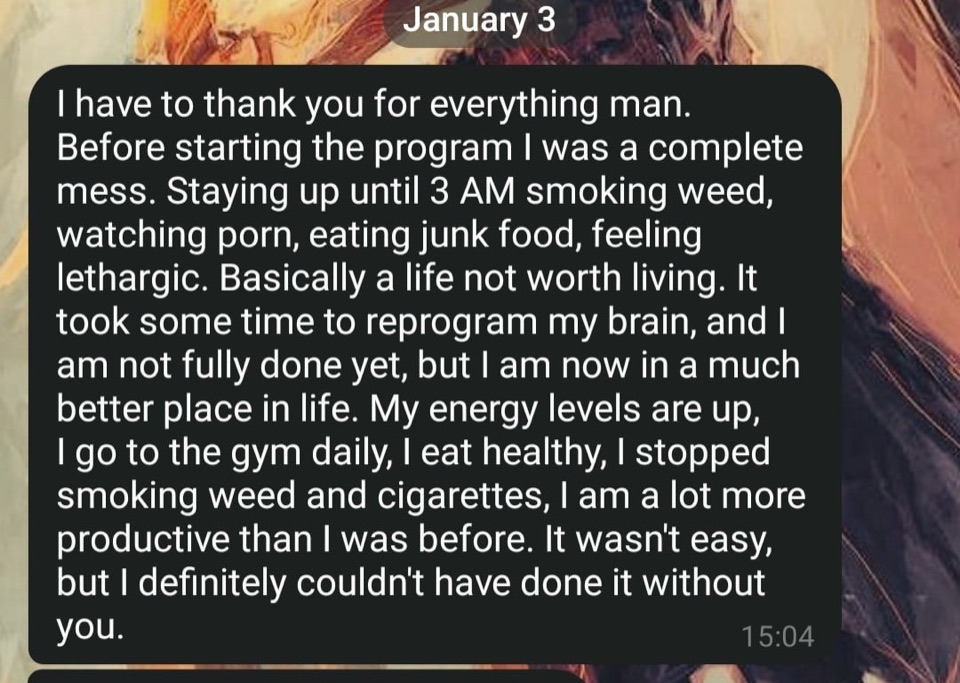
- Written update (screenshot): one message, dated 3 January
Most nights, this client didn't get to bed until 3 AM. The hours after midnight were where everything happened: weed, porn and junk food, one after another, until they finally went to sleep. The next day was spent tired and slow, and that night went the same way.
When they wrote to us in January, that pattern was gone. They'd stopped weed and cigarettes, they were eating healthily, and they were going to the gym every day. They had more energy and were getting far more done. They were also honest that it hadn't been easy, that it had taken time, and that they weren't finished. This file follows how the nights changed.
Four habits sharing the same few hours
The client's description of their life before the program is short and blunt. "Before starting the program I was a complete mess. Staying up until 3 AM smoking weed, watching porn, eating junk food, feeling lethargic." Their own summary of how that felt was "basically a life not worth living".
What stands out in that description is how the habits were stacked on top of each other in the same few hours. Weed in the late evening made it easier to stay up and harder to stop. Being high and awake at midnight made junk food the obvious next step. Being alone and awake at 1 or 2 AM, with a screen in reach, made porn the next one after that. Cigarettes ran alongside all of it. Each habit made the next one easier, and all of them pushed bedtime later.
The cost came the next day. "Feeling lethargic" is the client's word, and it fits a body that sleeps at 3 AM and eats badly most nights. Mornings were slow or lost. Work got whatever energy was left. Training probably didn't happen at all, given that daily gym sessions are one of the first things the client lists once things changed. And a tired, flat day made the night's habits feel more welcome, which kept the whole thing going.
Nothing in the message describes earlier attempts. When habits are tied together like this, though, trying to stop them one at a time usually fails. Stop the weed and the late nights are still there, with porn and junk food filling them. Stop the porn and the weed is still keeping you up.
What we found: the night was holding everything together
When the specialist asked on the first call what kept the habits going, the answer turned out to be the night itself. The habits shared one setting: late, alone, awake long after the rest of the world had gone to bed. As long as the client was still awake at 1 AM, the habits had the time and conditions they needed.
That made the plan clear. Before asking the client to stop anything, we'd move their night back. Fixed sleep and wake times would come first, along with bright mornings and dim evenings. The phone would go out of the bedroom. Training would tire them out properly by the evening. Food would change too, because junk food was part of the same late-night pattern. When the time came to stop, the client would stop the core habit and name the habits that rode on it. And the empty late hours would be planned for in advance, because those were where everything had happened.
Before the first day, they wrote down their commitment and fixed the date it would begin.
Phase 1, Days 1 to 30: moving bedtime back
The first week. On Day 1 the client wrote their first evening entry for their specialist. That was harder than it sounds for someone whose nights had always run late, because writing it meant ending the day on purpose. Then came the change the whole plan rested on. The client set a fixed bedtime far earlier than they were used to, and a fixed wake time. For the first nights they lay awake long after lights out, because their body still expected the day to end at 3 AM. They told their specialist they couldn't sleep, and the specialist told them it was expected and that it would pass.
At night the phone now stayed outside the room they slept in. For this client that took porn out of the late hours, which was where it had always been. Daily walks went in, in daylight, and then training. The gym, which the client would later go to "daily", started here, and it did as much for their sleep as anything else, because a body that's trained hard is ready for bed at a normal hour. A short daily practice for attention went in at the end of the week.
The second week. Eating changed. Junk food went out and real meals came in at set times. A few of the old late-night cravings turned out to be partly hunger from a day of eating badly, and they eased once the day's eating was sorted. Then the day got a fixed structure, evening included, so the hours before bed had a shape and an end.
The lessons explained the loop a habit runs in and why the plan was to stop completely. Then the client wrote down everything they reached for to feel good without effort. Weed, cigarettes, porn and junk food were all on it, along with a few things they hadn't thought of as habits until they wrote them down. They traced the history of it all honestly, from the first late night to the present.
Day 15 and the weeks after. Abstinence started on Day 15. Weed was the core habit and the others depended on it, so the late nights and everything that came with them were named and planned for at the same time.
The client didn't pretend this part was easy, and we won't either. "It wasn't easy," they wrote later, and "it took some time". The first weeks without weed brought restless nights and vivid dreams, which are common and which we'd warned them about. Their mood was flat for a while, and they were short-tempered at times. The hardest stretch was around midnight, when their body still expected the weed and everything that used to come after it. On those nights the client held on to one thing, which was getting up at the fixed time the next morning whatever the night had been like. Slowly, the late hours got easier to get through.
Cold and heat came into the routine next. A new hobby gave the evenings something to work toward, a calming practice helped on nights that were hard to settle, and attention training continued. The month closed with lessons on cravings and on how the brain links each habit to the place and time it happened. For this client, that explained why midnight in their own room still felt risky. On Day 28 the client and their specialist looked back over the month on a call, and most of it was about sleep.
Phase 2, Days 31 to 60: the hours after dark
Day 31: the trigger map. The client's list of triggers was long, and honest about the parts they'd never have said out loud. The late hours were at the top: being awake after midnight, being alone in their room and not being able to sleep. Being hungry late at night was there, along with specific shops and delivery apps. So were boredom, low moods and the end of a long, unstructured day. Certain friends they used to smoke with were on it, and the first cigarette of the day was its own trigger.
Day 32: the reset. Anything to do with weed or cigarettes left the home. Delivery apps were deleted, and screens were set up so porn was hard to reach. The room where the late nights had happened was rearranged so it no longer looked like the place they'd happened. Anything that had to stay got a plan.
Building the responses. The weeks that followed went into a response for every trigger left on the list. The late evening got a fixed close to the day. Nights when sleep didn't come got something to do that wasn't a screen or a smoke. Time with friends who smoke got a plan made beforehand.
The most useful thinking work was on one particular thought: I can't sleep anyway, so I might as well. That thought had started more late nights than anything else. The client put it on paper and worked through it at a calm moment, in daylight.
There were practices for the craving itself too, for breathing, for tension in the body and for the moment it peaks. Those mattered most on nights when sleep wouldn't come.
A run of nights without sleep. The answer got its real test in the middle of the phase. After weeks of sleeping well, the client hit a run of nights when sleep wouldn't come at all. Nothing in particular had gone wrong. They just lay there, wide awake at 1 and 2 AM, in the same room where those hours had always been spent high, eating and on a screen. On the second night the thought came back almost word for word, and it sounded more reasonable than it ever had. They really couldn't sleep.
What they did was small. At 1 AM they wrote their specialist a long message, knowing no answer would come until morning. Writing out what was happening turned out to be most of what they needed. They got up and did what they'd planned for a sleepless night, which didn't involve a screen or a smoke, and went back to bed when they were tired. In the morning their specialist didn't spend long on reassurance. They went through the last few days of entries together, saw that training had slipped to the evening and dinner had moved late, and put both back where they'd been. The next night was rough too. A night or two after that, they were sleeping again, and none of the old habits had come back.
On Day 52 everything was put together into one plan, matched trigger by trigger, with a sleepless night now near the top. The client spent the next week living on that plan and writing down each craving as it came, and the phase ended with a call to look back over it.
Phase 3, Days 61 to 90: from "a complete mess" to someone who trains every day
The third phase deals with how the client sees themselves. The old picture was the one in their message: a complete mess, up until 3 AM, lethargic. If the client still saw themselves that way, one bad week could bring the old nights back.
The phase started with an honest look at the past: why earlier attempts hadn't held, and what the late-night pattern had been doing for them. Then the client's picture of themselves was rebuilt around the facts of their days. They were at the gym daily, eating healthily, up in the mornings and getting their work done, and they'd got through a run of sleepless nights without the old routine. The goal they chose suited what drives them, and much of their extra energy went into their work.
Before the 90 days ended they rehearsed the moments that could undo it: a weekend with nothing planned, an evening with friends who smoke, a late night out that ran past midnight. They recorded the changes as they happened, set their Day 90 view of themselves beside their Day 1 account, and made a plan for after the program.
Where things stood on 3 January
The message from 3 January is the last thing on record. The client wrote:
"It took some time to reprogram my brain, and I am not fully done yet, but I am now in a much better place in life. My energy levels are up, I go to the gym daily, I eat healthy, I stopped smoking weed and cigarettes, I am a lot more productive than I was before."
"It wasn't easy, but I definitely couldn't have done it without you."
The message doesn't say where in the program 3 January fell. If it came before Day 90, as "not fully done yet" may suggest, then the last weeks described above came after it and aren't on record.
The client describes the work as unfinished, and that's an honest way to see it. The nights had changed, the main habits had stopped, and the days had filled with things they'd chosen. The plan for after the program was there to keep it that way.
Why the nights changed
- We treated the night as the problem. The habits all lived in the same late hours. Moving the client's night back took away the time and conditions all of them depended on.
- Sleep and food came before stopping. By Day 15 the client was sleeping at fixed times, training and eating properly. Some of the late-night cravings had already eased.
- The hard weeks were expected. The restless nights and flat mood after stopping weed were explained in advance, so the client knew to wait them out.
- The sleepless-night thought was answered. The thought that they couldn't sleep anyway, so they might as well, had started many late nights. It was taken apart in writing before it came back.
- There was someone to write to at 1 AM. Even with no reply coming until morning, writing it out to someone who knew how their nights used to go was enough to get through it, and the next morning's review found what had changed.
For anyone whose habits all happen after midnight
If your habits all happen late at night, one after another, much of this case will probably sound familiar. The habits may be less separate than they feel. They may share the same few hours, and as long as those hours stay the same, stopping one will probably leave the others in place.
It also shows that this kind of change takes time. The client says plainly that it wasn't easy and that they weren't finished. What they had at the end was more energy, daily training, better food, and days that weren't spent recovering from the night before.