Case file 31
A two-line message, ten months on
Name withheld
- Came in with
- Alcohol and drugs
- Program
- 90-Day Behavior Control System, with a specialist
- Where it stood at last contact
- "10 months out of alcohol and drugs"
- On record
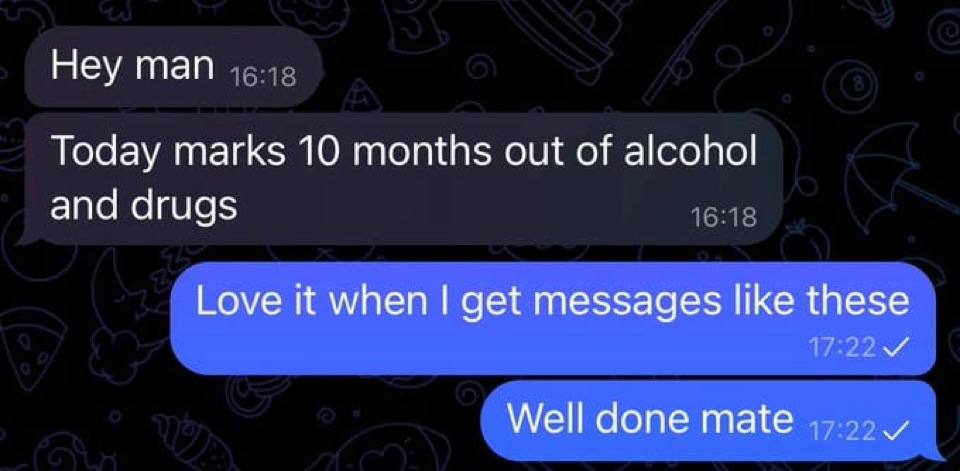
- One written update (screenshot)
One afternoon a message arrived from a client we hadn't heard from in a while. There was no question in it and nothing that needed sorting out. It just said: "Hey man". Then: "Today marks 10 months out of alcohol and drugs".
Ten months is long after the program's 90 days. This file is shorter than most, because the record is only two lines long. But those two lines speak to a part of stopping that most people never plan for: the months after the hardest part is over.
Good for a few weeks, then back again
Before coming to us, the client had no trouble stopping. They'd done it plenty of times. The trouble was staying stopped.
The first weeks of each attempt went well. The client paid attention, stayed away from the places and people that went with drinking and using, and felt better almost straight away. Then life settled down. The cravings eased, things felt normal again, and they stopped paying such close attention. Somewhere in the second or third month there'd be an ordinary evening, with nothing dramatic about it, and they'd have a drink. The drugs followed soon after, and months of effort were gone.
Going round that cycle did its own damage. Each time, the client proved they could stop, and each time they proved they couldn't stay stopped. After enough rounds, they started every new attempt half expecting it to end the same way.
What we found: plans built for the first weeks only
On the first call, the client's specialist looked at what each earlier attempt had been built to do, and the answer was the same every time. Every one had been built to get them through the first few weeks and the worst of the cravings. Once the cravings eased, there was no plan left, and they stopped being careful. But the triggers hadn't gone anywhere. They were still part of the client's life, and sooner or later one of them turned up on an evening when the client wasn't watching for it.
So the plan we set had a different aim: for the client to still be off both long after the program ended, without needing us. That meant three things. First, we'd rebuild their days, so stopping didn't rest on willpower alone. Second, they'd map every trigger, build a response for each one and practice it until it came without thinking. Third, they'd spend the last month on who they were without alcohol and drugs, and on a plan for the months after Day 90, around the time the old attempts had always fallen apart.
One thing had to be settled before any date was fixed. Anyone who drinks heavily every day talks to a doctor before stopping, and the client's specialist checked where they stood on that first.
Days 1 to 30: the foundations
This client had always been good at the first weeks, so the first month wasn't where their case was won. It still had to be done. A nightly log began on Day 1, and their specialist read it. Then came the basics, one after another: sleep and waking at set times, morning light, dim evenings, no phone in the bedroom, walks, training, better meals, a short attention practice and a day with set points in it from morning to night. Before Day 15 they also listed the easy rewards they leaned on and wrote out the history of both habits.
On Day 15 the client stopped drinking and stopped the drugs, both on the same day. The weeks after were hard in the usual ways, with restless evenings and unsettled sleep, but the client had been here before. They'd got through early weeks plenty of times. What was different this time was everything else going in alongside the stop: a hobby with rising goals, a calming practice and attention training. The lessons on how cravings work, and how the brain remembers the setting of every past use, closed the month. Day 28 was the first progress call.
Days 31 to 60: answers for ordinary evenings
On Day 31 the client mapped every trigger they could find. Some of them were the obvious ones: certain people, certain places and the end of a hard week. But the specialist pushed the client to find the quiet ones too, because those were what had ended the earlier attempts. They found boredom on a weeknight, a good mood that seemed to deserve a reward, and the feeling that everything was fine now.
On Day 32 the client cleared out everything they could. Over the following weeks they built a response for each trigger that was left, including the ordinary ones. The thought they worked on hardest was the one that had turned up in the second or third month of every earlier attempt: I've got this under control now, one won't matter. They took it apart in a written exercise early, weeks before the point where it had always appeared.
The test came near the end of the second month, and it didn't come on a bad day. It came on the best day they'd had in a long time. News they'd been waiting on for months came through one weekday afternoon. Everything felt fine, and that was exactly the feeling that had ended the earlier attempts. Within the hour the old thought arrived, close to how they'd written it down weeks before, and because they'd seen it on paper they knew it the moment it showed up. They didn't message anyone. They marked the news with a long walk and a good dinner at home, went to bed at their usual time, and mentioned the day on their next call with their specialist almost in passing. For their specialist, that passing mention was the best news of the month. The quiet trigger had come, and the client had handled it on their own.
A week of practice and the second progress call rounded off the phase.
Days 61 to 90: planning for month four and beyond
In the last month the client worked on the stretch their earlier attempts had never planned for. They went back through those attempts, and the timing stood out straight away. Every one had fallen apart once things felt normal. They'd already met one of those moments on the day the good news came. So they went through the others ahead of time: an easy week, a holiday, a run of months where nothing was wrong at all. They also built a new view of themselves from what they were already doing every day, and picked a goal to work toward.
At the end, the client compared how they saw themselves on Day 90 with their Day 1 account, and made a plan for the months after the program. That plan was built around the stretch where every earlier attempt had failed, and six months of aftercare followed.
What the client sent
"Hey man"
"Today marks 10 months out of alcohol and drugs"
That's all it said, and it doesn't need more. Ten months is several times longer than any of their earlier attempts lasted, and well past the second and third months where the old pattern used to catch up with them. The client wasn't asking for anything. They were marking a day and wanted us to know.
Why it lasted past the third month
- The plan was built for the long run. Earlier attempts were built for the first weeks. This one was built for the months after Day 90.
- The quiet triggers were mapped. Boredom, a good mood and the feeling of being fine all got responses, alongside the obvious triggers.
- The thought that it was all under control was dealt with early. It had ended every earlier attempt. This time it was taken apart before it arrived, and when it did arrive, on a good-news afternoon, they knew it straight away.
- The client prepared for the easy weeks as well as the hard ones. The moments that had caught the client out before were the ones where nothing was wrong.
For anyone who can stop but can't stay stopped
If you've stopped drinking or using before, and it held for a few weeks and then fell apart, think about when it fell apart. For some people the first weeks aren't the hard part. The hard part comes once the cravings ease and life feels normal again.
That second stretch needs its own plan, made in advance and built around your own quiet triggers. This client's ten months show what can happen when that plan holds.