Case file 34
Two habits, stopped a month apart, and both still gone
Name withheld
- Came in with
- Alcohol and cigarettes
- Program
- 90-Day Behavior Control System, with a specialist
- Where it stood at last contact
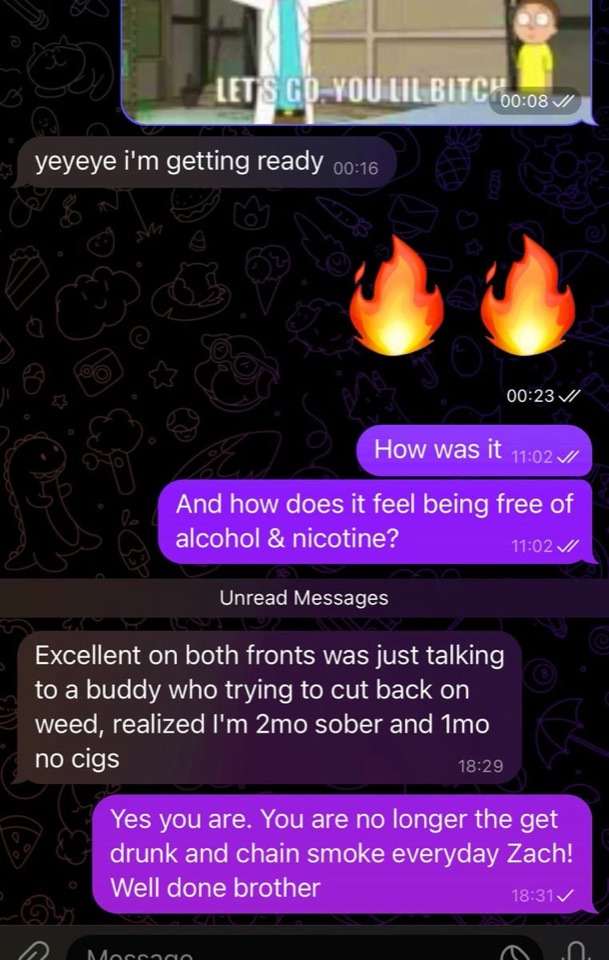
- "2mo sober and 1mo no cigs"; "Excellent on both fronts"
- On record
- One written update (screenshot)
Two months without a drink and one month without a cigarette. This client only worked those numbers out halfway through a conversation with a friend. He'd come to us drinking and smoking, and he didn't stop both on the same day. The drinking went first, and the cigarettes followed about a month later. When his specialist asked how it felt to be free of both, he answered: "Excellent on both fronts". And then: "realized I'm 2mo sober and 1mo no cigs".
The word "realized" tells you something too. He'd stopped keeping count, and it took a conversation with someone else to remind him. The rest of this file is the order things happened in, and why the order mattered.
A drink in one hand and a cigarette in the other
Before the program, his drinking and his smoking were so tied together that he struggled to say where one ended and the other began. He smoked at other times too, but he smoked most when he was drinking. His evenings were a drink in one hand and a cigarette in the other. A drink made him want a cigarette, and a cigarette made him want the next drink.
He'd tried to stop smoking a few times. Each attempt lasted until the first evening he had a drink. A couple of drinks in, a cigarette felt like the most natural thing in the world, and the attempt ended right there. He'd never seriously tried to stop drinking. In his mind the drinking was the normal part, and the smoking was the problem he kept failing to fix.
His body paid for it first. He felt it in his breathing, his sleep and his mornings. Both habits cost him money he'd rather have kept, and his evenings went the same way every night without him really deciding anything. And every failed attempt at the cigarettes told him the same thing: he was someone who couldn't stop. He didn't know yet that he'd been trying to stop the wrong habit first.
What we found: the cigarettes rode on the drinking
On the first call, his specialist went through his attempts to stop smoking one at a time. Every one had ended the same way, with a drink first and then a cigarette. Each time, it was the drinking that brought the cigarettes back.
So the order needed to change. The drinking was the core habit, and the smoking depended on it. As long as he kept drinking, any attempt to stop smoking would hit its hardest moment every single evening, right when his guard was lowest.
Because alcohol was going first, his specialist asked him plainly how much he was drinking. Anyone who drinks heavily every day talks to a doctor before stopping, and Day 15 was set with that rule in mind.
So we staged it. He'd spend two weeks rebuilding his days, his sleep and his body before stopping anything. On Day 15 the drinking would stop, and the cigarettes would be named as the habit that came with it. Then, once the drinking was gone and his responses were in place, the cigarettes would go too. By then they'd have lost the thing that had always brought them back.
His commitment went on paper before Day 1.
Days 1 to 30: a day with fewer gaps in it
His log started on Day 1, and his specialist read it as it came in. Within a few days it showed something he'd never counted: how many of his cigarettes went with something else. There was one with the first coffee, one after meals and one at every break. Most of them came in the evening, with a drink.
We started with his sleep, as we do with almost everyone: regular hours, morning light, darker evenings, and the phone kept out of the bedroom. Walks, training, better food and a short attention practice followed. Training was hard at first, because every cigarette showed up in his breathing. But it was also one of the first places he could see himself making progress, and that mattered.
By the second week his evenings, always the longest empty stretch of his day, had set points in them. He also listed the small, easy rewards his days ran on, with the cigarettes at the top, and traced the history of both habits from the beginning. When he saw the two histories side by side, he noticed that his smoking had picked up at the same time as his drinking.
Day 15: the drinking stops, and the cigarettes get a date
On Day 15 he stopped drinking. The cigarettes were named as the habit that came with it, and he and his specialist agreed they'd go next, once he had the tools to handle them.
The first weeks without a drink were hardest in the evenings. That was when he'd always drunk, and now the evenings felt long and a bit restless. He smoked more for a while, which his specialist had told him might happen. That was one of the reasons the cigarettes were left for a second stop instead of being stopped at the same time. His sleep was unsettled for a stretch, and then it started to improve until it was better than it had been in a long time.
The rest of the month added a hobby he could keep getting better at, a calming practice and more attention work. The lessons he remembered were the last ones, on the brain's side of a craving and how it stores the setting of every drink and every cigarette. That explained why some places still made him want both. His first progress call, on Day 28, came two weeks into his life without a drink.
Days 31 to 60: the cigarettes on their own
His trigger map. On Day 31 he wrote down every trigger for both habits. A lot of them were shared. Evenings, certain friends, certain places, the end of the working day and stress were on both lists. The cigarettes had more of their own: the first coffee, after meals, breaks, waiting for something and the drive home. With the drinking already gone, he could see clearly which triggers were left.
Day 32: the reset. The drink was already out of his home, and now everything to do with smoking went too. He rearranged the spots where he'd always smoked, or made a plan for them. Between the two clear-outs, his home had nothing left in it for either habit.
The second stop. Partway through the second month, once his responses were built, he stopped smoking. This time there was no drinking to bring the cigarettes back, and each trigger had a planned response. The first coffee of the day had something new attached to it, and his breaks had something else to fill them. His evenings, which used to hold both habits, now had a routine in them that had nothing to do with either.
His work on his thinking covered both habits. One thought had ended every attempt at the cigarettes: just one, it doesn't count, I'll stop properly tomorrow. On a day he felt steady, he sat down with it on paper and picked it apart. He had good evidence to work with, because he'd already been sober for weeks, and that had started with a thought he'd decided not to follow.
Then came what to do while a craving was actually happening: a way to steady his breathing in company, a way to ease the tension in his body, and a way to get through the few minutes when it was at its worst. Cigarette cravings come on hard but don't last long, so having something to do for those few minutes made the difference.
The hardest weekend. In his first weeks without cigarettes he went to stay with family for a few days. It was the kind of visit he'd always got through with a drink in the evening and a cigarette out on the back step, and some of his family still did both. There was no leaving early, and he hadn't told them he'd stopped either one. On his weekly call before he went, he and his specialist spent most of the time on one question: where would he go when he needed a break, now that the back step was off limits? The answer was a walk, and he took one after almost every meal, because that's when the cravings came. The first evening was the worst. By the last one the craving after dinner was short enough that he barely noticed it. He wrote the whole visit up in his log when he got home.
The practice week at the end of the phase came while the cigarettes were still new to him, which made it more useful than usual. His second progress call followed.
Days 61 to 90: the person a friend talks to about cutting back
The last phase dealt with how he'd always seen himself. For a long time he'd thought of himself as a drinker and a smoker, and as someone who couldn't stop the cigarettes however many times he tried. He had a lot of failed attempts to back that view up.
He went back over those attempts first. Looking at them all at once, he could see they'd failed for the same reason: he'd been trying to stop the cigarettes while the drinking kept bringing them back. Once he saw that, he could stop beating himself up over them. He'd simply been stopping the wrong habit first.
His new view of himself came from the facts. He hadn't had a drink in weeks or a cigarette since the second month. He was training, breathing better and sleeping well. All together, that was a different man from the one in his Day 1 write-up, and the work of this phase was to keep acting like him. He also chose one goal that mattered to him, and made a start on it within days.
It was during this stretch that a friend talked to him about cutting back on weed, and somewhere in that conversation he worked out his own numbers: two months without a drink and one month without a cigarette. He hadn't been counting, because he'd been too busy getting on with his life. His reply to his specialist came right after, and the rest of this section came after it.
Near the end he rehearsed the situations still ahead that could bring either habit back: a night out, his next family visit and a stressful week at work. He kept writing down what had changed as it came. He finished by comparing his Day 1 write-up with the man he was now, and planned out the months after the program.
His answer, word for word
When his specialist asked how it felt to be free of both, he wrote back: "Excellent on both fronts was just talking to a buddy who trying to cut back on weed, realized I'm 2mo sober and 1mo no cigs"
The two habits that had kept each other going were both gone. And he only noticed how long it had been because a friend brought up cutting back.
Why both have stayed gone
- The right habit went first. Every earlier attempt went after the cigarettes while the drinking kept bringing them back. This time the drinking stopped first.
- The second stop was planned. The cigarettes were named on Day 15 and stopped once his responses were ready. They didn't have the drink to fall back on anymore.
- His body came first. By the time he stopped either, his sleep, training and routine had already changed.
- Shared triggers were dealt with once. Evenings, certain friends and stress fed both habits, so each response covered both.
- The hardest weekend was talked through before it came. His specialist knew both of his trigger lists, and they'd worked out where he'd go during the family visit before he left home.
For anyone who drinks and smokes
If you've tried to stop smoking and it never lasts past the first drink, think about what happens just before you light up. For a lot of people it's a drink, and as long as the drinking carries on, the cigarettes keep coming back.
You don't have to stop both on the same night. What matters is the order, and that each one stays gone once it's gone.
That's how it went for him. He stopped one, then the other, and after a while he stopped counting.