Five months, no relapse, and urges that faded
A client came to us with a porn habit, and five months later the urges had gone down with each passing day, which is the part most people don't believe.
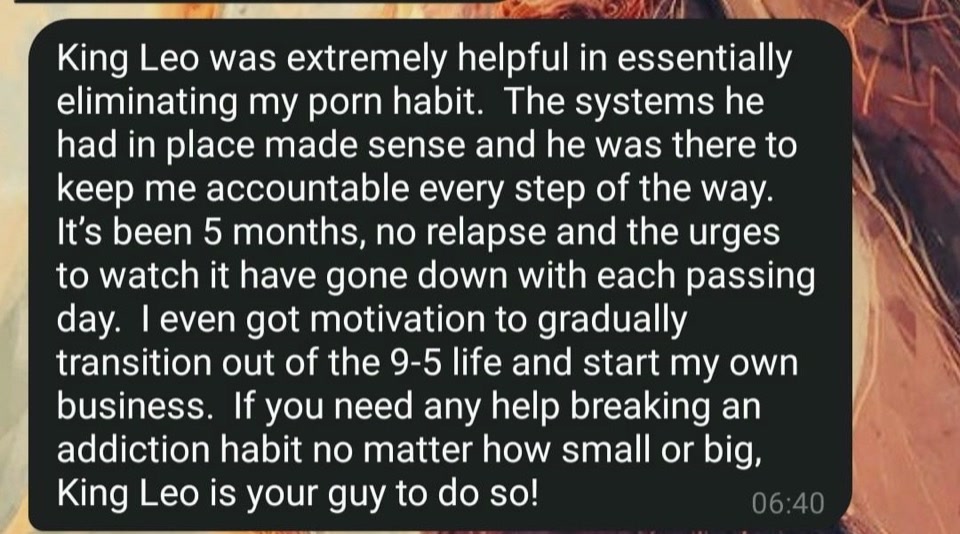
A client came to us with a porn habit. Five months later, they sent us this: "It's been 5 months, no relapse and the urges to watch it have gone down with each passing day."
This is how we did it.
But first, look at the last part of that sentence, because it's the part most people don't believe.
If you've tried to stop before, you probably know the feeling of the urge never going anywhere. You get a few days in, maybe a few weeks, and it's still there every night, just as loud. So you start to believe that stopping means fighting that urge every day for the rest of your life. Nobody can keep that up, so sooner or later you give in.
The urge feels permanent because, so far, it's always ended up getting what it wanted.
An urge is your brain predicting a reward. Every time the habit followed the urge, your brain learned that the prediction was right. And when you hold out for a week and then give in, it learns something worse: that the reward still comes if it keeps pushing long enough. So the urge stays strong, because, as far as your brain can tell, pushing until you give in works.
An urge fades the other way around. It has to show up, again and again, and get nothing. Every time it arrives and the habit doesn't follow, the prediction gets a little weaker. That happens slowly, a little more each day, which is exactly what this client described.
The catch is that this only works if the urge goes unanswered for long enough. White-knuckling usually gives out before that happens, which is why the urge never seems to fade.
So the three phases of our program are built around getting someone through that stretch.
In phase 1, we rebuild the day: sleep, training, daylight and a routine with fixed points. A rested person with a full day has far fewer of the empty, worn-out hours where the urge usually wins.
In phase 2, we map the triggers and build a response for each one, and the client practices it until it's automatic. So when the urge comes, they already know what they're going to do, and they don't have to fight it out on the spot.
In phase 3, we work on who you are without the habit, so the change holds after the 90 days are over.
And through all of it, someone is checking in. This client put it this way: "The systems he had in place made sense and he was there to keep me accountable every step of the way."
Here's the message.
"It's been 5 months, no relapse and the urges to watch it have gone down with each passing day. I even got motivation to gradually transition out of the 9-5 life and start my own business."
Look at "with each passing day". The urges didn't disappear in the first week, they went down a little at a time, because every day they showed up and got nothing.
And look at the last line. With the habit out of the way, this client started thinking about leaving the 9-5 and starting a business. That's the kind of thing that tends to come back once a habit isn't taking up your time and energy anymore.
If the urge feels like it'll never leave you alone, it's probably because, in the end, it has always been given what it wanted. Stop giving it that, for long enough and with the right support, and it gets quieter.
The Behavior Control System
Our 90-day program, private and one-on-one, built around your life.
See our programsField Notes
One letter a week from the lab.