Case file 24
He used nicotine to think, and now he thinks better without it
Name withheld
- Came in with
- Nicotine
- Program
- 90-Day Behavior Control System, with a specialist
- Where it stood at last contact
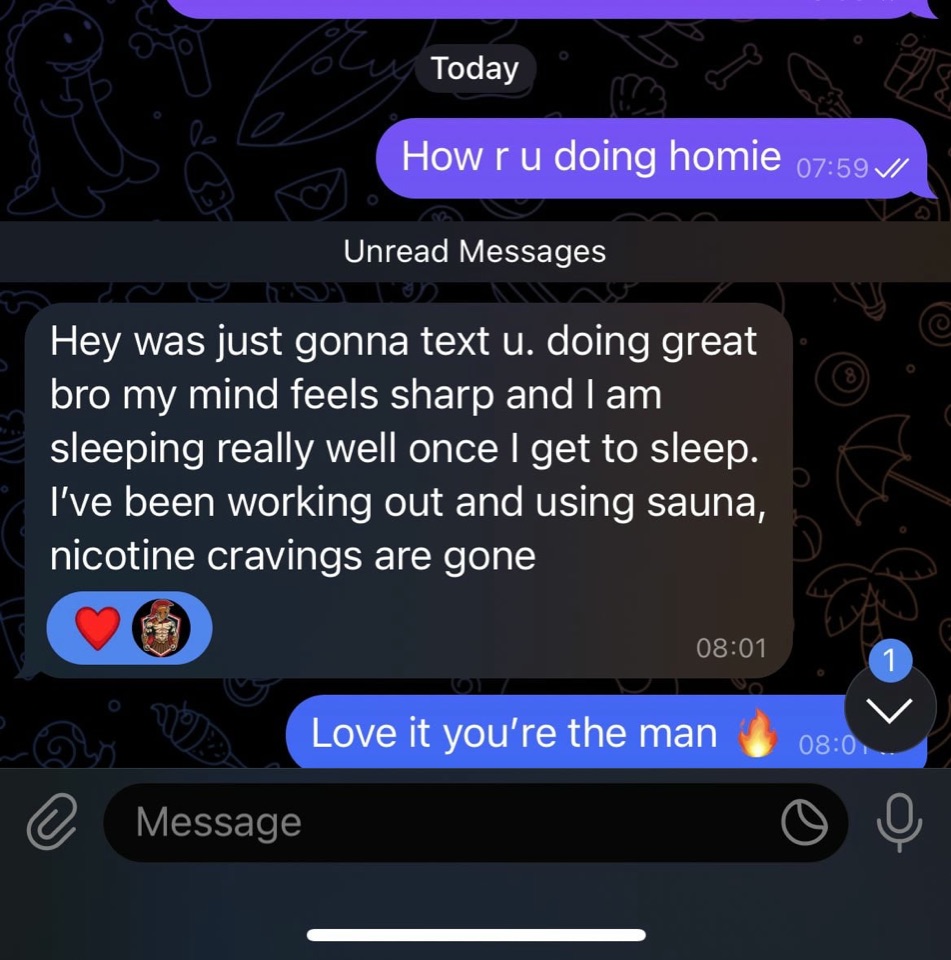
- "nicotine cravings are gone"; mind sharp, sleeping well, training and using the sauna
- On record
- One written update (screenshot)
Nicotine was what this client had long relied on to get his head working. It was how he started the day and how he pushed through hard work. When we checked in with him, he told us his mind felt sharp, that he was sleeping really well once he got to sleep, and that he'd been training and using the sauna. Then he added the line he'd come to us for: "nicotine cravings are gone".
Below is how he got there, and how the thing he'd relied on to focus turned out to be getting in the way of his focus.
A top-up for every part of the workday
It's easy to think of nicotine as a small habit. It doesn't knock you out for a night or cost you a weekend. It just runs quietly through the whole day, and for him that was exactly the problem.
He relied on it at specific moments. There was the first one of the morning, before he felt properly awake. There was one with coffee, one before any piece of work he didn't want to start, and one in the gaps between tasks. He reached for it when he was stressed, and he reached for it when he was bored. Over time it had stopped feeling like a choice. It was just part of how he worked.
At first he didn't connect what it was costing him to nicotine. His focus came in short bursts with a dip after each one, so he was never far from needing another. He wasn't sleeping well either. He found it hard to switch off at night, and he woke up feeling like he needed the first one just to get going. The times he'd tried to stop, he'd felt foggy and irritable within a day or two. To him, that fog proved he needed nicotine to think. So every time, he went back to it to get his head working again.
That belief is what kept him stuck. If you think a substance is what makes your mind work, then every attempt to stop feels like you're making yourself worse at your job.
What we found: the fog was withdrawal
On the first call, his specialist went through how his days ran and what each attempt to stop had looked like. The same thing showed up every time.
Every earlier attempt had gone in the same order. He'd stop, the fog would come, and he'd go back. He'd taken the fog as the truth about how his brain worked, when it was really the first stage of withdrawal. He'd never got far enough past it to find out what his mind felt like once it cleared. He'd also always tried to stop while he was sleeping badly, not training, and working long days without a break, which is about the hardest time there is to stop.
Nicotine was doing three jobs for him. It woke him up, it got him through the start of hard work, and it gave him a reason to take a break when he had no other. If he took it away and left those three jobs undone, they'd bring him straight back to it.
So the order of the plan mattered more than usual. We'd start with the things that make a mind feel sharp in the first place: sleep, light, movement and training. He'd stop nicotine on Day 15, once those were already working, so he wasn't relying on it to keep his head clear. And each of its three jobs would get something else to do it.
His commitment went in writing before the start date.
Days 1 to 30: sleep and movement before stopping
The first week. Once his nightly log was running, his specialist saw the same thing in it almost every day: his worst afternoons came after his worst nights. After a poor night's sleep, he used more nicotine and got less done.
So sleep came first. He moved to fixed times to sleep and wake, with light in the morning and low light at night, and his phone out of the bedroom. Getting to sleep was the stubborn part. His mind was used to staying busy late into the night, and it didn't settle straight away. But once he was asleep, he stayed asleep, and that part got better quickly. He still describes it that way: sleeping really well "once I get to sleep".
Daily walks came next, and he used them as thinking time. He'd always reached for nicotine to get an idea moving, and a walk turned out to do the same job without the dip afterward. Training went in at fixed times, and so did a short daily sitting practice that trains attention. That practice would matter later.
The second week. The daily routine that went in during the second week was built around his work. The long stretches where nicotine had been his only break now had breaks in them that he'd planned himself.
Then he listed every easy reward he leaned on without earning it. Nicotine was on the list, of course, but so were other things he'd never thought of as habits. He also traced the history of his nicotine use, from the first time to the day he joined. It was the first time he'd seen all of it written out in one place.
Day 15 and the fog he'd always run from
On Day 15 he stopped nicotine.
The fog came, as it always had, but this time two things were different. On his weekly call the week before, he'd been told that it would come, roughly what it would feel like, and that it would pass. And he was stopping after two weeks of fixed sleep, daily walks and regular training, so he was in far better shape to handle it.
The first week was still hard. He was short-tempered, and his concentration came and went. The urge was strongest first thing in the morning and when he sat down to start work. On the worst day he messaged his specialist to say his head felt like cotton wool and he couldn't think. His specialist reminded him of what they'd talked about on the call. This was the part he'd never got past before, and it wouldn't last.
And it did pass. Around the second week without nicotine, his mornings started to clear. By the end of the month he noticed something he hadn't expected: his focus was steadier than it had been with nicotine, because there was no dip to recover from.
From Day 16 the program brought in controlled stress, and for him that meant the sauna, which became a regular part of his week. He liked it. It gave him somewhere to go and something to do in the evenings, and he slept better on sauna days. The hobby, the calming practice and the attention work that came alongside it mattered less to him. In the last days of the month he learned what goes on in the brain during a craving, and how the brain remembers where he was every time he used. That explained why sitting down at his desk with a coffee still made him want one. His first progress call came on Day 28.
Days 31 to 60: something new in every spot nicotine used to fill
His trigger map. On Day 31 he wrote down every trigger he could find. Most of his were tied to his workday: waking up, his first coffee, sitting down to a hard task, the gaps between tasks, finishing something and getting stuck on something. Stress was on the list, and so was boredom. A few places came up too, along with one or two people he used to step outside with.
Day 32: the reset. He cleared everything to do with nicotine out of his home, his car and his bag. The spots where he'd always used it were rearranged, or he made a plan for them. That dealt with everything that could simply go.
His responses. Over the next three weeks he built a response to each trigger that was left. His first coffee now came with something else in place of the nicotine. Sitting down to hard work got a short routine of its own. The gaps between tasks became proper breaks that actually rested him. When he got stuck on something, he went for a walk.
The biggest piece of work was on one thought. For a long time he'd believed that he thinks better with nicotine. In this phase he wrote that belief down and worked through it on paper, with weeks of his own log open beside him, and the log showed weeks of clear mornings and steady focus without it. So by the time the thought came back, he already had a better answer to it.
For the craving itself, he had a way of breathing he could use at his desk, something for the tension a craving left in his body, and a way of waiting out the worst of it. A nicotine craving doesn't last long. Knowing that, and having something to do while it lasted, made it a lot less frightening.
The hardest day. It came after one bad night. Partway through the phase he lay awake into the early hours, his mind running the way it used to, and got up on very little sleep. The next morning had nearly every trigger on his map in it at once: the first coffee, a hard task waiting and a head that felt slow. The old belief came back with the strongest case it had made in weeks, because his head really was foggy, and he knew exactly what used to clear it. He remembered his first week without nicotine, when the fog had felt permanent and then lifted, and he treated the morning the same way. He did the easy work first, took his walk earlier than usual and left the hard task for the afternoon. At lunchtime, once the worst had passed, he messaged his specialist to say it had been his hardest morning in weeks and he'd got through it. His specialist asked him to write down exactly how the day had gone while it was fresh, because it was the best evidence he'd ever have against the old belief. He went to the sauna that evening and slept well. On their next call the day went into the case against the belief: his worst morning in weeks, and he'd got through it without nicotine.
Then the phase wound down: a week of practice, every craving written down, and the second progress call.
Days 61 to 90: from someone who needs it to think
The last phase dealt with how he saw himself. He'd always thought of himself as someone who works best with nicotine, and that view of himself didn't go away just because he'd stopped. If he kept it, then sooner or later a hard week would come and that old view would tell him to have one, just to get through.
First he looked back at his old attempts properly. Every one of them had ended in the fog, and every time he'd taken the fog as proof. With all of them in front of him, he could finally see what had happened. Each time, he'd given up just before he'd have found out what his mind was like without nicotine.
The way he saw himself now came from his days as they actually were. He trained regularly, used the sauna, took long walks and did focused work in the mornings. Seeing that written out, next to an honest list of what he was good at, gave him a standard to live up to, and this phase asked him to keep living up to it. He chose one goal tied to what drives him, a piece of work he'd been putting off for a long time, and took the first step that week.
Then he went through, ahead of time, the days most likely to catch him out later: a deadline week, a night out with people who still use nicotine, and a week away from home and his routine. He kept a record of what had changed as it happened. For his last piece of work, he compared the man he was on Day 90 with the man in his Day 1 write-up, and then planned the months after.
His answer when we checked in
His specialist checked in one morning. He answered within a couple of minutes: "Hey was just gonna text u. doing great bro my mind feels sharp and I am sleeping really well once I get to sleep. I've been working out and using sauna, nicotine cravings are gone"
If you read it in order, it tells the whole story of his case. He starts with his mind, the thing he'd always believed nicotine was looking after. Then he talks about his sleep, and he's honest about the part that's still slow. Then he mentions the training and the sauna, which he'd built into his life. The habit itself comes last, almost in passing: "nicotine cravings are gone".
Why he got past the fog this time
- He got through the fog. Every earlier attempt ended at the same point. This time he knew it was coming, knew it would pass, and had someone to message on the worst day.
- His mind was looked after before he stopped. Fixed sleep, walks, training and an attention practice were in place before Day 15. So his focus no longer depended on nicotine alone.
- Each job got a replacement. Waking up, starting hard work and taking a break each got something else to do the job nicotine had done.
- His main belief was tested against his own log. The idea that he thinks better with it was taken apart using weeks of his own evidence.
- His worst morning became evidence. After a near-sleepless night, with every trigger in place, he got through the day without nicotine, and his specialist made sure that day went straight into the case against the old belief.
For anyone who uses nicotine to focus
If you've tried to stop nicotine and felt like your brain turned to fog, you'll recognize a lot of this. The fog is real, but it doesn't last. It's what withdrawal feels like in the first days. If you always go back before it lifts, you never find out what your mind is like without nicotine.
It also helps to look at what nicotine is doing for you. If it's how you wake up, start work and take a break, stopping it leaves three gaps. Those gaps need filling on purpose, or the habit fills them again.
He'd always been afraid that stopping would cost him his focus. Instead, his mind ended up sharper than it had been with nicotine.