Case file 28
The renewal date that finally passed
Name withheld
- Came in with
- Reliance on a prescription medication ("this stuff")
- How long
- The renewal date hadn't passed with ease once in two and a half years
- Earlier attempts
- Not described; the message says this was "the first time" in 2.5 years they'd been able to let the date pass
- Program
- 90-Day Behavior Control System, with a specialist
- Where it stood at last contact
- Off the prescription; the renewal date "came and went with ease"; routines holding; "Feeling very whole and my heart feels full"
- On record
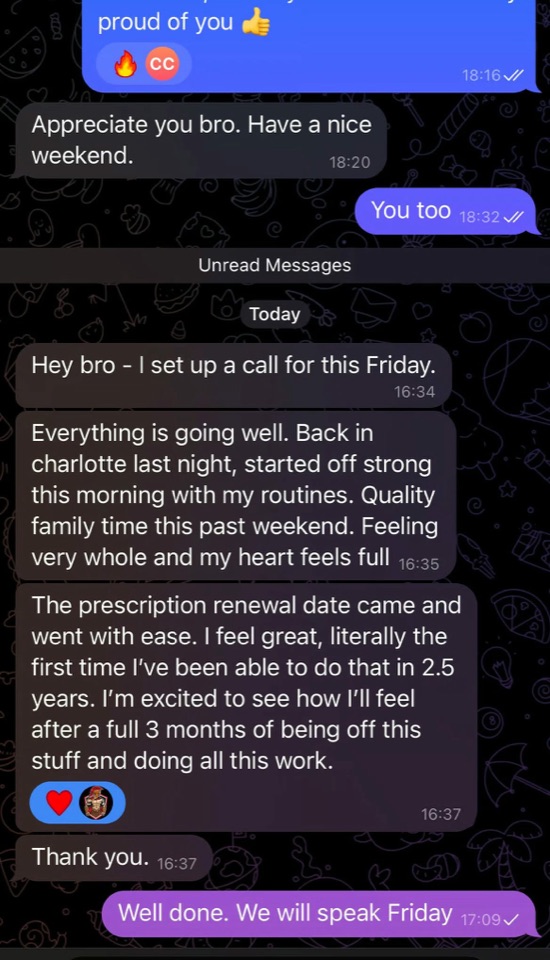
- One written update (screenshot, three messages)
For two and a half years, one date on the calendar decided things for this client. It was the renewal date for a prescription they relied on and wanted to be free of. Every time it came round, it didn't pass easily. Partway through the program they sent their specialist a message about their morning routine and a weekend with their family, and then they said the thing they'd been waiting two and a half years to say: "The prescription renewal date came and went with ease."
What follows is the work around that date: what we found on the first call, how the program was built around a trigger they could see coming well in advance, and what their life looked like by the time it arrived.
One thing comes before everything else in this file. Changes to a prescription go through the doctor who prescribed it. Some medicines aren't safe to stop suddenly. This file doesn't describe the medical side, because that wasn't ours. It describes our side: the days, the routines, the triggers and the thinking that had made every renewal date end the same way.
Two and a half years of the same outcome
Most habits run on triggers that turn up without warning: a bad day, an argument, an evening alone. This client's habit had triggers like that too, but it also had something much less common, which was a date.
A renewal date sits on the calendar where you can see it. In the weeks before it, the client already knew how it would go. They'd tell themselves that this time they'd let it pass, and then, as the date got closer, the reasons to renew would get louder. Every time, the date came and they didn't manage to let it pass. After two and a half years, the outcome felt decided before the date even arrived.
The cost went beyond the prescription. When you depend on something you're trying to get off, everything feels tight and tense. The client was getting through their days and doing what they had to, but they weren't fully there for them. They were with their family, but not really present. The words they use for the change, "very whole" and a heart that "feels full", suggest how much had been missing before.
They'd wanted to come off for a long time. What they hadn't had was a way to change what happened when the date came round.
What we found: the date was the trigger, and the days before it did most of the damage
On the first call, the client's specialist set out to find what was keeping the reliance going. The prescription itself wasn't our side of it. Our side was the pattern around it, and in this case it was easy to see what sat in the middle of that pattern.
The renewal date was the strongest trigger in the client's life. The specialist's reading was that the attempts had been lost in the days leading up to the date, well before the date itself. As the date got closer the client would get more anxious and sleep worse, and the old reasons to renew would start to sound more reasonable. By the time the date came, they'd already lost most of the argument with themselves. Trying to win it on the day had never worked, because on the day they were already worn down.
So the plan was built backwards from the date. Under everything went a steady base for the client's days, so they wouldn't go into the hard stretch already tired. The date itself would be treated as a known trigger, with the response worked out and practiced long before it arrived, so there'd be nothing left to decide on the day. And every decision about the prescription itself stayed where it belongs, with the prescribing doctor.
Phase 1, Days 1 to 30: routines strong enough to survive a trip
The first weeks. The nightly log began on Day 1, and their specialist read it. It made the anxious stretches easy to see. Some days were steady, and some were tight and restless from the moment they woke up.
The first thing we built was the base. Sleep moved to fixed times, with light in the morning, low light at night and the phone out of the bedroom. Walks, training, a short attention practice and better meals followed. By the second week the day had set points from morning to night, so it ran to a plan that didn't depend on how the client felt when they woke up.
The client took to the mornings first, and they became the backbone of the plan. Later on, the first thing they'd report to their specialist was how the morning had gone, before anything else.
Travel. The client's life involved time away, and early on that was where the routine was weakest. A trip meant a different bed, different hours and no fixed points in the day. The specialist worked through it with them: what the routine looked like away from home and what the first morning back should look like. The aim was for a trip to bend the routine a little without breaking it. Later in the program, after a trip, the client's update would start with exactly that: they'd got back the night before and "started off strong this morning with my routines."
The written work. In the second week the client listed the easy rewards they leaned on, not just the prescription, and wrote the honest history of how their reliance on it had grown. Writing out two and a half years of renewal dates in their own words made the pattern plain.
Day 15. In the program, abstinence starts on Day 15. What that meant for the prescription itself wasn't ours to decide. The rest of the program's rules came in around it, and the specialist went through them on the client's weekly call the week before, so the client knew what the next weeks would ask of them.
The second half of the month added a hobby, a calming practice and some awareness work, and the client took to them without much trouble. The lesson that hit home came at the end of the month, on how cravings work and how the brain links old use to places, times and moods. For the client, that explained why the weeks before a renewal had always felt so tense. On Day 28 the client had their first progress call with their specialist.
Phase 2, Days 31 to 60: a plan for a date they could see coming
Day 31: the trigger map. The client wrote down every trigger they could find. The renewal date was at the top, but writing the full list showed that it was really a chain. There was the date itself, and there were the days before it, when anxiety climbed. There was the appointment and the conversation it involved, and there were the thoughts that showed up as the date got closer. There were also smaller triggers: bad nights, tense days and trips that threw the routine.
Day 32: the reset. What could go, went, and what couldn't go was rearranged. Reminders of the old pattern came out of the client's space where that was possible, and the rest was planned for.
The thoughts. Most of the work in this phase went into the reasons that had been winning for two and a half years. Every time the date came round, the same few thoughts turned up and sounded completely sensible: this isn't a good time, I'll come off after this busy stretch, one more renewal won't matter. The client wrote down the main one and took it apart in writing, carefully, while they were calm and the date was still a long way off. When it came back nearer the date, it didn't carry the weight it used to.
The response to the date. Then the client and their specialist built the response to the renewal date itself, one piece for each part of the chain: what the days before it would look like, what the client would do when the anxiety rose, and how the day itself would go. For the anxious moments inside that chain, they learned to steady their breathing, to let go of the tension that builds in the body, and to wait out a hard moment until it passed. By the end of the phase the plan was written down and had been rehearsed, so the client wouldn't have to work anything out on the day itself. A practice week, with everything logged, and the second progress call closed the phase.
The date came and went
When the date came, the client did what they'd already decided to do. The days before it were steadier than they'd been in years, because the routine was holding and the specialist was checking in. The thought that always showed up did show up, and the client recognized it before it could get going. Then the date passed.
The client's message about it is in the record:
"The prescription renewal date came and went with ease. I feel great, literally the first time I've been able to do that in 2.5 years. I'm excited to see how I'll feel after a full 3 months of being off this stuff and doing all this work."
The words that matter most there are "with ease". After two and a half years of dates that went the other way, this one cost them very little.
The client also said where they thought it came from: "being off this stuff and doing all this work." They saw it as the result of weeks of effort.
Phase 3, Days 61 to 90: who they are with the date behind them
The client sent that message before they'd finished the program, so everything in this section came after it.
The last phase deals with how people see themselves. After two and a half years, the client had come to see themselves as someone who couldn't get off it, and every renewal date had backed that up. Now there was one date that said otherwise.
Phase 3 began by going back over the past renewals one at a time, and asking why each had gone the way it did. With the first call in mind, the answer was clear. The days before each date had never been planned for. The client also worked on letting those past renewals go. They stopped treating them as proof that they couldn't do it, and started seeing them as plans that hadn't worked.
The new picture was built from what they were already doing: the strong mornings, the routine that held through travel and the time with their family. The client picked a goal that matched what drives them and took the first step. Late in the phase they rehearsed the moments that might test them later, like a hard week at work or a stretch of bad sleep, so they'd have been through them once already. They kept noting what had changed as it came. At the end they set their Day 1 write-up next to how they saw themselves now, and made a plan for after the 90 days, with six months of aftercare to follow.
The update, in the client's words
Here's how the client's message went. The first thing in it was practical: "Hey bro" and a call already booked for that Friday. The client was setting up their own check-ins by then.
Then: "Everything is going well." After a trip, they "started off strong this morning with my routines. Quality family time this past weekend. Feeling very whole and my heart feels full"
And then the date: "The prescription renewal date came and went with ease. I feel great, literally the first time I've been able to do that in 2.5 years."
They ended it with "Thank you."
Why the date passed this time
- The date was treated as a known trigger. Earlier attempts had tried to win on the day. This time the response was planned and practiced long before, so the decision had already been made by the time the date arrived.
- The days before the date got the most attention. The specialist's reading was that the attempts had been lost in the run-up, so that's where the work went.
- The routine was built to survive real life. The client's mornings held up through travel, and that steadiness carried them into the hardest stretch.
- We stayed on our side of the line. Our work was the routine, the triggers and the thinking around it, and it never stood in for medical advice.
- The people around them came back into the picture. The update mentions family time and feeling whole before it gets to the renewal date, and that order tells you a lot about what had changed.
For anyone with a date they already know they'll lose to
If there's a date, a time of year or an appointment you already know you're going to lose to, it can feel as if it's decided before it arrives. This case shows that knowing it's coming can work in your favor. You get weeks to plan for it, and the planning can happen while you're calm.
And if your habit involves a prescription, start with the doctor who prescribed it. The work in this file is the part that sits around that.