Case file 35
Eighty-two days off the pills, during the hardest stretch
Name withheldEmployed, with a manager
- Role and country
- Employed, with a manager
- Came in with
- Prescription stimulants they had come to misuse ("giving up meds")
- Earlier attempts
- Attempts to cut back that held on easy weeks and gave way on hard ones
- Program
- 90-Day Behavior Control System, with a specialist
- Where it stood at last contact
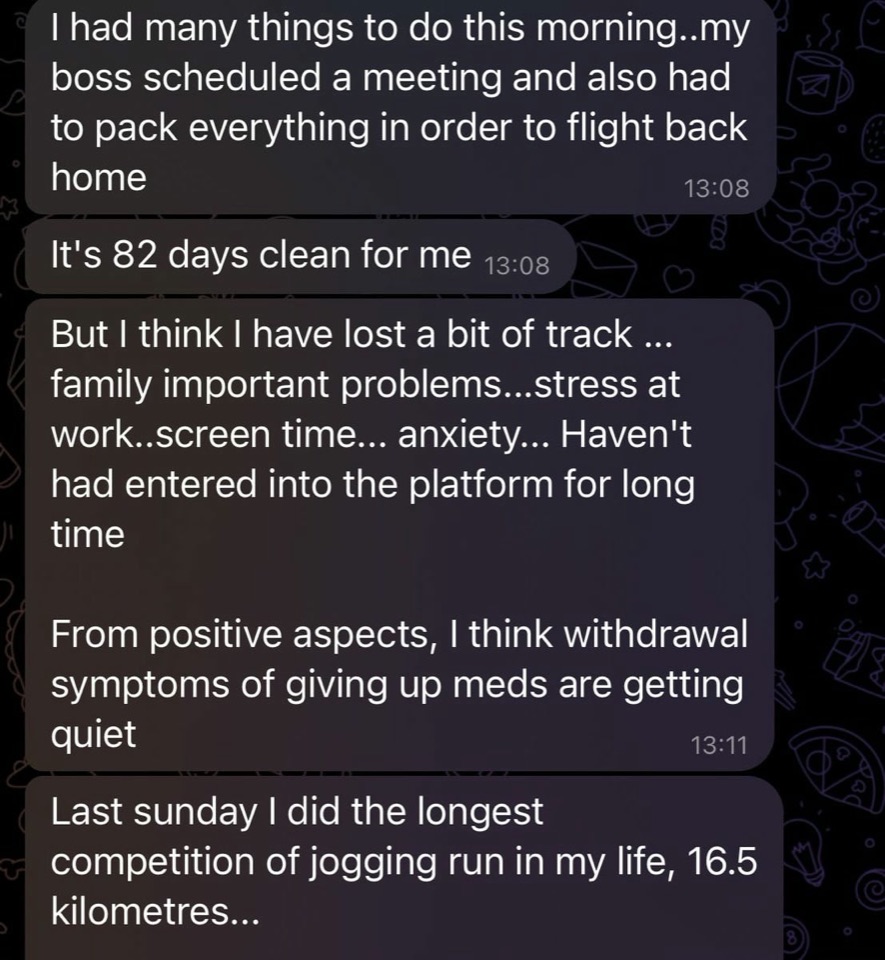
- "82 days clean", meaning 82 days off the stimulants; withdrawal "getting quiet"; the longest run of their life, 16.5 km; a hard stretch with family, work, screen time and anxiety, and away from the program's lessons for a while
- On record
- One written update (screenshot, five messages)
This client's update is honest about a bad stretch, and that's why it's worth reading. It came on a busy morning, between a meeting their boss had called and packing for a flight home. They were 82 days clean, which for them meant 82 days off the prescription stimulants they'd come to rely on to get through their working days. They were also honest that they'd "lost a bit of track": family problems, stress at work, too much screen time, anxiety, and a long gap since they'd last opened the program. In the same message they reported two good things. The withdrawal from coming off the stimulants was getting quieter, and the Sunday before, they'd run 16.5 kilometers in a race, the longest run of their life.
Below is what was built before that stretch, and why it held when the client's attention was elsewhere.
Before anything else: changes to a prescription go through the doctor who prescribed it. Some medicines aren't safe to stop suddenly. The record doesn't say how this client's doctor was involved, so this file covers our side of the work only.
A working life that ran on pills
The client came to us with a full life. They had a job with a manager, travel for work, and a family that needed them. Somewhere along the way, the stimulants they'd been prescribed had become the thing that held those days together.
A stimulant gives focus and energy on demand, and a job with a manager asks for both, all day. On a heavy day the client would take more than they were meant to, or take it later in the day to get through the afternoon and still have something left for the family in the evening. A late dose meant they couldn't sleep, so they lay in bed on their phone until the early hours. A short night meant a heavy, foggy morning, and the quickest way out of that fog was the next pill.
They'd tried to cut back to what they'd been prescribed before, and on an easy week it held. Then a hard week at work, a trip or a problem at home would land, and they'd be back over the line within days. Nothing else about their days had changed while they tried, so the first bad week found them tired, short of sleep and facing a full calendar, with the pills in the drawer.
What we found: the plan had to survive the bad weeks
On the first call, the specialist looked at what was keeping the habit going and at how the client's life was set up. Stress was at the center of it. Work stress and family stress were what sent them to the stimulants, and the stimulants were adding stress of their own: the short nights, the anxious edge and the crash at the end of the day.
The specialist's reading was that this client needed a plan that would still work in the bad weeks, when there wasn't time or energy for anything extra. Every job the pills had been doing would need something else to do it. Sleep at fixed times had to cover the mornings, training had to burn off the stress, and a steady routine had to carry the day when their attention dropped.
The prescription itself stayed outside our plan. Our part was everything around it, and watching for the stretches when coming off made everything else harder.
Phase 1, Days 1 to 30: a body that could take the strain
The first two weeks. Their specialist read the nightly log from the first entry on Day 1. The early entries were full of things that would show up again later: long working days, family worries, the afternoon pill and evenings lost to the phone.
Sleep came first, with fixed times, light in the morning, low light at night and the phone out of the bedroom. For this client, that last one mattered most, because the phone in bed was where the late doses had kept them up. It was also hard to give up, because the screen was where they went to switch off. Daily walks went in as thinking time. Then training, and for this client, running quickly became the part they cared about most. It took the stress of the day out of them, it gave them a lift that didn't end in a crash, and it gave them something to get better at. The attention practice, the changes to eating and the daily routine went in around it.
In the second week they listed the easy rewards they reached for without earning them. The stimulants were at the top, and screen time was on the list too. It would come back later. Then they wrote the honest history of their use, from taking the pills as prescribed to the point where the dose had started to follow their workload.
Day 15. On Day 15 they stopped taking the stimulants. Their specialist had gone through it with them on their weekly call the week before. Coming off a stimulant usually brings a heavy, flat stretch first: tiredness, long sleep, a bigger appetite and a low mood. That came, and it landed on working days, with a manager who still expected them sharp. The evenings were the hardest part. Without the afternoon pill, they got home with nothing left and were short with their family. Their specialist read the log every night, and on the worst days the reply was simple. This was what coming off felt like, and it wouldn't stay this heavy. Together they moved the run to the end of the working day, so the hour that used to need a pill had something else in it.
The hobby, the calming practice and the awareness work filled out the rest of the month. The lessons on how cravings work and how the brain links old use to places, moods and times of day closed it. For this client, that explained why sitting down at their desk in the morning still brought the thought of a pill, weeks after the last one. Day 28 was the first progress call.
Phase 2, Days 31 to 60: stress as a trigger, and a response for it
On Day 31 the client wrote down every trigger they could find. Stress was the biggest group: work pressure, a demanding meeting with their manager, the slow hour after lunch at the desk, and the days when family problems took over. There were the mornings after a bad night, when the fog made a pill look like the only way to start. There were travel days, with an early flight, a full day of meetings and an evening alone in a hotel room. And there were the hours lost on the phone at night that led into a short night and a heavy morning.
The Day 32 reset took out what it could. Nothing to do with the old pattern stayed in the work bag, the desk drawer or the travel kit, and the phone went out of the bedroom for good. The meetings, the trips and the family calls weren't going anywhere, so they went on the list to prepare for.
Most of this client's Phase 2 work went into stress, because that's where their attempts had always broken down. They learned why, for them, stress felt so much like needing a pill. They learned a way of breathing they could use in a meeting room or a taxi, a way to release the tension that builds up in the body, and a way to wait out a craving until it passed. They wrote down the thought that always came on a heavy day, the one that said it's a prescription, so it can't really be a problem, and the one close behind it, just this week, until things calm down. They took both apart in writing while they were calm. Each trigger that couldn't be removed got a planned response of its own: the morning after a bad night, the meeting with their manager, the afternoon slump, a travel day and a family call that went badly.
The hardest moment of the phase came on the first work trip after they'd stopped. Travel days had always been pill days: an early flight, meetings straight from the airport and a presentation to get through on too little sleep. By then the client was feeling well, and the craving that came while they were packing the night before was stronger than anything in the first weeks. Their specialist had warned them this could happen once the tiredness had gone. The travel day already had a plan, made at home weeks before. They messaged their specialist from the hotel that evening, ran the next morning before the meetings, and came home without having taken anything.
The practice week, with every craving logged, and the second progress call closed the phase.
Losing track, and saying so
Later, life got crowded. The record doesn't say exactly when. Counted from Day 15, eighty-two days clean would put the message a little after the program's 90 days, during aftercare. If they stopped earlier, it came in the program's last weeks. Either way, it came after everything described above. Their update lists what happened: "But I think I have lost a bit of track ... family important problems...stress at work..screen time... anxiety... Haven't had entered into the platform for long time"
Every trigger on that list was one they'd mapped in Phase 2. Family problems, work stress and anxiety arrived together, and the screen time crept back in at night. The lessons were the first thing to go, because they needed sitting down and making time for.
But the basics didn't go. The same message opens with "It's 82 days clean for me", and it ends with the longest run of their life. The parts of the plan built to carry on when attention dropped had done exactly that. The client was still sleeping, still training and still off the stimulants.
The client's specialist didn't treat the message as bad news. On the next call, they went through the list item by item. The screen time got a fresh look first, because late nights on the phone had once led straight to a heavy morning and a pill, and it needed its old limits back before it grew. For the stress, they took the responses they'd already built in Phase 2 and put them back into the day on purpose. The family problems weren't ours to solve, but the specialist helped them plan around the hardest moments. The specialist took the anxiety seriously and suggested the client raise it with their doctor as well. The specialist also didn't ask them to catch up on every missed lesson at once. They started again from where they'd stopped, one lesson a day.
Phase 3: the person who runs 16.5 kilometers
Phase 3 is about the client's idea of who they are. For this client, the old idea was of someone who can't keep up without a pill: at work, at home and on the road. A hard stretch is exactly when that old idea comes back, and it's easy to decide that nothing has changed.
This time there was evidence against it, and most of it was the running. It had started as a way to fill the hour the afternoon pill used to cover. By now it was something they trained for, with each long run a little longer than the last. There was the work, too: weeks of meetings and a trip handled without the stimulants. Phase 3 started with a post-mortem on earlier attempts to cut back, and the pattern was clear. Each one had ended in a hard week, with nothing in place to carry them through it and the pills close at hand. This time the basics were in place, and the client could see it.
The new idea of themselves was built from that. They picked a goal that fitted what drives them and took the first step. They rehearsed the moments most likely to test them later, like another bad week at work, a family crisis or a stressful trip, as the person they were now. They wrote down evidence of change as it happened. On Day 90 they read their Day 1 write-up against how they saw themselves now, and set a plan for after the program, with six months of aftercare behind it.
Eighty-two days, in their own words
The client's update, in their own words:
"I had many things to do this morning..my boss scheduled a meeting and also had to pack everything in order to flight back home"
"It's 82 days clean for me"
"From positive aspects, I think withdrawal symptoms of giving up meds are getting quiet"
"Last sunday I did the longest competition of jogging run in my life, 16.5 kilometres..."
All of that is from a busy morning when they'd "lost a bit of track", and they were still off the stimulants, with the withdrawal easing and the longest run of their life behind them.
Why it held through the bad stretch
- The plan was built for bad weeks. Sleep, training and a steady routine were set up to carry on when attention dropped, and when it dropped, they did.
- Each job the pills did got a replacement. Sleep covered the mornings, and running covered the end of the day. The running became the client's own, and it was still growing in the worst stretch they'd had.
- The client said it out loud. Losing track, the screen time and the anxiety all went in the message. Because they said it, their specialist could act on it.
- The late-night phone was treated as part of the loop. It had been on the client's list since the second week, so when it crept back, the specialist knew where it led and dealt with it first.
For anyone getting through the working week on a prescription stimulant
If you've started taking more of a prescription stimulant than you were meant to, just to keep up with a job and a family, you probably know how attempts to cut back end. A hard week arrives, you're short of sleep and behind, and the pill is right there. This case shows what it looks like when an attempt is built for that week from the start, with something else ready to do each job the pill was doing.
It also shows that a few weeks of drifting didn't undo what had been built. This client was honest about losing track, and they were still 82 days off the stimulants, with the longest run of their life behind them.