Case file 29
Up at 07:30, two clean hours of work, and the games off the trading screen
Name withheldTrades for a living
- Role and country
- Trades for a living
- Came in with
- Video games, played late into the night, which wrecked the mornings
- Earlier attempts
- Uninstalling the games and reinstalling them; rules about a last match that never held
- Program
- 90-Day Behavior Control System, with a specialist
- Where it stood at last contact
- Up at 07:30 every day; two hours of fully focused work; new habits "effortless"; cravings work next
- On record
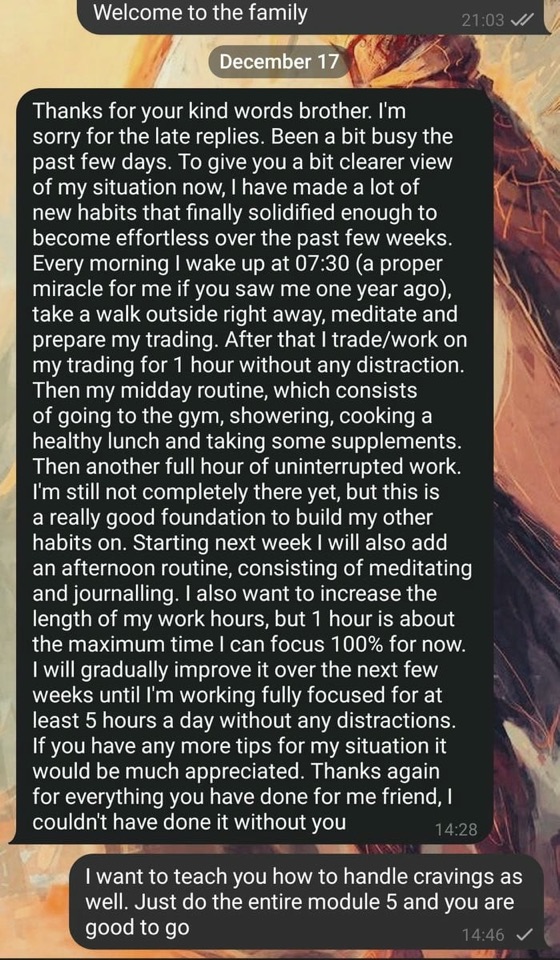
- One written update (screenshot, one long message)
This client trades, and when they came to us they were gaming late into most nights. The mornings paid for it. A year earlier, waking at 07:30 would have been, in their own words, "a proper miracle". In a long message to their specialist, they set out a day that runs like a timetable: up at 07:30, a walk outside, a sitting practice, an hour of trading with no distractions, the gym, a cooked lunch, then another full hour of work. They called these new habits "effortless". They were also honest that one hour was as long as they could fully focus for now, and that they planned to build toward five.
Here's how that day was built: how the specialist and the client took the nights back, put the hours together one at a time, and what came next.
A year earlier, the night ran on and the morning never started
When you work for yourself, nobody tells you when to stop at night or when to start in the morning. For this client, the games had taken over both. The trading day would end, they'd sit down for a match to wind down, and the next time they looked at the clock it was the middle of the night. Then came a late wake-up, at a different time every day. The morning blurred into the afternoon. Trading happened in short bursts, while they were still tired from the night before. An hour of real focus was out of reach.
The computer they traded on was also the computer they played on, so the game was a click away from the charts all day, right there the moment a trade closed. A late night meant a late start, and a late start meant a day that never properly got going. By the evening the day already felt lost, so another night went the same way.
They had tried to stop more than once. After a bad week they'd uninstall everything, then reinstall it on a quiet evening a few days later. They'd set a rule about a last match at a sensible hour, but the rule had to be kept with the next match already loading. Each time the plan was one match, and each time it turned into the night.
The cost showed up in their work first. Trading needs a clear head and patience, and a short night gives you neither. It also showed up in how they felt about themselves. Look at the phrase "if you saw me one year ago". It's what someone says when they know the person they used to be was in a bad way.
What we found: no structure, so the games set the hours
The first call was about what kept the gaming going, and with this client the answer was the lack of structure. The games didn't need a special trigger. They needed an empty evening and a computer that was already switched on, and the client had both every day.
The call also showed what the games were doing for them. In trading you can do everything right and still lose. A game tells you within minutes whether you won, so after a losing day it was somewhere they could still win something.
That made the plan fairly clear. The day needed fixed points first, starting with its two ends: the time they went to bed and the time they got up. With both fixed and the first hours of the day decided, the games would lose the late nights they depended on, and focus would come back as sleep settled. Then the games would stop, and after that the client would learn to handle the cravings.
The specialist was also clear about pace. This client was ambitious, and ambitious people often try to change everything in the first week, then drop it all when one day goes wrong. So the day would be built one block at a time, and each block had to hold before the next was added.
Phase 1, Days 1 to 30: building the day one block at a time
The nights and the mornings. The client's nightly log, which the specialist read, began on Day 1. The first entries showed what the first call had suggested. There was no fixed bedtime, because bed came whenever the last match ended, and there was no fixed wake time either.
So the first block was sleep and waking: the same two times every day, with daylight early, dim light late, and the phone left outside the bedroom. The bedtime was the harder half, because it meant ending the evening's gaming far earlier than usual. The alarm was hard too, and the client said so in the log more than once. The specialist kept both times fixed and kept them going.
The morning walk came next. The specialist put it straight after waking, outside, so daylight and moving came before any screen, the trading screen included. A few minutes of sitting still to train attention followed. By the time they sat down at the desk, they'd already done three things that day, and none of them had happened on a screen.
The first focus hour. Then came the block that mattered most for their work: one hour of trading with nothing else open. For this client, nothing else meant no game running in the background and no launcher waiting in the corner of the screen. One hour was deliberately small. What mattered was that the hour was completely clean, and short enough that the client could do it every day and trust it.
The middle of the day. Training went in next, then eating. Together they became the client's midday block: the gym, a shower, a cooked lunch. After that came a second hour of work, run the same way as the first. By the second week the specialist had helped them join all of it into one timetable that ran through the whole day, so the long empty stretches the games used to fill were gone.
The written work. In the second week the client made a list of every quick, easy reward their day offered. Past the games, it took in phone games, gaming videos between trades and late-night streams. They also wrote out the history of their gaming honestly, from something for the weekend to the thing that decided when they slept.
Day 15. On Day 15 the games stopped on every device, along with the streams and videos, so the habit couldn't move to another screen. A relapse in the next two weeks would be studied later and not counted as failure. The first evenings without a game were the hard part. Mostly the client felt bored and restless, and a little cut off from the friends they used to play with. But the bedtime stopped being a fight, because nothing was running late anymore.
The rest of the month was lighter for this client, because the day was the main work. A hobby and a calming practice went in. The month ended on how cravings work, including why closing a trade could still bring a match to mind weeks after the last one. Day 28 brought the first progress call.
"Effortless"
The update came after that stretch of building, and the client had been quiet for a few days before it. "I'm sorry for the late replies. Been a bit busy the past few days." Then they set out where things stood, in more detail than most clients ever write:
"To give you a bit clearer view of my situation now, I have made a lot of new habits that finally solidified enough to become effortless over the past few weeks."
"Every morning I wake up at 07:30 (a proper miracle for me if you saw me one year ago), take a walk outside right away, meditate and prepare my trading. After that I trade/work on my trading for 1 hour without any distraction."
"Then my midday routine, which consists of going to the gym, showering, cooking a healthy lunch and taking some supplements. Then another full hour of uninterrupted work."
The word to notice is "effortless". In the first weeks, every block took effort. The bedtime took effort, the alarm took effort, and the clean hour took a lot of effort. So did the evenings with no game in them. Over a few weeks of doing them every day they stopped needing a decision, and that's when habits start to hold.
The client didn't oversell any of it: "I'm still not completely there yet, but this is a really good foundation to build my other habits on."
They also had a plan for the next block: "Starting next week I will also add an afternoon routine, consisting of meditating and journalling." They were honest about where they stood on focus: "I also want to increase the length of my work hours, but 1 hour is about the maximum time I can focus 100% for now. I will gradually improve it over the next few weeks until I'm working fully focused for at least 5 hours a day without any distractions."
Most people in this position want five hours straight away. This client knew one hour was the true number and planned to build up from it.
They finished by asking for more tips. The specialist's answer was that the next thing to learn was how to handle cravings, and that it was all in the next part of the program.
Phase 2, Days 31 to 60: the cravings work
That message is the last thing on record in the client's own words. Everything below came after it.
With the day built, the work turned to the cravings. This is the part of the program that today starts on Day 31.
The trigger list. Once the client's triggers were on paper, most of them came from working alone at a screen that used to have games on it. There were the minutes after a trade closed, good or bad, and a losing day, when a game felt like the one place left to win. There was the late afternoon once the work blocks were done, and evenings with nothing planned. Friends coming online were on the list, and so was news of an update or a new season, and being tired.
The reset. On Day 32, everything to do with gaming that could be removed was removed. The games, launchers and saved logins came off the trading computer. The headset and controller went to a friend. The client left the group chats where late sessions got organized and stopped the store's emails. The desk was set up for trading and nothing else.
The responses. Over the next few weeks the client built a planned response for each trigger that couldn't be removed. The minutes after a trade got a routine of their own, away from the desk. A losing day got a plan for the evening after it, made in advance. The late afternoon got the new afternoon block. Friends asking them to join got an answer decided before anyone asked. The thoughts that give permission were written down and taken apart in writing on a calm day: that they'd earned a match after a good session, that they needed one after a bad one, and that it would only be one. A breathing practice for the desk came in too.
The night of the launch. Their hardest test came from a release they'd been waiting on since before the program. It went live late on a weeknight, and the friends they used to play with were all planning to be on for it. Every instinct said one night wouldn't matter. But the whole day the client had built rested on one thing, the 07:30 wake-up, and a night like that would knock out all of it: the walk, the clean hour, the midday block. And every night that had gone wrong before had started as just one. They brought it to their weekly call and decided with their specialist to let the launch go and keep the sleep. They told their friends ahead of time they wouldn't be on, and went to bed at the usual time. The next day everyone was talking about it. They felt left out, and said so in their log without dressing it up. But the morning held, and so did the focus hours. Looking back, they counted it as the week the routine stopped being something they followed and became something they protected.
The phase ended with Days 53 to 60 of practice and the second progress call.
Phase 3, Days 61 to 90: from one focused hour toward five
The last phase looks at how you see yourself. The person this client thought they were was a night person who gamed until late, couldn't get going and couldn't stay focused. Their own words, "if you saw me one year ago", show how much of that was still in their head.
Phase 3 began with a look back at earlier attempts and why none of them had held. The answer was the same each time. They'd uninstalled the games in days with no structure, on a computer still set up for work and play, and the first empty evening brought them back. Then they worked on letting those attempts go.
Their goal for this phase came from their own update: to work fully focused for five hours a day. It fits what drives them, because it's about doing their work well. The wish to keep getting better, which had kept them in games, now went into the work hours. They went about it the same way they'd built the mornings, adding time a block at a time and only once the last block held. They went through, ahead of time, the moment most likely to knock them off course now: the evening after a run of losing days, when a game would feel like the one place left to win. They kept a note of the changes as they saw them. On Day 90 they read their Day 1 write-up again, and wrote down how the building would carry on after the program.
The day as it ran when they wrote
The message is the clearest picture on record. When they wrote it, the client was up at 07:30 every day, getting two clean hours of work in, training and eating well, adding an afternoon block, and working steadily toward five hours of focus, with the cravings work still ahead. They signed off: "Thanks again for everything you have done for me friend, I couldn't have done it without you"
Why the new day held
- The nights were fixed before the games stopped. The gaming lived in late nights and empty hours, so the first job was a bedtime and a wake time.
- Every block was small enough to do every day. The target was one clean hour. Because it was small, it became "effortless", and something effortless can be built on.
- The trading computer went back to being for trading. For years the game had been a click from the charts. Once the games came off that machine, closing a trade no longer led straight to a match.
- The client told the truth about their limits. "1 hour is about the maximum time I can focus 100% for now" is an honest number, and an honest number is something you can plan around.
- The cravings work came after the foundation. The specialist held it back until the day could support it.
Trading by day, gaming by night
If you work alone at a screen and play on the same machine, you probably know this pattern. The work ends, one match turns into the night, and the next morning starts late and foggy. You don't need a big trigger. An empty evening is enough, and when nobody sets your hours, you get a lot of empty evenings. This case shows that the change started with a bedtime and a wake-up time, two weeks before the games stopped.
It also shows that you don't have to fix everything in a week. This client started with the two ends of the day. A few weeks later they had a day that ran itself, and an honest plan for the next step.