Case file 33
A pencil drawing of mountains, from someone who'd been gaming since childhood
Name withheld
- Came in with
- Video games, which had run through "the majority" of their life
- How long
- Since childhood: "the majority of my life", in the client's words
- Earlier attempts
- Uninstalling and reinstalling; getting rid of a console and getting another; moving to games on the phone
- Program
- 90-Day Behavior Control System, with a specialist
- Where it stood at last contact
- Drawing regularly and improving fast; "Everyday I'm growing more and more, its speeding up as well"
- On record
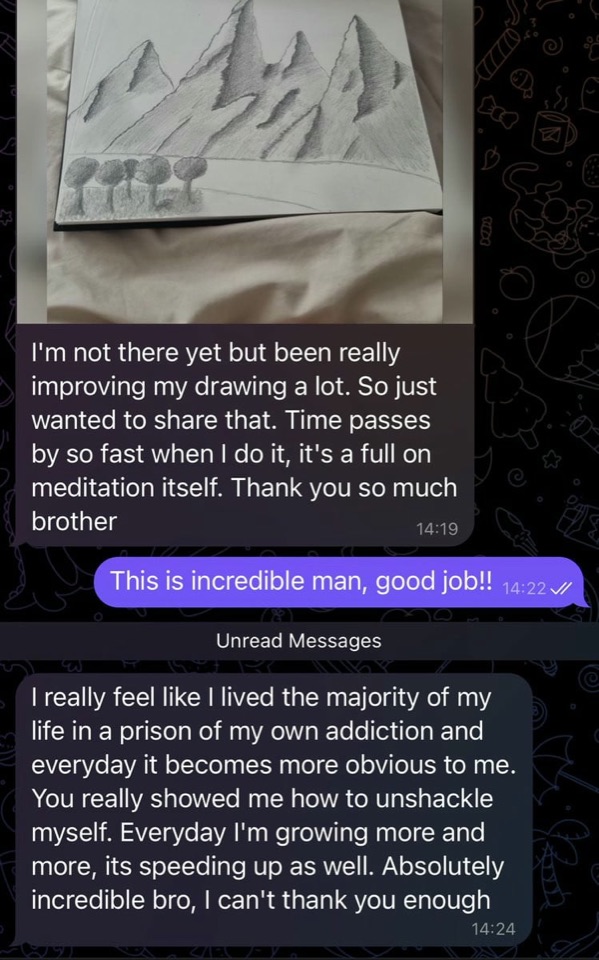
- One written update (screenshot: a photo of a pencil drawing and two messages)
What this client sent us was a photo and two messages. The photo is a pencil drawing: a range of mountains, shaded with care, and a row of small trees along the bottom. The first message says they've been "really improving my drawing a lot" and that time flies when they do it. The second says something much bigger. "I really feel like I lived the majority of my life in a prison of my own addiction and everyday it becomes more obvious to me."
The addiction was video games, and it had been there since they were a child. Between those two messages sits most of what this case is about: what a habit that old had been doing for them, what we went after in each phase, and why a drawing ended up being part of the answer.
Games for as long as they could remember
When you've played games since you were a kid, gaming becomes part of how your life is put together. It's where your evenings go, where you go after a bad day, what fills a quiet hour, and how you get through the moments that feel like too much. For this client it had been that way through school and through every hard stretch since. You can't remember what those moments were like without a game, because for most of your life you've never had them without one.
That's what the client means by a prison, and it explains why the walls were hard to see. When you've lived inside something that long, it just seems like the way things are. You don't notice what it's keeping out, like hobbies, plans, sleep, people in the same room and a clear head, because you never had them alongside it. The client's own words make the point: it "becomes more obvious" every day, which means that before, it wasn't obvious at all.
A habit this old comes with a long list of attempts to stop, and theirs followed a familiar pattern. After a lost weekend they'd uninstall everything, then reinstall it a few weeks later on a quiet night. They got rid of a console and, before long, had another one. When they stopped the big games, the same evenings went into games on their phone, or into hours of watching other people play. Each attempt that didn't hold felt like more evidence that this was just who they were.
What we found: the game was their one way out of their own head
On the first call, the specialist looked for what gaming was doing for the client, because a habit that lasts that long is always doing something. With this client, the answer was switching off. A game was the one reliable way they had to step out of their own head and let hours pass without thinking. It had been doing that job since childhood, so they'd never had to learn another way to do it. It also gave them something they knew they were good at.
That mattered for the plan. If the games were stopped and nothing took over that job, the need would still be there every evening with nothing to meet it, and the old answer would be waiting. So the plan had to do two things. It had to stop the gaming, in the program's order, with the body and the day steadied first. And it had to give the client another way to lose themselves in something, one that cost nothing and left them better off.
Phase 1, Days 1 to 30: the base, and then something to do with their hands
The first two weeks. The client's nightly log started on Day 1. In the first week their specialist asked them to write about their evenings in more detail than usual, because that's when the gaming and the switching off happened.
The base came first: set hours for sleep, the phone and screens out of the bedroom, walks, training and better food, joined up into a day with fixed points from morning to night. One piece was harder for this client than the rest. The program has people sit quietly for a short while each day to train attention, and for someone who'd always used a game to get out of their own head, sitting quietly inside it was uncomfortable at first.
In the second week the client wrote down the whole history of their gaming, and every smaller reward that had grown up around it: games on the phone, streams, gaming videos before bed. It started with games after school, so the history was long: holidays and weekends that disappeared into it, then the evenings of recent years. Writing it out was the first time they'd seen the whole of it in one place.
Day 15. On Day 15 the games stopped on every device, along with the streams and videos the habit tends to move to. On the weekly call before it, the specialist set it up as a test: any relapse before the end of the month would be studied in Phase 2, not counted as failure. The first evenings without a game were long, perhaps the first like that since childhood. The need to switch off was still there, boredom came with it, and for now nothing was meeting either.
The drawing. That changed shortly after. In the program, the days after Day 15 bring in a new hobby with goals that keep getting harder, and the client chose drawing. In this program a hobby has a specific job. It gives you a reward you earn by getting better at something, in place of the habit's reward, which came for nothing. The goals keep getting harder so that it stays new enough to hold your interest. For a lifelong gamer, it also gave them somewhere new to be good at something.
The client started simply. The first drawings weren't much, and they knew it. But they kept going, a little each day, and the specialist asked to see them now and then, so there was always a next drawing to make.
A calming practice came in after Day 15 as well. Toward the end of the month they learned how cravings work, including why the corner of the room where the setup used to be could still make them want to play: the brain keeps the setting of every past session. On Day 28 came their first progress call.
Phase 2, Days 31 to 60: the old evenings, one by one
With the games stopped, the work in Phase 2 was making sure the moments that used to lead to them couldn't catch the client off guard.
Their trigger list on Day 31 was long after so many years, and most of it was about the need to switch off: the end of a hard day, being alone in the evening, feeling overwhelmed, and restless hours with nothing planned. Some were about the games themselves: friends coming online, an invitation to play, clips that turned up on their phone. Some were things and places, like the chair, the headset and that corner of the room.
On Day 32 they cleared out what they could. The console was sold, and the games, launchers and accounts came off the computer and the phone. They left the servers where sessions got organized, muted the group chats they wanted to keep and unsubscribed from the gaming channels they'd watched for years. The corner where the setup had stood was rearranged. Then they planned around what was left.
Then came the responses. The triggers still standing after the reset each got a planned answer. An invitation to play got an answer the client had decided on before it came. The evenings, where the old switching off used to happen, got the most work. The drawing became part of that plan, though the specialist made sure it wasn't the only part. If one thing has to handle every bad evening, it fails on the first night it isn't enough. So the evening plan had a second and a third step behind the drawing, including ways to settle the body and sit out a craving. The client also took apart, in writing, the main thought that gave permission, one with years of practice behind it: that a single game would help them unwind.
The night the drawing didn't work. That first night came some weeks into the phase. A hard day ended with the client alone, wound up and badly wanting to switch off. Then a friend they used to play with messaged to say the old group was on that night and a player short. They sat down to draw, as planned, and it went wrong. The lines wouldn't come, and a bad drawing on a night like that made them feel worse. Before the program, that would have settled the evening. The one thing they had for it would have failed, the invitation was sitting on their phone, and the old answer would have come back. This time the drawing was only the first step. They put the pencil down and moved on to the next step of the plan, and by the time they'd worked through it the worst of the craving had passed. They wrote it all up that night, and their specialist's reply was short. The plan had done what it was built to do, because when one part failed, the next part was there. The client answered their friend the next day, and a few days later they were back at the drawing.
The photo and the two messages quoted below came in partway through this phase, so everything in Phase 3 came after them. The phase itself ended the usual way, with a practice week and the second progress call.
Phase 3, Days 61 to 90: seeing the prison from the outside
Phase 3 deals with self-image, and when a habit has lasted most of a life, the old view goes deep. In the client's own eyes, they'd been a gamer since they were a kid, and an addict who couldn't stop. Their habits, their failures and their idea of who they were had all been built around it.
First they looked back at every earlier attempt and asked why it hadn't held. For this client one reason stood out. Each time, they'd taken the game away and left the need underneath with nothing to meet it, or moved the same evenings to a different screen. They'd been carrying those attempts around as proof they couldn't do it, and the next step was to put them down.
Their new view of themselves came from what they were doing now, and the drawing was the clearest evidence of it. It's hard to keep believing you're only a gamer who can't stop when there's a stack of drawings on the table, each one better than the one before. The wish to get better at something, which games had fed for years, now had a drawing to go into. The client picked a goal that fitted what drives them, took the first step, and kept writing down evidence of change. On the last days they read back what they'd written about themselves before Day 1, and wrote a plan for the time after.
By the time Phase 3 started, the client had already begun to see their old life clearly. Their message says so. Once you've spent some time outside something, you can see its walls, and this phase built on what they'd started to see.
The drawing and the message
The client sent the photo of the mountains during the second month, with this: "I'm not there yet but been really improving my drawing a lot. So just wanted to share that. Time passes by so fast when I do it, it's a full on meditation itself. Thank you so much brother"
"Time passes by so fast" is worth noticing. For most of their life, hours vanishing without effort was what a game did for them. Now drawing does it, and at the end of those hours there's something on the table that they made.
Then the second message: "I really feel like I lived the majority of my life in a prison of my own addiction and everyday it becomes more obvious to me. You really showed me how to unshackle myself. Everyday I'm growing more and more, its speeding up as well."
Why this attempt didn't leave a gap
- We found what gaming was doing for them. It was the one reliable way to switch off, and had been since childhood. Knowing that meant the plan had to find another way to do that job, as well as stopping the games.
- The replacement was earned. Drawing gives the same lost-in-it feeling, and it rewards getting better. The client could see their progress, one drawing to the next.
- The games couldn't move to another screen. Earlier attempts had left the phone, the streams or a new console. This time all of it stopped on the same day, and on Day 32 the routes back were removed.
- The drawing wasn't left to carry everything. It was one part of a planned response for the evenings, alongside the rest of Phase 2, so one bad night couldn't knock it all over.
- The new picture of themselves had evidence. Every finished drawing was proof they were someone other than the person the addiction said they were.
For anyone who's been gaming since they were a kid
If you've played games for most of your life, you may not be able to picture yourself without them, and that can make stopping feel like losing part of yourself. This case shows that the game is often doing a job for you. For this client the job was switching off, and the job can be done another way.
It also shows that the clearest view of the habit sometimes comes after you've stopped. The client said it gets "more obvious" every day. You can't see the walls well while you're still inside them.