Case file 32
The thought that the next bet would put things right
Name withheld
- Came in with
- Online gambling (sports betting), and a run of relapses that each started with the same kind of thought
- Earlier attempts
- At least one earlier relapse ("since last time")
- Program
- 90-Day Behavior Control System, with a specialist
- Where it stood at last contact
- No relapse "since last time"; naming the thought out loud when it comes, and "its working"; going through the program with a week away at their cousins' coming up
- On record
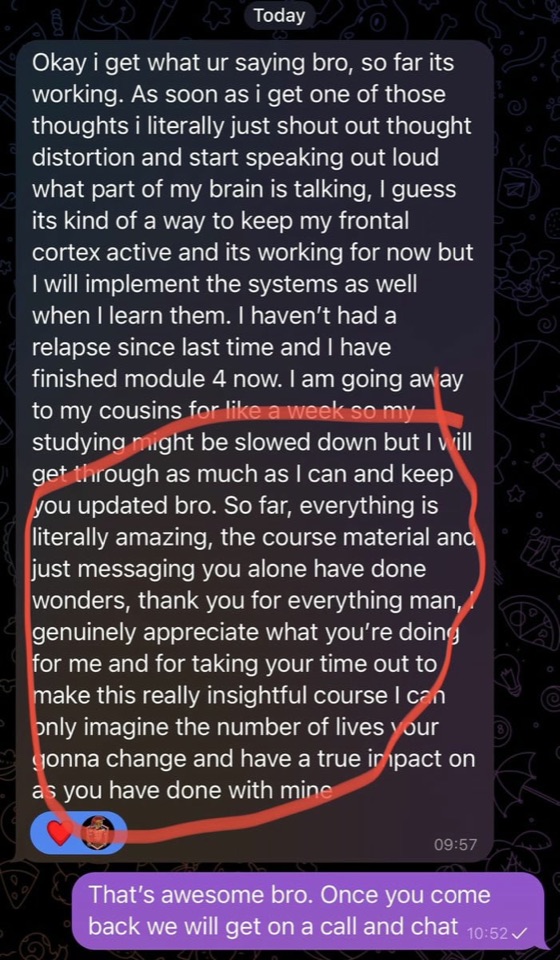
- One written update (screenshot, one message)
Every time this client went back to betting, a thought had come first. It was nearly always the same thought in a different form: the next bet would put things right. By the time they sent the update quoted here, they'd found a way to catch it. "As soon as i get one of those thoughts i literally just shout out thought distortion," they wrote, and they hadn't had a relapse since the last one. They'd also finished the part of the program on how those thoughts work, and they were about to spend a week away at their cousins'.
This file follows how they got there: the betting and the relapses, what the first call found, the work on the thoughts, and the week away from home that came next.
Every relapse began with a thought that sounded like good sense
Most people describe a relapse as a moment of weakness. Ask them to slow it down, though, and the moment usually turns out to be the end of something that started earlier. With this client, it started with a thought.
All their betting was on their phone. There was always a match on somewhere, and the app was a few taps away in the evening, in bed and at half-time. A loss rarely ended a night, because by then the thought had arrived: one more bet and they'd be back to even. It sounded like their own voice, and it sounded sensible. On other nights it took a different form. They knew this league. It had been a while, so one bet wouldn't matter. They'd stop properly tomorrow, once they'd won some of it back.
The client would argue back in their head, and the thought would come back with a better reason. It knew every excuse they'd ever used, so it usually won. Afterwards came the guilt, and the money they'd just lost became the reason for the next round. That's why trying harder hadn't worked. It meant winning that argument every time, against a thought that always had a fresh loss to point at, and nobody wins it every time.
What we found: the thought was making the decision
The first call turned up something the client hadn't noticed. By the time their thumb opened the app, the decision had usually been made a few minutes earlier, by a thought they hadn't recognized as a trigger. And the thought mostly came at night, when they were alone, after a loss or a bad day, with nothing planned.
That set the plan. Phase 1 would make their days and nights steadier, because a tired, restless person gets more thoughts like that and believes them more easily. In the second part of the program the accounts and apps would go, and the work would go straight at the thought, ending with a planned response for every trigger that was left. The specialist also said plainly that a relapse could still happen along the way, and that if one did, it would be studied rather than hidden.
Phase 1, Days 1 to 30: fewer openings for the thought
The first two weeks. From Day 1 their specialist had a nightly log to read, and it soon showed a pattern. The bad evenings followed the bad days, and the bad days followed short nights, a lot of them spent on late matches with the app open.
So the nights came first. Bedtime and waking got fixed, and the phone left the bedroom, which also meant no more bets placed from bed. Walks, training and changes to their eating followed, and the day got enough fixed points that there were no long empty stretches for the thought to fill. The piece that mattered most for this client was the smallest: a few minutes a day of sitting still and training attention. Everything later depended on noticing the thought early, and this was where that started.
In the second week came two pieces of writing: a list of every quick, easy reward in their life, and the history of their betting. Writing the history made one thing obvious. Nearly every time they'd gone back to betting, they could remember the thought that came first more clearly than the bet itself.
Day 15. Betting stopped on Day 15, in every form. Beforehand, the specialist repeated what they'd said on the first call: a relapse in the weeks ahead would be information for later, not the end of anything.
The first weeks without betting were restless, and match days were the longest. A hobby with goals that kept getting harder gave their competitive side somewhere to go, and a calming practice gave them something to do on bad evenings. Near the end of the month they put every problem in their life on paper, the money included, with the real figures. It turned a vague dread into something they could plan for, and later those figures became evidence against the thought. The lessons on how cravings and memory work, and the first progress call on Day 28, closed the month.
Going through the relapse together
In the weeks after Day 15, the client relapsed. Their message calls it "last time". It came on an evening that had already gone badly. They were on their own, a match was on, and the app was still on their phone, because the accounts weren't due to close until Day 32. The thought arrived in its most familiar form, one good bet would start to win back what they'd lost, and they placed the bet.
They told their specialist, and the two of them went through it the way the program asks: what had happened that day, where they were, and the thought that came just before. They also went through the hours after the bet, because with gambling that's where one bet turns into days of chasing it. This time it hadn't. For the first time after a relapse, the client had a clear record of how it happened, rather than a vague sense of having failed again. And the specialist could see exactly where to aim next.
Phase 2: catching the thought before it decides
Phase 2 opened with the client's full trigger map on Day 31. Most of theirs were feelings and times: evenings alone, tiredness, boredom, low moods, payday, the big matches and the half-time lull. A loss of any kind was on it, because a loss was what brought the thought out. So were the free-bet emails and the odds that kept turning up in their feeds.
On Day 32 everything that could go, went. The betting accounts were closed, not just the apps deleted. Self-exclusion went on, the bank card stopped accepting gambling payments, every device got blocked, and the offers were cut off. The thought could still arrive. But now there was a real gap between the thought and the bet.
The part of the program the client's message calls "module 4" is about the thoughts that lead to a relapse. In the program as it runs today, that work sits in the middle of Phase 2. It covers the thoughts that give permission, like one won't hurt or I'll start Monday, the low, negative thoughts that set off a craving, and a written exercise that takes apart the main thought behind a person's relapses.
For this client, it described exactly what they'd been losing to for years. Once they learned that those thoughts follow a pattern, the thought about winning it back stopped sounding like a plan. It sounded like the betting trying to get its way.
The client then did something of their own. In their words:
"As soon as i get one of those thoughts i literally just shout out thought distortion and start speaking out loud what part of my brain is talking, I guess its kind of a way to keep my frontal cortex active and its working for now but I will implement the systems as well when I learn them."
The specialist had told them this would work as a start, but that it was one tool and the full set of responses was still to come. Their message opens with "Okay i get what ur saying bro, so far its working." They knew it was working for now, and that the next step was the planned set of responses, built trigger by trigger, later in Phase 2.
Then came the result: "I haven't had a relapse since last time and I have finished module 4 now."
A week at their cousins'
The same message brought up the next test. "I am going away to my cousins for like a week so my studying might be slowed down but I will get through as much as I can and keep you updated bro."
A week away is a real risk for anyone in the program. The routine that's been holding things up is built around home: the same bed, the same walks, the same times. Away from it, the days get looser and there's more empty time. And a week with family usually means sport on the TV most evenings. The client was already thinking about it, and they called the program their "studying", which tells you how seriously they took it.
Before they went, the specialist kept the plan simple. The blocks would travel with them, because they lived on the phone and the bank card. So would the core of the routine: fixed sleep, a walk and the sitting practice. They decided in advance what they'd do when a match came on, so the decision wasn't left to half-time. The log would still be written each night, the lessons could slow down, and they'd message if anything felt shaky. The specialist's reply set the next step: once the client was back, they'd get on a call.
Phase 2 continued: a response for every trigger left
The message is where the client's own words stop. What follows came after it.
Back home, the client built a planned response for every trigger the reset couldn't remove: the evenings alone, match days, payday, and the moment after any kind of loss, when the urge to win something back used to show up. They also settled what they'd do in the hours after a bet, if one ever happened again, so one bet could never turn into a week of chasing it.
The main thought behind their relapses was taken apart in a written exercise on a calm day, with their own figures from the first month as the evidence. They learned what to do with their body when a craving peaked. They kept naming the thought out loud, but now it was one part of a full set of responses. A week of using all of it, with every urge written down, and then the second progress call finished the phase.
Phase 3, Days 61 to 90: someone who doesn't believe every thought
Phase 3 turned to how the client saw themselves. After a run of relapses, they'd come to believe two things: that they always gave in in the end, and that their problems were always one good win away from being fixed. The month opened by going back over their past attempts one by one. Each time, they'd been arguing with a thought they didn't recognize as a trigger, and losing. Then they worked on letting those attempts go, so they stopped being proof of what they couldn't do.
The new picture was built from what they were doing now: catching the thought, naming it and getting on with the evening. The part of them that loved reading a game and taking a risk didn't have to disappear. It needed a goal that added up over time instead of draining away, and they picked one and took the first step. The moment they went through in advance was the one that had caught them last time: an evening alone that had already gone badly, a match on, and the familiar thought arriving on top of it. The final days compared the person they were now with their Day 1 write-up, and ended with a plan for after.
No relapse since last time
The message they sent midway through Phase 2 sums up where things stood at that point. On the tool: "so far its working." On the betting: "I haven't had a relapse since last time and I have finished module 4 now." On the program: "So far, everything is literally amazing, the course material and just messaging you alone have done wonders, thank you for everything man, I genuinely appreciate what you're doing for me."
Why the thought stopped winning
- We found the real starting point. Every relapse started with the thought that the next bet would put things right, so the plan went after the thought, not just the betting.
- The relapse was gone through in detail. Looking closely at "last time" showed exactly where to aim next.
- There was time between the thought and the bet. With the accounts closed and the payments blocked, the thought could no longer turn into a bet in seconds, and that gave everything else time to work.
- The client built on what they learned, and treated it as a start. Naming the thought out loud was their own move. They and their specialist both knew it was working "for now", and the full set of responses followed.
- Someone was on the other end of the messages. In the client's own words, the course material "and just messaging you alone have done wonders".
For anyone who keeps betting to win it back
If your relapses always start with a thought that sounds sensible, that the next bet will put things right or that once won't matter, this case is worth reading closely. The thought feels like your own decision. It's usually the first step of the betting.
This client didn't stop by arguing harder. They got better at noticing the thought for what it was, they put real distance between the thought and the app, and then they built a plan for every trigger that was left.