Case file 36
No longer looking for the one right program
Name withheld
- Came in with
- Online gambling, on casino apps and betting sites, with frequent bad days and a tendency to act on impulse
- Earlier attempts
- Not described in detail; before the program they kept "looking for the only right solution, the only right program"
- Program
- 90-Day Behavior Control System, with a specialist
- Where it stood at last contact
- Fewer bad days, "much calmer", no longer acting on impulse; meditation, chess and learning guitar; "enjoying life more"
- On record
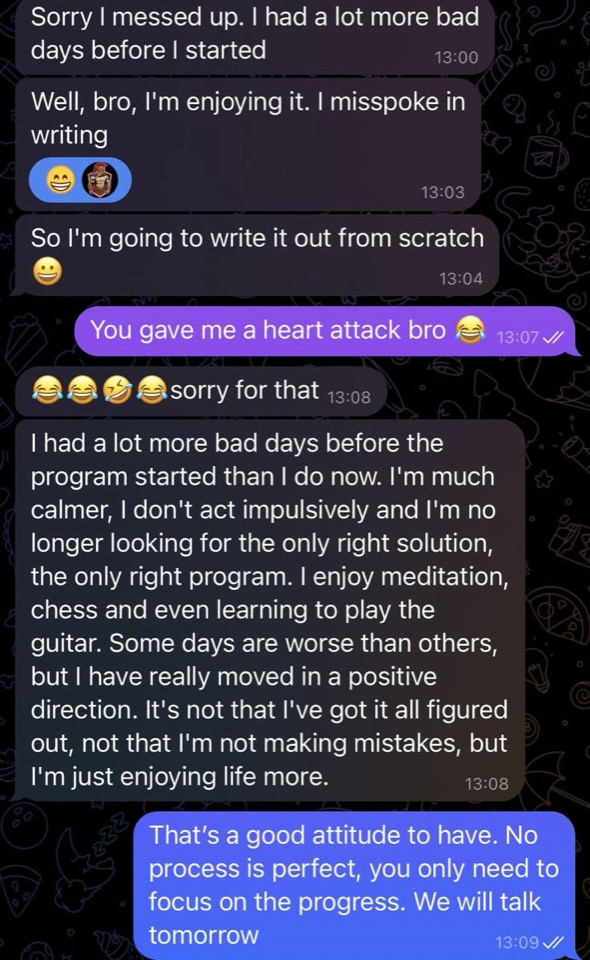
- One written update (screenshot, five messages)
Before this client joined, they were searching. Each time a way of stopping gambling didn't work, they went looking for the next method, the next program, the one that would finally be right. They had a lot of bad days, and on a bad day the casino app was usually where they ended up. In a written update partway through the program, they wrote that they had far fewer bad days than before, that they were "much calmer", that they didn't act on impulse, and that they'd stopped looking for "the only right solution, the only right program". They were filling their time with meditation, chess and the guitar, and while they didn't claim to have it all figured out, they said they were enjoying life more.
The sections below cover what the first call found underneath the gambling and the searching, what each phase went after, and why the message almost came out wrong the first time.
Before: a deposit in under a minute, and a new method each time the last one failed
The gambling lived on the client's phone. There were casino apps with slots and live tables, and betting sites for when a game was on. On a bad day the client was restless and on edge, and the feeling could turn into a deposit in less than a minute. One spin led to the next, and a loss led to a bigger bet to win it back. Afterwards came the regret.
The impulses didn't stop at gambling. Some went into things they'd regret in other parts of life: a decision made too fast, something said or bought in the moment. But the casino app was where acting on impulse cost the most, because it took no time and the money went straight out. Every bad day made a session more likely, and every session, with the losses and the guilt after it, made more bad days.
They'd tried to stop more than once, and each time they'd throw themselves into a method that sounded right: deleting every app, a deposit limit, a new program. For a while it would feel like the one. Then a bad day would come along, or a bonus offer would land, and when the method didn't hold they decided the method had been the problem and went looking for the next one.
The searching felt good in its own way. Starting something new gives you a rush of hope and a clean slate. But it meant nothing was ever given long enough to work, and every failed method added to a quiet belief that maybe nothing would.
What we found: gambling was one part of a wider pattern
The first call found that the gambling was one sign of something wider. The client acted on impulse in every part of their life, and the casino app was where that did the most damage, because nothing stood between the feeling and the bet.
That shaped the plan in three ways. First, the program would steady the client's days before asking them to stop anything, because an impulsive person on a bad day has almost no gap between feeling something and acting on it, and steadier days would widen that gap. Second, casino apps and betting would stop together, because closing one and leaving the other open would just move the habit across. Third, the specialist was clear about the searching. This program is a fixed sequence, and part of what this client needed was to stay with one sequence, in order, through the bad days, and see what happened when nothing got swapped out halfway through.
The client agreed. It was harder than it sounds, because switching to something new was exactly what they'd always done.
Phase 1, Days 1 to 30: steadier days and three new things to do
The first two weeks. The most useful thing early on was the nightly log, which their specialist read. It made the bad days easy to see, along with what had come before each one: usually a short night, a tense day or long empty hours with the phone in hand. Those empty hours were where most of the late sessions on the casino app had started.
So the base came first. Sleep, mornings, walks, training and food were set up the way the program sets them up for everyone, and the day got enough fixed points to leave fewer restless, empty stretches. The phone left the bedroom at night, which also took away the late sessions in bed. The piece that mattered most for this client was the daily sitting practice for attention. For a person whose problem was acting before thinking, a few minutes a day of noticing before doing was the same skill they needed, practiced on a small scale. Over time it became something they enjoyed.
In the second week the client put the easy rewards in their life on paper and traced the history of their gambling. The search showed up clearly in it, one method after another, each dropped after a bad day.
Day 15. On Day 15 the gambling stopped, all of it, from the casino apps to the occasional bet on a game. On the weekly call before it, the specialist made a specific point to this client: there would be bad days, and a bad day wouldn't mean the program was wrong. It would mean there was something to look at in the log.
The first weeks without gambling brought some of those bad days. The evenings felt long without the app, and the restlessness it used to soak up had nowhere to go. At least once the client felt the old urge to go looking for something different. They told their specialist, and the two of them looked at what the log said about that day. Nothing was swapped out.
Guitar and chess. In the second half of the month came a new hobby with goals that get harder, and more work on attention. The client picked up the guitar and chess. Both reward patience and both ask you to slow down and think before you move, while on a casino app the next spin is always one tap away. For someone who'd always moved too fast, that was the point.
The month ended with how cravings build and fade, and their first progress call fell on Day 28.
Phase 2, Days 31 to 60: widening the gap between feeling and acting
The triggers. The client's Day 31 list was mostly feelings: restlessness, frustration, a sudden low mood, the urge to do something, anything, right now. Then came the things that turned those feelings into a bet. There were bonus offers and free spins in their inbox, payday, empty evenings alone with the phone, a game on the TV, and the thought of money already lost.
The reset. On Day 32 we took away every route to a bet that could be taken away. The client closed their casino and betting accounts, which isn't the same as deleting the apps. They excluded themselves from the sites they'd used, set up a block with their bank so card payments to gambling sites would be refused, and put blocking software on every device. The offer emails went too. None of it was meant to be unbreakable. It put time between the impulse and the deposit, and for this client, time was exactly what had always been missing.
Looking back at impulsive decisions. Early in the phase the program sets aside a day to look back at impulsive decisions across a whole life, not just the gambling. For this client it was an uncomfortable day and an important one. They could see the same pattern in places that had nothing to do with casino apps, and they could see where the search for the next program fit into it.
The responses. The rest of the phase went into planning what they'd do about each trigger the reset had left. Paydays, empty evenings and the thought of winning it back each got a response decided in advance. Alongside that came ways to calm the body and wait out a craving, and a written piece that took apart the main thought behind their relapses. For a client who acted fast, it meant the response was already there when the feeling came.
The message they didn't send. Their hardest moment in this phase had nothing to do with gambling at first. On a frustrating day, someone said something that made them angry, and they had a reply typed out within a minute. It was sharp and it would have done damage. Before the program it would have gone straight out, and the evening would probably have ended on the casino app. This time there was a small gap, and in it they noticed what was happening. They didn't send it. The urge to gamble came an hour later, as it always used to after a day like that. With the accounts closed there was nothing quick to reach for, and it passed. On their weekly call the specialist spent most of the time on the message rather than the craving, because it was the first time the gap they'd been building had held somewhere other than the gambling. That was exactly the wider pattern the first call had found.
The phase wound up with its practice week and the second call.
The update they rewrote from scratch
The update came near the end of the second month, in two goes. The first message opened with "Sorry I messed up." The client had worded something badly, so it seemed to say the opposite of what they meant. "I had a lot more bad days before I started," they wrote, and then: "Well, bro, I'm enjoying it. I misspoke in writing". Then: "So I'm going to write it out from scratch".
It's a small moment, but it says something about the client. An impulsive person sends a message and moves on. This client stopped, saw it was wrong and took the time to write it again properly.
The rewritten version is the core of the record:
"I had a lot more bad days before the program started than I do now. I'm much calmer, I don't act impulsively and I'm no longer looking for the only right solution, the only right program. I enjoy meditation, chess and even learning to play the guitar. Some days are worse than others, but I have really moved in a positive direction. It's not that I've got it all figured out, not that I'm not making mistakes, but I'm just enjoying life more."
The specialist's reply was that no process is perfect, and the thing to watch is progress. They spoke the next day. Everything in Phase 3 came after this update.
Phase 3, Days 61 to 90: someone who stays the course
In the last phase, the work turns to how the client saw themselves. This client's verdict on themselves was that they couldn't stick with anything, and the trail of half-finished methods seemed to prove it. Under that sat another: someone who couldn't sit with a bad feeling without acting on it, usually on the app.
Phase 3 began with a post-mortem on past attempts. The answer was in the client's own message: they'd kept looking for the one right program, and so none of them had been given the time to work. Then they worked on letting those attempts go, so they became a record of what the search had cost, not proof that the client was someone who always gives up.
They built a new picture of themselves out of what they were doing now: sitting every day, practicing chess and guitar, getting through bad days without a deposit, and staying with one plan through all of it. They picked a goal that fitted what drives them and took the first step. The moment they chose to walk through in advance was the one most likely to undo everything: a bad week some months from now, when a shiny new method turns up promising to be the right one at last. They wrote down evidence of change as it happened. The last step put their current view of themselves next to the Day 1 write-up, and then came a plan for the months that followed.
Fewer bad days, in their words
The rewritten update, sent at the end of Phase 2, is quoted in full above. The lines that matter most: "I'm much calmer, I don't act impulsively". "Some days are worse than others, but I have really moved in a positive direction." "I'm just enjoying life more."
Why staying with one plan worked
- We treated gambling as part of a wider pattern. The client acted on impulse everywhere, and the casino app was where it did the most damage. Working on the impulse helped with the gambling.
- The fast route to a bet was closed. For someone who acted in seconds, closed accounts and blocked payments put time back between the feeling and the deposit.
- They stayed with one sequence. This time nothing was swapped out on a bad day, and the client saw what a plan does when you give it time.
- Bad days were expected and looked at. When bad days came, the client looked at the log with their specialist instead of looking for a new method.
- The new hobbies asked them to slow down. Chess, guitar and the daily sitting practice all reward patience, and the client came to enjoy all three.
For anyone who gambles on impulse and keeps switching methods
If your gambling happens in a rush on a bad day, and you've dropped one way of stopping after another when it didn't work fast enough, this case is worth reading. The searching can feel like effort, but it can also be part of the same pattern: the quick move toward something new and exciting that the casino app runs on.
This client didn't find a perfect program. They closed the fast routes to a bet, stopped looking for something better, stayed with one plan in order, and had fewer bad days because of it.