90 days without alcohol and drugs, and the oath that helped
A client came to us with alcohol and drugs, and at the 90-day mark they said it was impossible without our support, what they learned and the oath and vows.
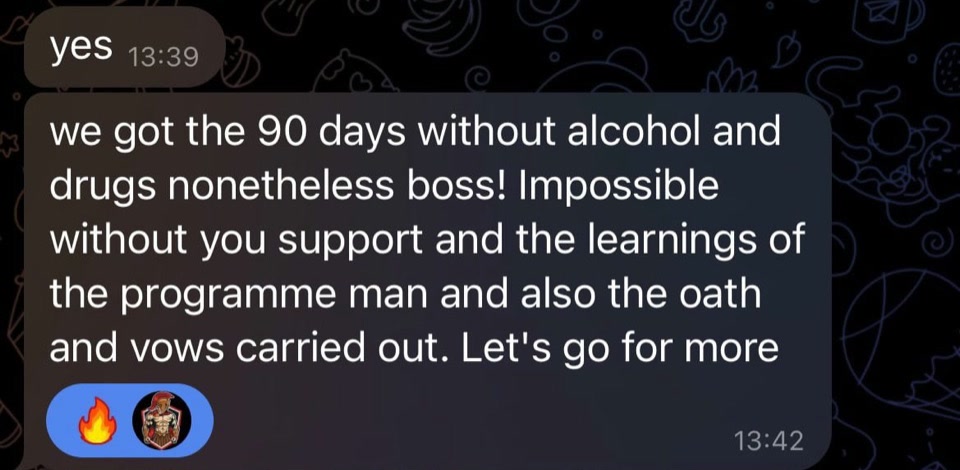
A client came to us with alcohol and drugs. At the 90-day mark, they sent us this message: "we got the 90 days without alcohol and drugs nonetheless boss!"
This is how we did it.
In the same message, this client said those 90 days were impossible without three things: our support, what they learned in the program, "and also the oath and vows carried out."
The support and the learning are the parts you'd expect. The last one, the oath and vows, is the one most people would skip past.
It sounds like a nice ceremony. But it's doing real work, and it's the thing most people trying to stop on their own never have.
Think about the promises you've made to yourself.
It's usually the morning after. You feel terrible and ashamed, and you swear that's the last time. In that moment, you mean it completely.
But that promise only lives in your head, and nobody else heard it. By Friday evening, when you're tired and the craving shows up, the promise is a faint memory from a bad morning, and the craving is right in front of you.
So the craving wins. You made the promise when you needed it least, and it's nowhere around when you need it most.
That's the gap the oath closes.
Before phase 1 even starts, every client writes an oath. It's personal. It says what they want to build and what they're leaving behind from their old self, and it's written to be as emotional as they can make it. Then they send it to us, save it on their phone and print a few copies.
At the start they also take four vows: to stay committed to the change, to be honest with themselves, to hold back from excess, and to take pride in who they're becoming.
Then, in phase 2, those printed copies go to work. We put them in the exact places where the relapses used to happen, like next to the couch, on the bedside table or on the kitchen counter.
That changes what the place does. The couch used to remind your brain of the drink. Now, every time you sit down, the first thing you see is your own words about why you're stopping. A place that used to start a relapse now reminds you of your reason.
Phase 3 builds on the same thing. The oath describes who you want to be, and phase 3 is where we work on becoming that person, so you don't need the oath to hold you back anymore.
There's one more word in that message we want to point out: "nonetheless". To us that says the 90 days weren't smooth, and something got in the way. The message doesn't say what it was, and we're not going to guess. But the 90 days held anyway.
And then the client wrote "Let's go for more". Ninety days wasn't the finish line. It was where the next part started.
If you've made the same promise to yourself a hundred times, you probably meant it every time. What was missing was a promise you'd written down, shared with someone and put right where the habit happens.
And if you drink heavily every day, talk to a doctor before you stop. Stopping suddenly can be dangerous.
The Behavior Control System
Our 90-day program, private and one-on-one, built around your life.
See our programsField Notes
One letter a week from the lab.