Most people will say something they know is wrong just to fit in
You can hold out for days on your own and give in ten minutes into a dinner with friends, and a classic conformity experiment shows why.
You walk into a party having decided you're not drinking tonight, and you meant it the whole drive over.
Then someone hands you a glass, everyone around you is raising theirs, and saying no suddenly feels like the hardest thing in the room.
We see this over and over again. A man can hold out for days on his own and then give in within ten minutes of sitting down at a dinner with friends.
Most people put that down to weakness, but the research points somewhere else.
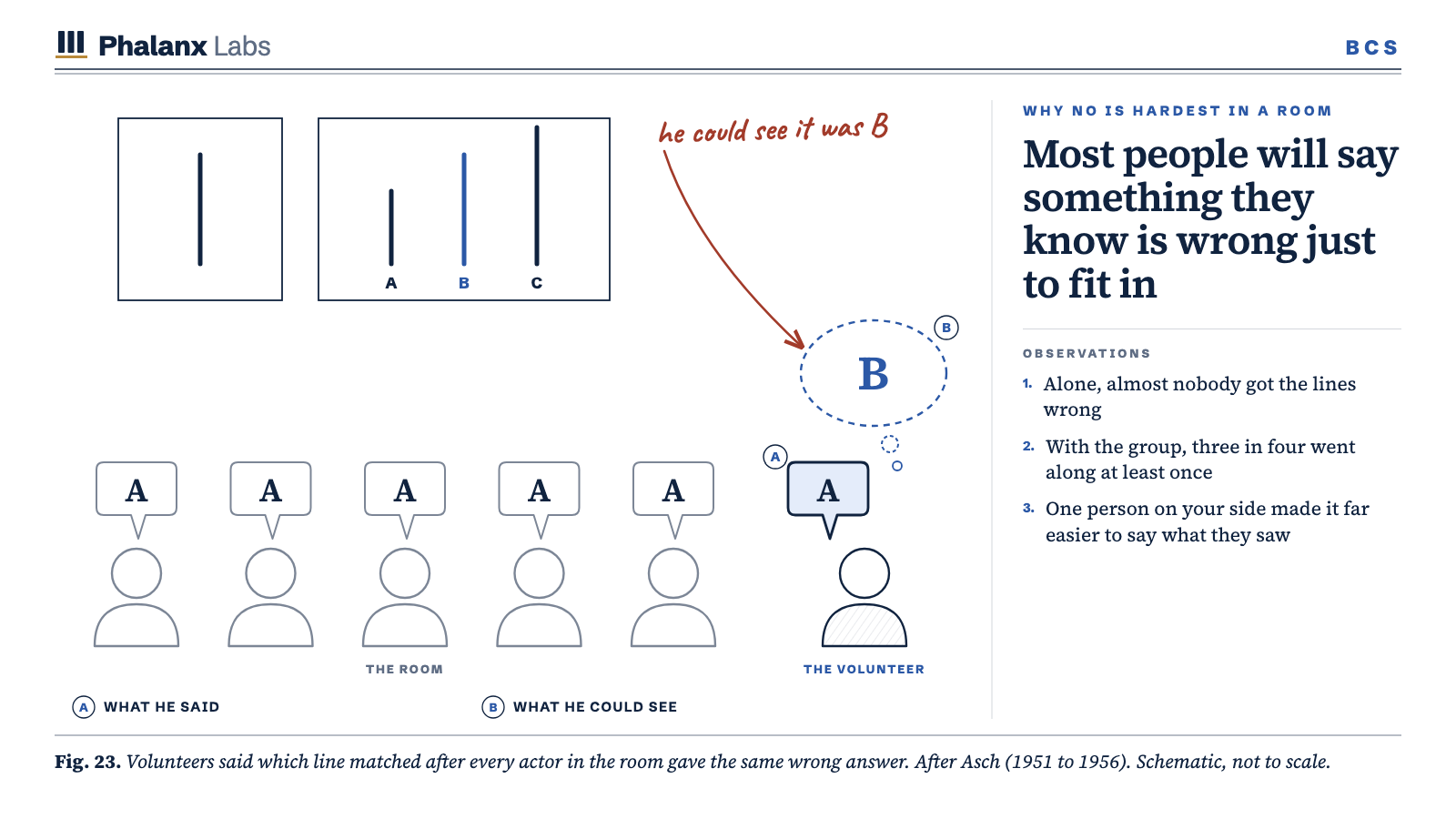
In the 1950s, the psychologist Solomon Asch found that when everyone in a room gave the same wrong answer to a simple question, about three out of four people went along with them at least once. They did it even though they could see the answer was wrong. When just one other person in the room gave the right answer, people went along with the group far less often.
So the pressure to fit in is strong enough to make people say something they know is false, and having one person on your side takes a lot of that pressure away.
Now apply that to the party. If a room can get people to give a wrong answer that costs them nothing, think about what it does to you when you're the only one at the table not drinking. People ask why, someone usually makes a joke about it, and you're holding your decision on your own while the craving builds.
Now we say drinking, but it works the same way with whatever you're trying to stop, whether that's the smoke break with people from work or the friend who always has weed.
So when you give in at a party, it doesn't prove you're weak. You were up against the whole room as well as the craving, and you were doing it alone.
So what do we do about it in our program?
Social situations are some of the strongest triggers there are, and handling them is a big part of phase 2. We don't ask you to just be stronger once you're in the room. We work on putting you in the best possible position before you get there.
That can mean calling the host before a gathering and telling them you're not drinking, so your decision has been said out loud and someone in the room is on your side. It means going in prepared, with a tool in your pocket you can use to interrupt a craving if one hits. And it means being honest about the people who encourage the habit, and cutting back the time you spend with them.
In other words, you get yourself that one person on your side before you walk through the door.
We also look back at the times it went wrong. Most of the time, saying no wasn't impossible. The situation gave you an excuse, and the explanation for why it was fine came afterwards.
None of this makes the pressure go away, and you'll still feel it. But it's a lot easier to keep a decision when you're not the only person in the room who knows about it.
This is how you stop losing your progress to other people's evenings.
Sources
- S. E. Asch (1956). Studies of independence and conformity: I. A minority of one against a unanimous majority. Psychological Monographs: General and Applied.
The Behavior Control System
Our 90-day program, private and one-on-one, built around your life.
See our programsField Notes
One letter a week from the lab.