How to deal with people who drag you back into the habit
Giving in around certain people is not a weakness of will: it's what happens when you walk into the hardest situation of your week and try to work out what to say and how to leave while it's happening.
The method: The People Plan
Contents10 sections
- Who is this for?
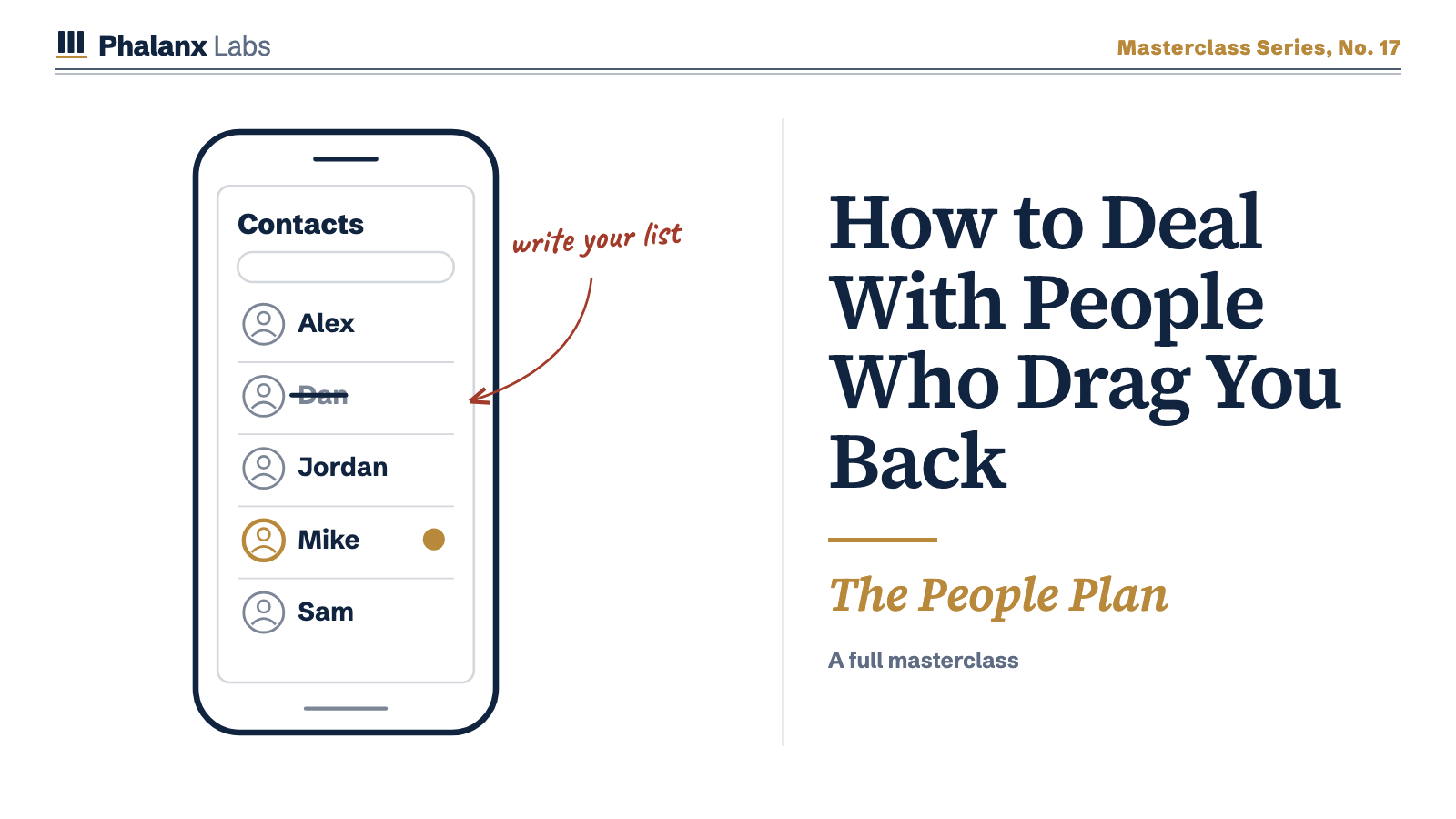
- Step 1: Write your people list
- Step 2: Write the one sentence you'll say
- Step 3: Cut off the red people's access to you
- Step 4: Tell the green and yellow people what you need
- Step 5: Have an exit plan for every risky event
- Step 6: Don't go to the red people after a fight
- Step 7: Fill the gap with new people
- Why does this work?
- Sources
(Works for porn, alcohol, weed, nicotine, scrolling, gambling, any habit. It's what we set up with every client, so the habit can't come back through the people around them.)
Who is this for?
- You do fine all week, then one night out with the old crowd puts you back at day one
- There's a friend, a brother or a coworker who always has it, offers it or laughs it off
- You've said "I'm cutting back" and someone answered "come on, just one"
- Deep down, you think a stronger man could sit with them and not give in
If this is you, read on.
Giving in around certain people is not a weakness of will.
It's what happens when you walk into the hardest situation of your week and try to work out what to say and how to leave while it's happening.
Think about how it actually goes..
You've had a good week. Then a friend texts, "Drinks Friday?" You tell yourself you'll go and just have a soda. You get there, he's already ordered you a beer, and everyone at the table has one. Somebody says "you're no fun anymore." You don't want to make a thing of it, so you drink it.
Sometimes it's quieter than that. Your brother vapes on the back porch at every family dinner, or an old friend sends you a link at midnight. Nobody pushes you. They just do it in front of you, and that's enough.
Here's what most people never realize.
When researchers looked at what was going on right before people relapsed, two situations came up more than any other. One was a bad mood. The other was being around people who were doing it, or who were pushing them to.
That pressure comes in two forms. The direct kind is someone trying to talk you into it. The indirect kind is a friend ordering a drink at dinner, or the stuff lying out on the table when you're at his place. Nobody has to say a word.
And it goes deeper than that..
Researchers have found that having even one person in your circle who still drinks raises your chance of relapse. But it works the other way too. Getting strong support from even one person makes a better result more likely. So one person can make this harder or easier, depending on which side they're on.
The support that helps most is specific. General kindness helps less than someone who backs you on this one thing, like a partner who wants you to stop and helps you do it.
So this isn't about becoming a hermit, or about trying harder at the table.
It's about having a plan for the people in your life, written down BEFORE the invite comes.
This post is not about theory though. Here's exactly how to set it up.
Let's begin.
Step 1: Write your people list
Take 15 minutes and write down everyone you see in a normal two weeks: friends, family, coworkers, group chats, the guys at the gym and the people you game with online.
Next to each name, write one of three colors:
- Green: they back you. They don't do the habit around you, or they'd stop if you asked.
- Yellow: they're fine, but the habit tends to happen when you're with them. The friend you only ever see at bars, or the coworker you smoke with on breaks.
- Red: they do the habit with you, supply it, or push you to do it. The guy you buy from, the friend who sends you links, the one who orders for you.
Be honest. Some of your favorite people will be yellow or red. That doesn't mean you have to cut them off. It means you need a plan for them.
Step 2: Write the one sentence you'll say
A lot of people give in at the table because they try to explain themselves. They give a reason, the other person argues with the reason, and they lose the argument.
So don't give a reason. Pick one short sentence and say it every time.
- Alcohol: "I'm not drinking."
- Weed or nicotine: "I'm good, I don't smoke anymore."
- Gambling: "I'm out of betting."
- Porn or scrolling: don't reply to the link, or say "Not my thing anymore."
If they push, you say the same sentence again, and again if you have to, without adding anything. Therapists call this the broken record. You repeat one clear sentence as many times as you need to, so you never get pulled into a debate you can lose.
Now practice it out loud. Say it to the mirror ten times. It sounds silly, but the first time you say it shouldn't be at a table with everyone watching.
Step 3: Cut off the red people's access to you
For the people who supply the habit or push it on you, make it hard for them to reach you.
- Delete the number of anyone you buy from, and block it so a text can't come through.
- Leave the group chats where the habit gets planned.
- Mute or unfollow the accounts that send you back to it.
- Turn down the invites that always end the same way. Say no, not "maybe".
Some red people you can't cut out, like a brother, a business partner or an old friend you love. For them, change WHERE and WHEN you see them: breakfast instead of the bar, the gym instead of his couch, the daytime instead of 11pm. You still see the person, just not in the setting where the habit happens.
Step 4: Tell the green and yellow people what you need
Most people around you want to help. They just don't know how.
So tell them plainly: "I've stopped drinking. It matters to me. When we hang out, don't offer, and don't take it personally if I leave early."
Then ask them for one or two specific things. Don't have it out when I'm over. Ask me how it's going. Let me pick the place.
You'll be surprised how many people say "Of course." And you'll learn a lot from the ones who don't.
Step 5: Have an exit plan for every risky event
Some events you can't skip, like the wedding, the work dinner or the bachelor party.
Before each one, decide four things:
- How you get there. Drive yourself, so you can leave when you want.
- When you leave. Pick the time before you arrive.
- Your excuse. "Early start tomorrow." Rehearse it.
- Who you'll text if it gets hard.
There's a story about a man in counseling who carried a small card with his reasons for stopping written on it. One Saturday, after a fight with his wife, he went to see one of his drinking buddies and had a few beers. When he went to the restroom, he remembered the card and read it. Then he went back, gave his friend one of the excuses he'd practiced, and left.
He still had a few beers that day. But because he had a way out ready, a few beers didn't turn into a lost month.
Step 6: Don't go to the red people after a fight
Look at what started that man's relapse. It wasn't the friend, it was the argument with his wife.
Arguments are a well-known relapse trigger, and right after one is often when you call the one person you know will say yes.
So set the rule now, while you're calm. After an argument, you don't see a red person for 24 hours. You call a green one instead, or you go for a walk.
Step 7: Fill the gap with new people
If you stop seeing the people you did the habit with, you'll have fewer people to see and fewer people to text. That gap is where a lot of people slide back.
So go looking for new people on purpose. Try one new thing a week for the next two months: a gym class, a run club, a martial arts class, a hobby group or a sober meetup.
Don't decide in advance what you'll like. Try a lot of different groups and keep going to the ones you enjoy.
Why does this work?
Because when you walk into a room without a plan, you're asking a tired brain to make a hard decision in front of an audience.
Every step here makes that decision before you walk in. You already know what you'll say and when you'll leave. The people who push the habit can't reach you as easily, and the people who care about you know how to help.
So you're no longer relying on willpower at the exact moment it's weakest.
Now, be honest with yourself..
You can't control other people. Some of them will push harder when you stop, because your change makes them look at their own habit. Some friendships won't survive this, and that's a real loss. And a plan for the people in your life won't fix the cravings that hit when you're alone.
And if you drink heavily every day, talk to a doctor before you stop. Stopping suddenly can be dangerous.
Write your people list tonight. It takes 15 minutes.
Try it out, it works.
This is part of phase 3 of our program. We go through every person and every social situation that pulls a client back, and we write the plan for each one before it happens: what to say, when to leave, and who to call.
Sources
- G. Alan Marlatt and Dennis M. Donovan (eds.), Relapse Prevention: Maintenance Strategies in the Treatment of Addictive Behaviors, 2nd edition (Guilford Press, 2005)
- David Capuzzi and Mark D. Stauffer, Foundations of Addictions Counseling, 2nd edition (Pearson, 2014)
- Marsha M. Linehan, DBT Skills Training Manual, 2nd edition (Guilford Press, 2015)
- Laura J. Petracek, The DBT Workbook for Alcohol and Drug Addiction (Jessica Kingsley Publishers, 2023)
The Behavior Control System
Our 90-day program, private and one-on-one, built around your life.
See our programsField Notes
One letter a week from the lab.