Keep the habit you've stopped from coming back through another one
You can go weeks without the habit you're trying to break, and then lose it all in one evening to a different habit you never thought was a problem.
You can go weeks without the habit you're trying to break, and then lose it all in one evening to a different habit you never thought was a problem.
Why does a couple of drinks bring back a craving you thought was gone?
We see this over and over again, and we're sure you've seen it too.
Say you've stopped vaping. You're a few weeks in. The cravings have dropped, your head feels clearer, and you're proud of yourself. Then a friend is in town, you go out, and you have a few drinks.
About halfway through the second one, you want a vape more than you did in the first week. It doesn't even feel like a craving, more like the obvious thing to do. And by the end of the night, you've bought one.
Now we say vaping and drinking, but this works the same way with porn and weed, gambling and scrolling, or any pair of habits that sit next to each other in your life.
So why does this happen?
Most people think of stopping a habit as staying away from one thing. Stay away from the vape and you'll be fine.
But your brain doesn't really keep a separate file for each habit. The habits run through the same reward system. That system learned, over years, that the habit was the fastest way to feel better. When you stop, the pathways that ran the habit start to quiet down, but they don't disappear.
And a different hit can wake them back up.
Here's some real science on this.
Researchers trained rats to press a lever for a drug. Then they stopped giving the drug, so pressing did nothing. After a while, the rats stopped pressing.
Then the researchers gave the rats a small dose for free.
The rats went straight back to pressing the lever, hard, even though the lever still gave them nothing. One small taste had brought the whole habit back. Later work found that other drugs could do the same thing, and so could stress.
Which proves our case. The old habit had never gone away. It had only gone quiet, and one small dose was enough to start it up again.
There's a second thing alcohol does, which makes this worse.
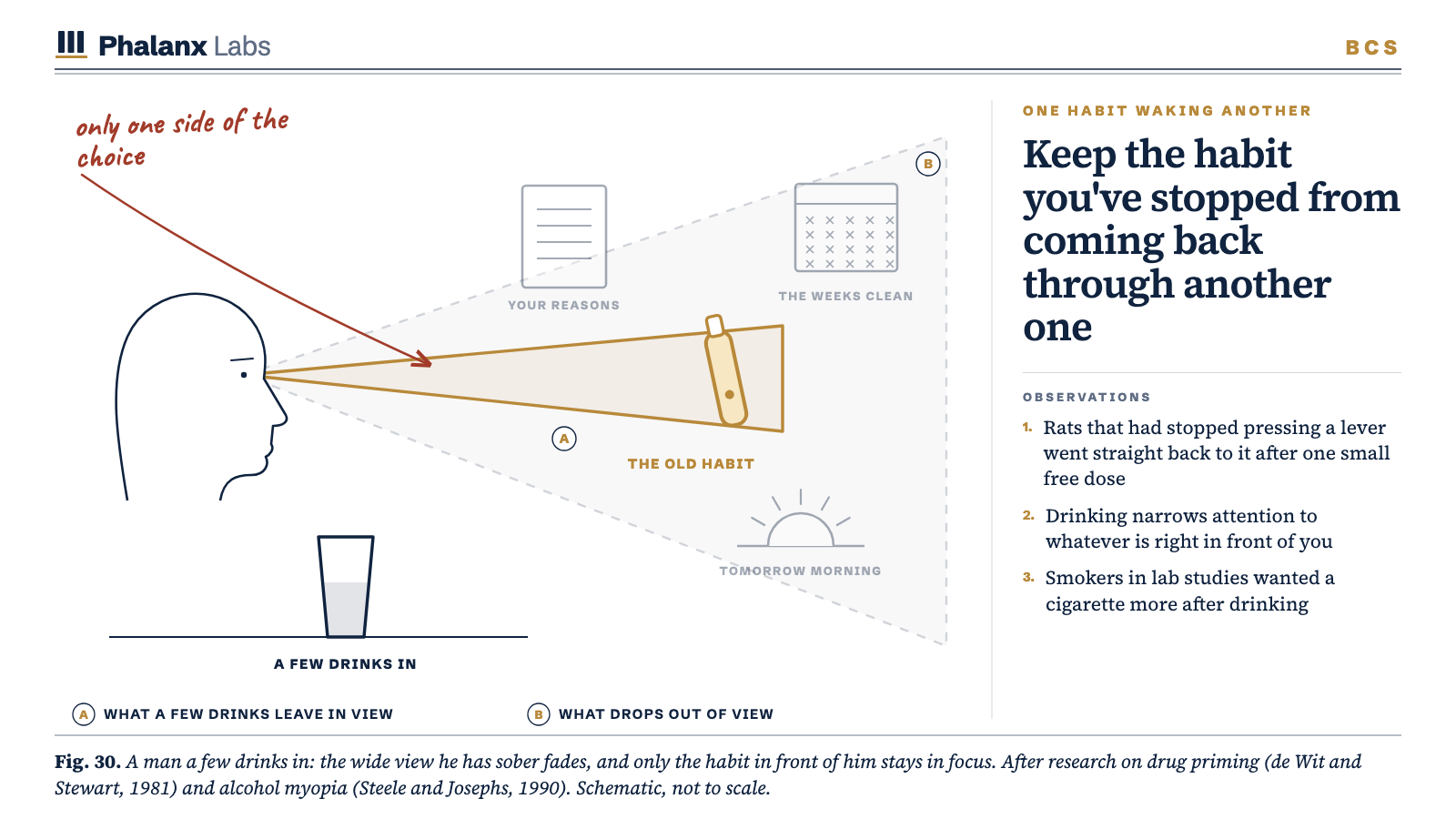
Drinking narrows your attention. Researchers who study this found that alcohol makes you focus on whatever is right in front of you, and lose track of things further away. So when you're a few drinks in, the vape in your friend's hand gets all of your attention. Your reasons for stopping, the weeks you've put in, how you'll feel tomorrow, all fade into the background.
That's why it doesn't feel like you're making a decision. You can't weigh anything up when only one side of the choice is in front of you.
Lab studies have found the same thing in smokers. After drinking, their urge to smoke goes up.
Put those two together. The drink wakes up the old pathway, and it also takes away your view of why you stopped. If you're in the place and the habit is in front of you, the craving WILL come.
This is why in phase 1 of our program, we don't only stop the habit a client came in with.
For at least the first 12 weeks, we cut out every quick, unearned hit, the drinking, the smoking, the porn, the scrolling binges, while the brain settles. It's a hard thing to hear, and most people push back at first. But stopping one habit while you keep feeding another is like trying to put out a fire while someone keeps adding fuel.
We also go through each client's habits together and work out which ones lead into which. Usually there's one that sets off the rest, and that's the one we deal with first.
We'll be honest with you, cutting everything out isn't the whole cure. BUT it stops the old pathways from being woken up every weekend, so the work you do during the week actually holds.
This is how you stop one night out from taking you back to the start.
Sources
- H. de Wit and J. Stewart (1981). Reinstatement of cocaine-reinforced responding in the rat. Psychopharmacology.
- C. M. Steele and R. A. Josephs (1990). Alcohol myopia: its prized and dangerous effects. American Psychologist.
The Behavior Control System
Our 90-day program, private and one-on-one, built around your life.
See our programsField Notes
One letter a week from the lab.