Why a client shouts “thought distortion” out loud
A client kept being talked into relapses by their own thoughts; now they name each one out loud the second it shows up, and they haven't relapsed since.
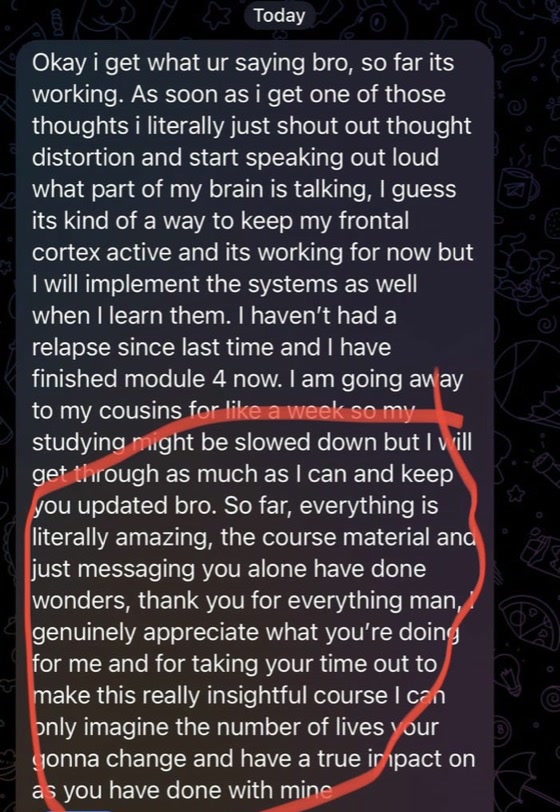
A client of ours was trying to stop relapsing, and the thoughts that led up to it kept coming back. Now, the second one of those thoughts shows up, they shout "thought distortion" out loud, and they haven't had a relapse since the last one.
This is how we did it.
Here's how they put it in a message to us:
"As soon as i get one of those thoughts i literally just shout out thought distortion and start speaking out loud what part of my brain is talking."
It sounds strange, but it's one of the most useful things a person can learn when they're trying to break a habit.
Think about how a relapse usually starts.
It almost never starts with your hand reaching for the habit. It starts with a thought.
It might be "You've had a hard week, you deserve it." Or it might be "Just this once won't matter."
The problem with these thoughts is that they don't sound like the habit talking. They sound like you, in your own voice, and they sound reasonable.
So you argue with them in your head. You tell yourself no, and the thought comes back with a better reason, so you argue again.
The whole argument happens inside your own head, and the thought knows every excuse you've ever used, because you came up with all of them yourself.
Most people lose that argument eventually. Not because they're weak, but because they're arguing with something they think is them.
That's what this client changed.
When you say "thought distortion" out loud, you're doing something very simple. You're putting a label on the thought, and the label tells you that the thought is a trick your brain plays when it wants the habit.
Once it has a name, it stops sounding like you. It becomes something that's happening to you, so you can watch it instead of doing what it says.
Saying it out loud makes it even clearer. It's much harder to drift along with a thought once you've heard yourself call it what it is.
The client had their own theory about why it works: "I guess its kind of a way to keep my frontal cortex active." In other words, it keeps the thinking part of the brain switched on at the moment the habit is trying to switch it off.
Now, this one tool isn't the whole program, and the client knew that too. They wrote that it was working for now, and that they'd use the systems as well once they learned them.
That's the order we work in.
In phase 1, we fix the basics of the client's life, like their sleep, their routine and the empty hours that the habit usually fills.
In phase 2, we go after the triggers and the cravings, and we teach clients how to deal with the thoughts that talk them into it. This is where tools like this one come in.
In phase 3, we work on who the client is becoming, so the habit stops fitting the person they are.
If you've ever been talked into a relapse by your own thoughts, this is for you. The problem was never a lack of willpower. You've been arguing with a voice you thought was yours, and that's an argument almost nobody wins.
The Behavior Control System
Our 90-day program, private and one-on-one, built around your life.
See our programsField Notes
One letter a week from the lab.