Stop letting your worst two weeks decide whether you can quit
The habit doesn't even feel that good anymore and you still can't stop, because your brain turns its own volume down to keep you level.
The habit doesn't even feel that good anymore, and you still can't stop doing it.
If that's you, you've probably asked yourself what's wrong with you. Why would anyone keep going back to something that barely works?
Think about how it was at the start. The first drinks, the first months with the vape, the early days of whatever your habit is. It felt great, and a little was enough.
Now you need more of it to feel much at all. And the hours afterwards are worse than they used to be. You're flatter, more anxious and more irritable, and the only thing that seems to fix it is doing it again.
We see this over and over again with the people we work with. It doesn't mean you're getting weaker. Your brain is doing exactly what it's built to do.
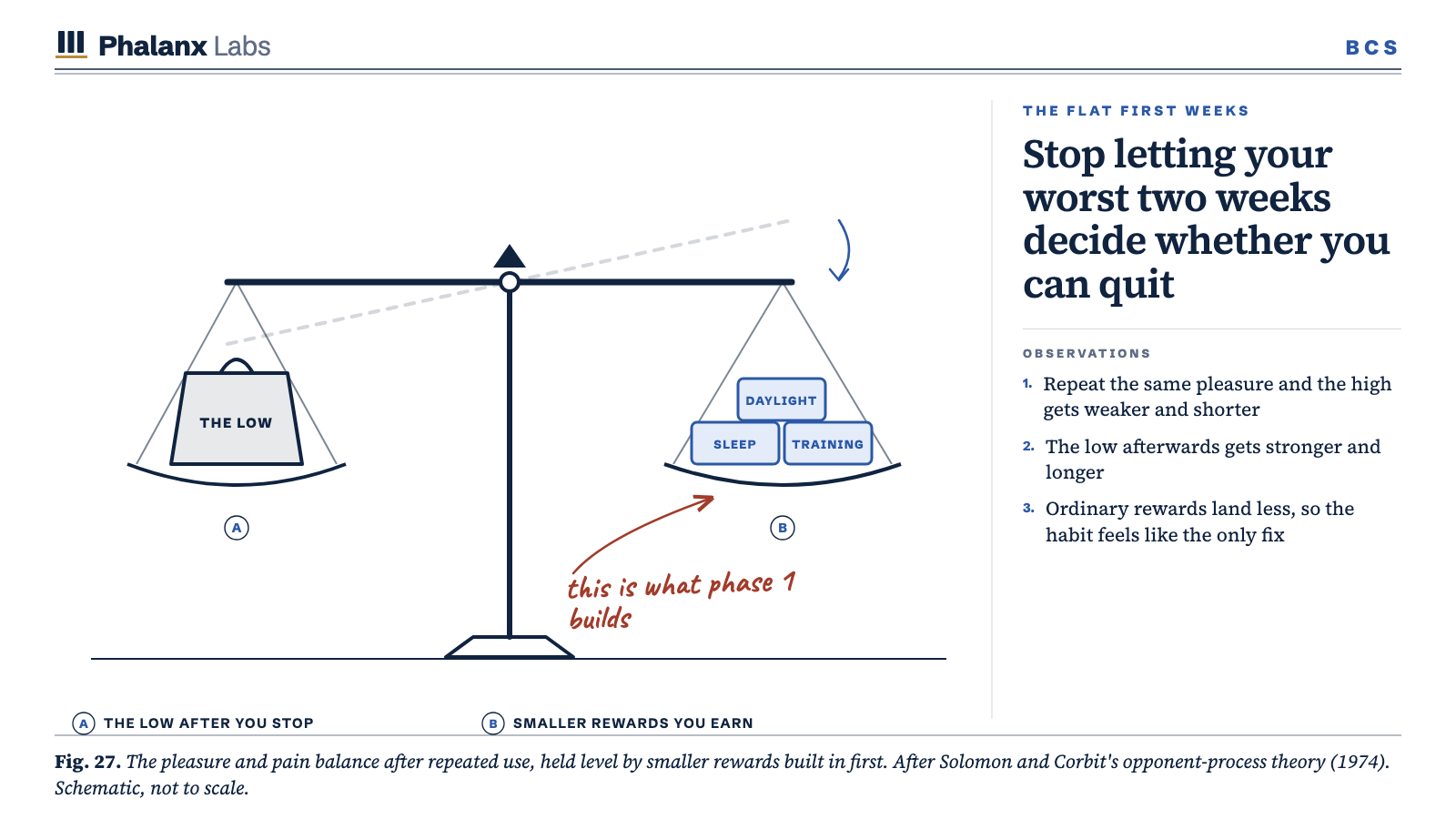
Your brain doesn't like being pushed too far in any one direction. Every time something gives you a big rush of pleasure, it pushes back the other way to bring you level again. And it doesn't stop at level. For a while afterwards, it tips you a little below where you started. That's the low you feel after the high.
Researchers who studied this found that the two sides don't stay equal. When the same pleasure is repeated again and again, the high gets weaker and shorter, and the low afterwards gets stronger and longer.
So the more often you do it, the less you get from it, and the worse you feel without it. That's what tolerance actually is.
It goes further than the habit itself. When scientists scanned the brains of people with addictions two weeks after they'd stopped, the part of the brain tied to reward and motivation showed far less dopamine activity than it did in people without an addiction. The researchers' conclusion was that these brains had become less sensitive to ordinary, natural rewards.
That's the part that keeps people stuck. Food, exercise, time with friends, a good day at work.. none of it lands the way it used to. So the habit starts to feel like the only thing that works, even when it barely works either.
Now think about what that does to an attempt to stop.
You stop on a Monday. But your brain is still tipped toward the low. So the first days off feel awful. Not because stopping is wrong for you, but because you're feeling the low without the thing that used to cover it up.
And since nothing else feels good yet, you go back. The habit takes the edge off a feeling that the habit itself created, and it feels like proof that you need it.
That's why so many people decide they're just not someone who can stop. They judge themselves on the worst two weeks, before their brain has had any time to level out.
This is why a large part of phase 1 of our program happens before clients stop at all.
The first weeks go into building the day back up. We start with sleep, then add daylight, training and a daily routine, and later a hobby they get better at. Each one is a smaller reward, but it's one they earn, and it's still there the next day. So by the time they stop, there's already something good in the day to carry them through the low.
Then they stop completely, and that means every other quick hit that does the same job too, not just the main habit. Swapping one shortcut for another keeps the brain tipped the same way, so clients write down every one of them and we go through that list.
And then we protect the time it takes. Your brain doesn't go back to zero after a relapse. It picks up close to where you left off, so one night in the middle of this costs far more than one night.
None of this makes the first weeks easy, and we tell clients that plainly. They're still the hardest part.
BUT when the day is already full of other things that feel good, the low after stopping is something you can get through, instead of something that sends you straight back.
This is how you get out of the loop where the habit fixes the feeling it caused.
If you drink heavily every day, talk to a doctor before you stop. Stopping suddenly can be dangerous.
Sources
- Anna Lembke, Dopamine Nation: Finding Balance in the Age of Indulgence (Dutton, 2021)
- R. L. Solomon and J. D. Corbit (1974). An opponent-process theory of motivation: I. Temporal dynamics of affect. Psychological Review.
The Behavior Control System
Our 90-day program, private and one-on-one, built around your life.
See our programsField Notes
One letter a week from the lab.