Why You Crave Things You Don't Even Enjoy
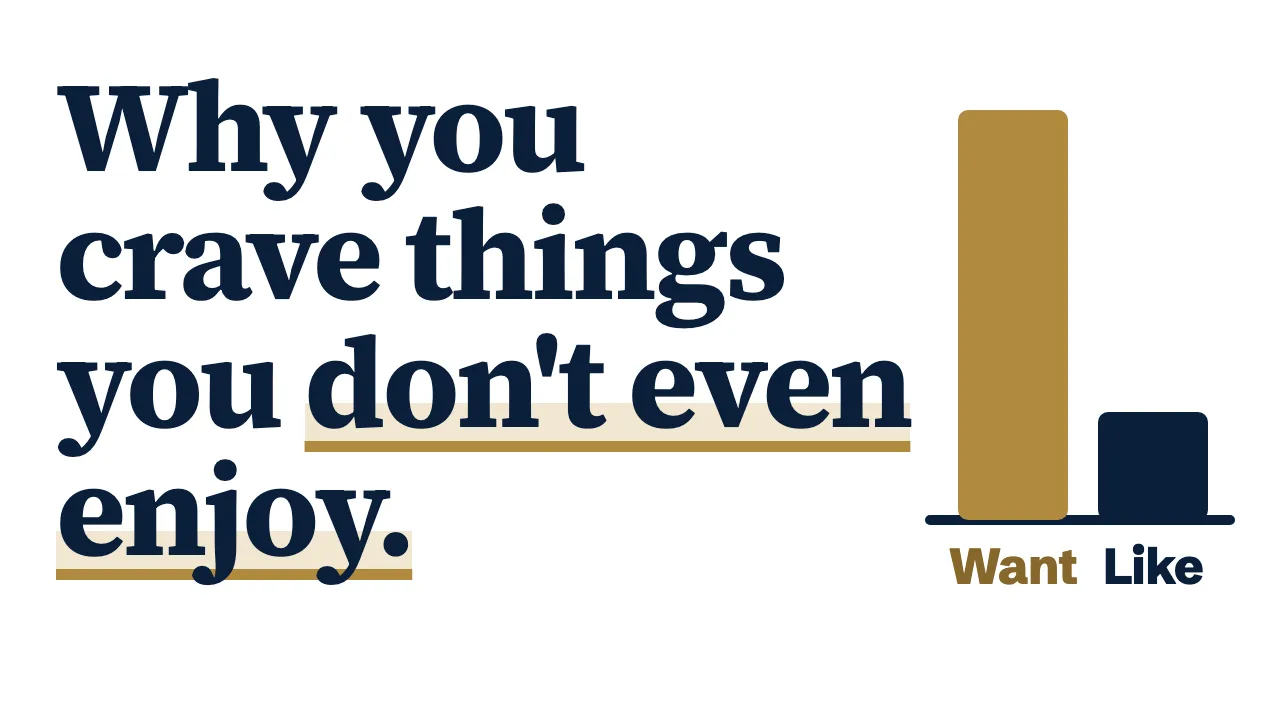
You can crave something badly, get it, and feel almost nothing, whether it's a drink, a cigarette, porn or your phone. This video explains why: wanting and liking run on two separate systems in the brain, and a habit can make the wanting stronger while the liking stays the same or drops.
Transcript
The narration, word for word. The client clips aren't included.
You can want something badly, get it, and then feel almost nothing. Maybe it's a drink you don't really enjoy anymore. Or a cigarette you barely notice. Or an hour of porn or scrolling that leaves you feeling worse than before. And then the next day, the craving comes back just as strong.
And it's easy to read that the wrong way. If you believe a strong craving means you must love the habit, then stopping feels like giving up the one thing in your life that still feels good. So you keep putting it off.
Most people blame cravings on dopamine. You've probably heard it called the pleasure chemical. But that's not quite what the research shows. Your brain handles wanting something and liking it with two separate systems. And a habit can make the wanting grow stronger while the liking stays the same, or even drops.
We've spent seven years helping more than 290 clients in 12 countries with exactly this. Everything in this video comes from published research, and you'll see the sources on screen. We'll go through four things: what wanting and liking actually are, what brain scans show, why the rest of your life starts to feel flat, and how a passing thought turns into a full craving. For each one, we'll also look at what you can do about it.
Let's start with the two systems. Liking is the pleasure you feel when you actually get the reward. Wanting is the drive that pushes you to go and get it. Two researchers, Kent Berridge and Terry Robinson, showed that the brain handles these two things separately. Wanting runs on large, sturdy brain circuits that use dopamine. Liking runs on smaller, more fragile systems, and it doesn't need dopamine to work.
So dopamine isn't really the pleasure chemical. It has more to do with wanting than with enjoying. In the last video, we saw how dopamine learns which places, times and moods come just before a reward. That's how a trigger gets made. And when a trigger shows up, it switches on the wanting.
Berridge and Robinson's theory says that if you take a drug again and again, the wanting can get stronger, especially the kind that kicks in when a trigger shows up. But the liking doesn't get any stronger. So when the trigger appears, the temptation hits you at full strength. Then you get it, and the pleasure is smaller and shorter than the temptation promised. It just doesn't satisfy the way you thought it would. And that gap is what our clients tell us about more than anything else. They want it badly, and then it gives them a lot less than they expected.
You can see this with smoking. In one study, brain scans showed that smoking a cigarette releases dopamine in the brain's reward area. But that dopamine isn't mainly there to make the cigarette feel good. It marks the cigarette as important, something worth having again. That's why so many smokers will tell you they don't really enjoy most of their cigarettes. But they still want every one of them.
This also helps you make sense of all the talk about dopamine detoxes. Dopamine does play a part in how we learn from rewards. But some people take it a lot further. They claim scrolling damages your dopamine system, or that you need a dopamine detox to fix it. When you look at what's actually been measured in people who scroll, it doesn't back that up. What the research does back up is more ordinary. You learn a habit because it rewarded you. After that, triggers set it off, and it gets harder to control when you're stressed or tired.
So here's the first thing you can do. Stop treating the strength of a craving as a sign of how good the habit will feel. A strong craving tells you that your brain has learned this trigger comes before a reward. It doesn't tell you how much you'll enjoy what comes next. So when a craving shows up, take it as a clue about what just set it off. You don't have to follow it.
That's the theory. And you can actually see wanting and liking split apart in real people. Some of the clearest examples come from studies on porn.
In one study in Cambridge, researchers compared how men's brains respond to porn. They scanned 19 men with compulsive sexual behavior and 19 men without it, while they all watched short explicit videos. The men who struggled said they wanted the videos more. But when they were asked how much they liked them, their answers were about the same as the other men's. The men who struggled also had stronger responses in three brain areas that researchers already knew about from studies on drugs. And the more those three areas worked together, the more desire the men reported. But that wasn't linked to how much they liked what they saw.
In the last video, we looked at a similar study. Men who were seeking treatment reacted more strongly to a signal telling them a picture was coming. But they didn't react more strongly to the picture itself. So it's the same pattern as the Cambridge study. They wanted it more, but they didn't like it any more.
In another study, researchers showed men a hundred porn images. They looked at how aroused the men got, and how strongly they craved more. Those two things predicted how many signs of problem use the men showed. But how much sex they were having in real life didn't predict it, and neither did how good it was. So if your porn use feels out of control, that doesn't simply mean something's missing in your sex life. It looks more like your brain has learned to respond to the screen itself.
These studies have limits. They were small, they mostly looked at men, and they only looked at people at one point in time. They show that people who struggle respond differently. But they don't prove the habit caused that difference. Still, they fit with what we've been talking about. People who struggle want it more, but they don't enjoy it any more.
And often, the wanting gets going before you've even noticed it. In studies of people who use weed regularly, anything to do with weed grabbed their attention. And it grabbed it much more strongly than you'd expect from how much they said they were craving it. So a lot of the time, when they noticed the urge, their attention was already on the weed. Men who struggle with porn showed something similar. Explicit images grabbed their attention faster.
That's why you have to respond early. If you wait until you notice a full craving, your attention is already on the habit. So decide ahead of time what you'll do the moment you notice the trigger. Don't wait until you're already craving it.
The hard part is that some of your triggers do their work before you even notice them. So they're hard to spot on your own. And that's what a Root-Cause Diagnostic is for. It's a call with our team where we map out exactly where your attempts to stop fall apart. We look at your triggers, the times it tends to happen, and the thoughts that give you permission to go ahead. You can apply at phalanxlabs.io/book.
So far, we've covered why the wanting gets stronger. But there's a second change too, and it's the one that makes stopping feel like a loss. Over time, everything else in your life can start to feel less rewarding.
In one study, researchers looked at 20 people with a serious drinking problem, what's called alcohol dependence. They'd recently stopped drinking. The researchers also looked at 20 people without a drinking problem. They gave both groups a dose of a stimulant drug, and then measured how much dopamine their brains released. In the people with alcohol dependence, the release was 70% lower in one part of the reward system, and 50% lower in another.
That study has limits. Most of the drinkers also smoked. And a stimulant drug isn't an everyday reward like a good meal. But the result fits what heavy drinkers say. Ordinary life feels flatter, and drinking becomes one of the few things that still makes the day feel better.
Research on gambling found something similar. People with a gambling problem played a simple guessing game while lying in a brain scanner. The reward areas of their brains responded less than other people's did. And the worse their gambling problem was, the less those areas responded. A major review of brain scan studies in addiction describes the same pattern. In people with an addiction, the reward system tends to respond less to the ordinary rewards in life. But it still responds strongly to the habit and to its triggers.
Now put these two changes together. The wanting has grown, and everyday rewards have faded. So the habit looks like the only good thing left, even though it gives you less than it promises. That's why stopping can feel like such a big loss.
Does that flat feeling lift after you stop? Research says it can. But it happens slowly, and not always completely. That's what the next video is about.
For now, here's what you can do. Build other rewards that can compete with the habit. Some researchers study addiction as a problem of choice. They describe it as putting too much value on one reward, and too little value on anything that pays off later. So if that's the problem, building up other rewards is one way out. When clients work with us, they list every reward in their life that's fast, easy and intense, including the habit. Then they learn the difference between a cheap reward and an earned reward. A cheap reward is one you get without effort. An earned reward is one you have to work for. When they look at their list, most of them find the habit is just one of several quick rewards, and the phone is often another one. And all those quick rewards add up. They keep your brain on the easy stuff, and away from the slower rewards you have to earn. So make your own list. Then pick a few small rewards you have to earn, and plan them in.
There's one more piece, and you can use this one right when a craving starts.
You feel a craving in your body. You might feel restless or tense, or get a tight feeling in your chest or stomach. That sense of what's going on inside your body comes from a part of the brain called the insula.
There's one study that hints at how much a craving depends on this part of the brain. Researchers looked at smokers who had suffered brain damage. If the damage included the insula, they were more likely to quit easily and right away. And they were more likely to stay off cigarettes without the urge sticking around. The smokers whose damage was somewhere else were less likely to quit this way. So the urge you feel seems to depend a lot on how your brain reads what's happening in your body.
Psychologists have also described how a craving builds, step by step. Their idea is called elaborated intrusion theory. The name just means a thought that pops up on its own, and then gets built on. So first, a thought about the habit just shows up. A trigger might set it off, or the way your body feels. If that thought promises pleasure or relief, your mind starts to build on it, often by picturing it clearly. You picture the drink. Or you picture placing the bet, and winning. That picturing takes up your attention, and it makes you more aware of what you're missing. That's how a passing thought turns into a full craving.
So there are two places where you can step in. The first is your body. If you're tired, tense or restless, that feeds the first thought. The second is the picturing. You can learn to notice it early and stop adding to it.
There's a simple way to do this called urge surfing. You watch the urge rise, peak and then fall, without acting on it and without fighting it. In a study of 123 people who smoked, researchers gave a short lesson in urge surfing. It didn't make the smokers' urges any weaker. But they smoked fewer cigarettes over the following week. So you'll still feel the wanting. It just doesn't have to end in the habit.
One safety note. Stopping some substances suddenly can be medically dangerous. If you drink heavily every day, or you take benzodiazepines or other prescription drugs, talk to your doctor before you stop.
Here are some of our clients, in their own words.
So here's the whole picture. Wanting and liking are two different things in your brain. When you keep repeating a habit, the wanting grows, especially when a trigger shows up. But the liking stays the same, or it fades. Your attention often gets to the habit before you do. Everyday rewards start to feel flatter, so the habit looks like the only good thing left. And a passing thought turns into a craving when your mind starts picturing it.
So a strong craving doesn't mean you love the habit. And you can work on every part of this. You can respond as soon as you notice the trigger, build rewards you have to earn, and catch the thought before you start building on it.
That's the work our clients do with us over 90 days. And when they do it, our success rate is 97%.
If you want to find out which triggers are behind the wanting in your own habits, that's what a Root-Cause Diagnostic with our team is for. Apply at phalanxlabs.io/book.
And if you're wondering whether the flat feeling lifts after you stop, and how long that takes, watch the next video. That's where we look at how long the brain takes to recover.
Sources
- Berridge KC, Robinson TE (2016). Liking, wanting, and the incentive-sensitization theory of addiction. American Psychologist 71(8).
- Brody AL et al. (2004). Smoking-induced ventral striatum dopamine release. American Journal of Psychiatry 161(7).
- Wood W, Rünger D (2016). Psychology of habit. Annual Review of Psychology 67.
- Arnsten AFT (2009). Stress signalling pathways that impair prefrontal cortex structure and function. Nature Reviews Neuroscience 10(6).
- Voon V et al. (2014). Neural correlates of sexual cue reactivity in individuals with and without compulsive sexual behaviours. PLoS ONE 9(7).
- Gola M et al. (2017). Can pornography be addictive? An fMRI study of men seeking treatment for problematic pornography use. Neuropsychopharmacology 42(10).
- Laier C et al. (2013). Cybersex addiction: experienced sexual arousal when watching pornography and not real-life sexual contacts makes the difference. Journal of Behavioral Addictions 2(2).
- Norberg MM et al. (2016). Craving cannabis: a meta-analysis of self-report and psychophysiological cue-reactivity studies. Addiction 111(11).
- Mechelmans DJ et al. (2014). Enhanced attentional bias towards sexually explicit cues in individuals with and without compulsive sexual behaviours. PLoS ONE 9(8).
- Volkow ND et al. (2007). Profound decreases in dopamine release in striatum in detoxified alcoholics. Journal of Neuroscience 27(46).
- Reuter J et al. (2005). Pathological gambling is linked to reduced activation of the mesolimbic reward system. Nature Neuroscience 8(2).
- Volkow ND, Koob GF, McLellan AT (2016). Neurobiologic advances from the brain disease model of addiction. New England Journal of Medicine 374(4).
- Bickel WK et al. (2014). The behavioral economics of substance use disorders: reinforcement pathologies and their repair. Annual Review of Clinical Psychology 10.
- Craig AD (2009). How do you feel, now? The anterior insula and human awareness. Nature Reviews Neuroscience 10(1).
- Naqvi NH et al. (2007). Damage to the insula disrupts addiction to cigarette smoking. Science 315(5811).
- Kavanagh DJ, Andrade J, May J (2005). Imaginary relish and exquisite torture: the elaborated intrusion theory of desire. Psychological Review 112(2).
- Bowen S, Marlatt GA (2009). Surfing the urge: brief mindfulness-based intervention for college student smokers. Psychology of Addictive Behaviors 23(4).
Our success rate means significant behavior change by Day 90 and no relapse through six months of aftercare. These are our own client outcomes, not a clinical trial. Individual results vary.
The client clips are individual clients' experiences, shared with their permission. They are not typical or guaranteed results.
Phalanx Labs is a behavior and performance engineering firm. What we do is not therapy, medical treatment or a crisis service.
More videos
 14:33
How Long It Takes Your Brain to Recover After You Quit
How long does it take your brain to recover after you quit weed, nicotine, alcohol, cocaine, porn or your phone? The research doesn't give one number. It shows several clocks running at once: withdrawal that fades within weeks, a reaction to triggers that can grow for months after you stop, and slower changes in sleep and the brain itself that you can't feel.
Watch 11:28
Why Disciplined People Can't Break Their Habits
You can be disciplined at work and still go back to a habit you've decided to stop, whether it's porn, alcohol, nicotine or your phone. This video explains why that happens, using published research on stress, triggers, sleep and relapse.
Watch