How to make your reason to stop stronger than the craving
Most people pick a reason to stop that's all about themselves, and that's exactly the reason that disappears when the craving shows up.
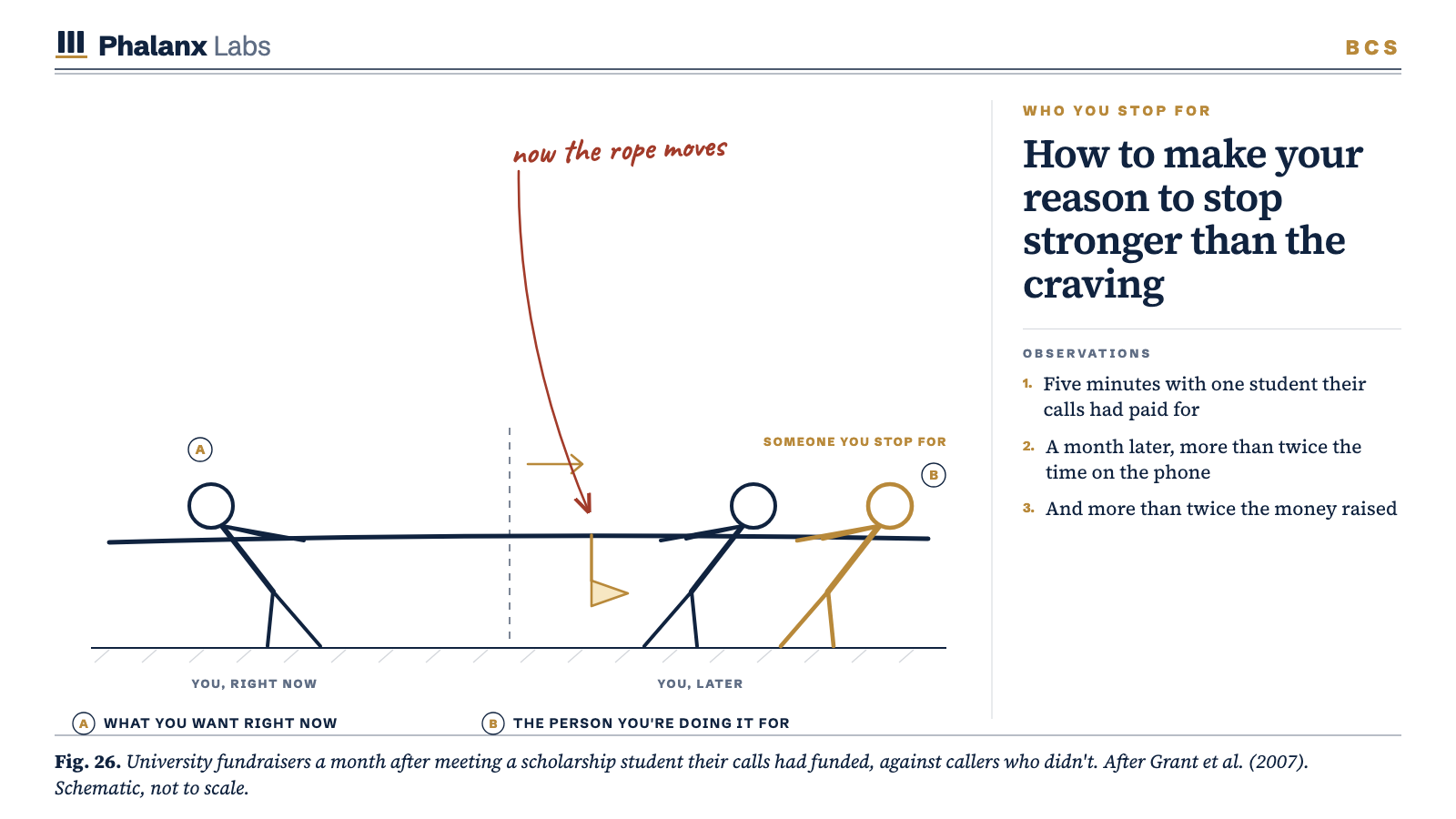
When you're trying to break a habit, the reason you give yourself matters more than you think. Most people pick a reason that's all about themselves, and that's exactly the reason that disappears when the craving shows up.
Think about the reasons you've given yourself before. Maybe it was "I want to be healthier", or "I want to feel better about myself".
They're good reasons, and when you've just made the decision, they feel strong.
But think about what happens later, when the craving comes.
The person who wants to be healthier is you. And the person who wants the habit right now is also you. So it's you against you, and the version of you who wants relief right now is the one who's actually there when the decision gets made.
We see this over and over again, and we're sure you have too. Someone can stop for their own health for a week or two. Then they have one bad day, and their health starts to feel like something they can deal with tomorrow.
There's a piece of research that shows why a different kind of reason works better.
Researchers once studied people working in a call center, phoning former students to raise money for scholarships. It's a hard, boring job, and most callers get turned down all day.
One group of callers got to spend five minutes, face to face, with a student whose scholarship had been paid for by the money they raised. That was the only thing that changed.
A month later, those callers were spending more than twice as long on the phone as before. And they were bringing in more than twice as much money. The callers who never met a student didn't change much.
Nobody gave them a bonus or a pep talk. They had just met the person their work was for.
Now think about what that means for your habit.
When your reason is "for me", it's competing with what you want right now. But some reasons have a face. It might be a person you'd let down, or a person you want to be an example for. A reason like that doesn't argue with the craving in the same way. It reminds you of something bigger than tonight.
That's why so many people manage to stop for someone else when they could never do it for themselves. You've probably seen it happen, maybe with a parent who couldn't stop for their own health but did when their kid asked them to.
There's a second part to this as well.
The reason works even better when it's tied to who you're becoming, and not only to what you're stopping. "I want to stop drinking" is about the drink, while "I want to become someone who doesn't let a substance run my life" is about you. Now we say drinking, but the same is true of whatever habit you're trying to stop.
This is a big part of phase 3 of our program.
By then, the habit is hard to reach and clients have learned to get through their cravings, so in phase 3 we work on the person underneath.
We start by naming the habit, and then writing down who the client wants to become, as a person rather than as a rule. Then we set the intention, which is the reason that will keep them going when it gets hard, and it almost always points at someone else. The example we give is "I want to stop drinking because I want to live out as an example for my wife and children."
Then we tie it back to the oath every client takes at the very start of the program. That way the reason is something they've already promised, not a new idea they came up with that week.
None of this replaces the work in the earlier phases. A good reason won't carry you if the bottle is in the kitchen and you've never learned what to do with a craving.
BUT once that work is done, this is what keeps you going on the days when nobody is checking on you.
Sources
- A. M. Grant, E. M. Campbell, G. Chen, K. Cottone, D. Lapedis and K. Lee (2007). Impact and the art of motivation maintenance: the effects of contact with beneficiaries on persistence behavior. Organizational Behavior and Human Decision Processes.
The Behavior Control System
Our 90-day program, private and one-on-one, built around your life.
See our programsField Notes
One letter a week from the lab.