What a night without sleep does to tomorrow's craving
After a bad night, small things feel like threats and the craving gets louder by the evening, because sleep loss changes how the brain handles stress.
You slept badly last night. Today, everything gets to you, even small things like a slow driver or a short email from work.
And by the evening, the craving for the habit you're trying to break is louder than it's been all week.
Why does one bad night make the habit so much harder to resist?
We see this over and over again with clients. Ask someone about the day they relapsed, and very often the night before it was a bad one.
A sleep researcher called Matthew Walker and his team looked at what happens in the brain after a night like that. In 2007, they took a group of healthy young adults and split them in two. One group slept normally, and the other stayed awake for about a day and a half straight.
Then they put everyone in a brain scanner and showed them a series of pictures. Some were neutral. Others were upsetting, and they got more upsetting as the test went on.
The researchers were watching a small part of the brain called the amygdala. Its job is to spot threats and set off your stress response. It's the part that makes your heart jump before you've worked out what happened.
In the people who'd slept normally, the amygdala reacted to the upsetting pictures, which is what you'd expect.
In the people who hadn't slept, it reacted far more strongly. The same picture set off a much bigger alarm.
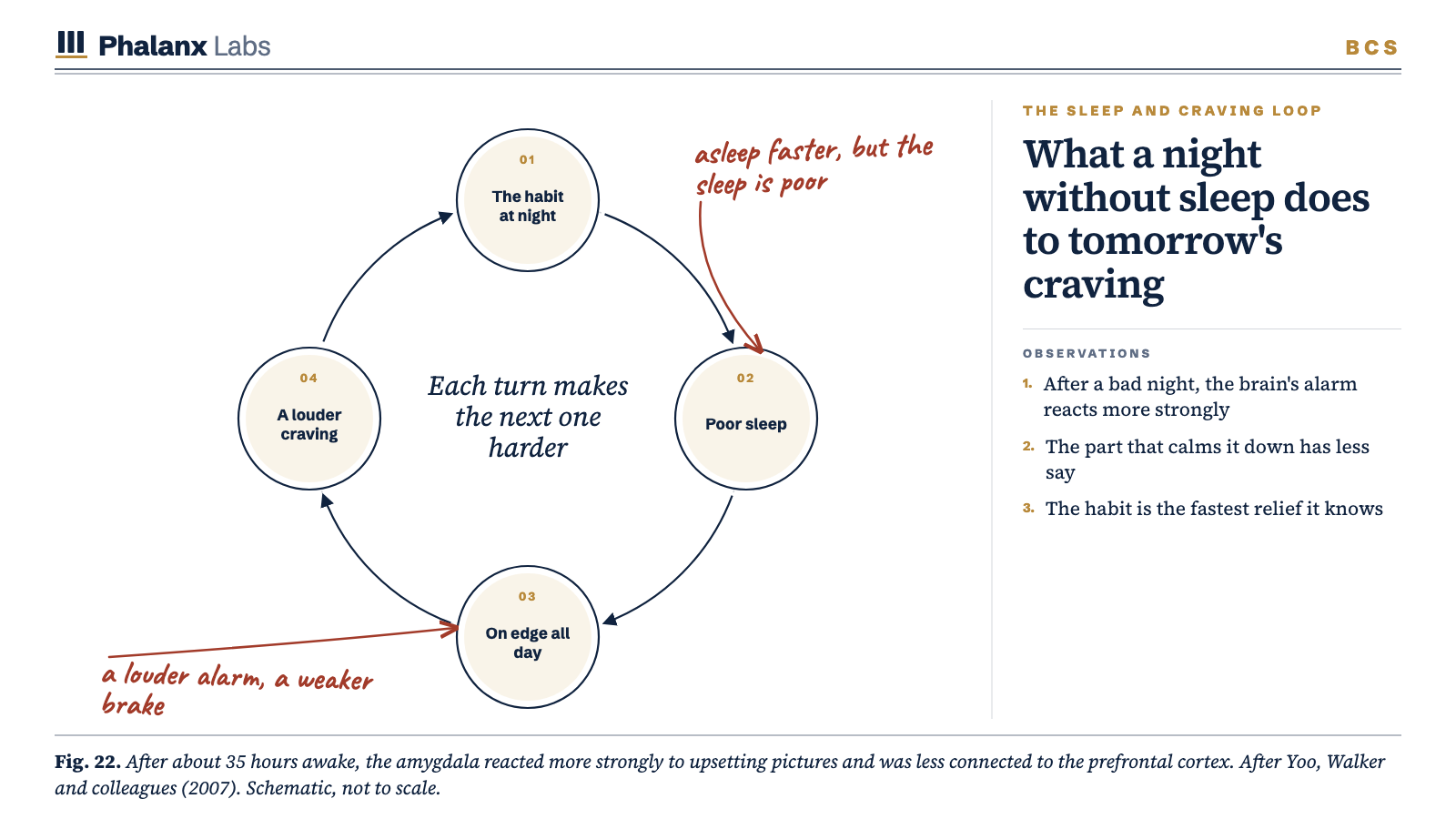
They found something else as well. Normally, the front of your brain, the part behind your forehead that thinks things through, keeps the amygdala in check. It's the part that says, "Calm down, it's only a slow driver." In the people who hadn't slept, the link between the two was weaker, so the alarm was louder and the part that's meant to calm it down had less say.
Now think about what that does to your day after a bad night. Small things start to feel like threats, and you end up far more stressed than the day deserves.
And what does your brain know about stress? It knows that the habit makes the feeling stop, at least for a while.
So the craving isn't really random. A stressed brain is looking for relief, and the habit is the fastest relief it knows. On top of that, the part of your brain that would normally talk you out of it is the part that sleep loss weakened.
And for a lot of people, this turns into a loop, because they use the habit to get to sleep. Maybe it's a drink to take the edge off, a joint, porn, or scrolling until your eyes close.
It can help you fall asleep faster, but the sleep you get is poor. So you wake up tired and on edge, and by the evening you want the habit even more. The habit damages your sleep, and the poor sleep makes the habit harder to stop.
So what do we do about it in our program?
The very first thing we set in phase 1 is sleep. Before we ask anyone to stop, we fix a consistent time to go to bed and wake up, we track how much sleep you're getting, and we aim for at least seven and a half hours from the start.
We also go through the things that wreck sleep without you noticing, like light at the wrong time of day, caffeine too late in the day, and the habit itself.
That's why sleep comes first. If you try to stop while you're running on five hours a night, you're asking a brain that's already stressed and on edge to fight the craving at the exact moment the part of it that makes good decisions is weakest.
Now, one good night won't make cravings go away, and not every craving comes from bad sleep.
But when your sleep is steady, your brain stops treating every small problem like a threat, and the part of you that makes good decisions has a lot more say in the evening.
This is how you start breaking out of the relapse loop.
Sources
- S.-S. Yoo, N. Gujar, P. Hu, F. A. Jolesz and M. P. Walker (2007). The human emotional brain without sleep: a prefrontal amygdala disconnect. Current Biology.
The Behavior Control System
Our 90-day program, private and one-on-one, built around your life.
See our programsField Notes
One letter a week from the lab.