How to stop lying to yourself about the habit
Lying to yourself about the habit is not a weakness of character: it's what almost everyone does when part of them wants to stop and part of them doesn't.
The method: The Radical Honesty Method
Contents10 sections
- Who is this for?
- Step 1: Get the real numbers
- Step 2: Write down what the habit does for you
- Step 3: Stop the small lies too, for 30 days
- Step 4: Tell one person the whole truth
- Step 5: Keep a 2-minute honest log every night
- Step 6: If you relapse, say it within 24 hours
- Step 7: Check your log against the real numbers every week
- Why does this work?
- Sources
(Works for porn, alcohol, weed, nicotine, scrolling, gambling, any habit. It's one of the first things we build with every client.)
Who is this for?
- You tell yourself it's "not that bad" or "only on weekends", and some part of you knows it isn't true
- You clear the browser history, hide the bottles or say you were "working late"
- You've promised to stop on Monday so many times that you don't believe yourself anymore
- Deep down, you think you can't trust a single word you say to yourself
If this is you, read on.
Lying to yourself about the habit is not a weakness of character.
It's what almost everyone does when part of them wants to stop and part of them doesn't. But as long as it keeps going, you can't fix the habit, because you can't see how big it really is.
Think about how it actually goes..
On Sunday night you tell yourself you only had "a few" drinks on Saturday. You don't count, because counting would make it real. On Tuesday someone asks why you look tired, and you say you slept badly. On Thursday you tell yourself you've earned it after the week you've had.
None of these feel like big lies, and most of them you don't even notice.
But add them up and you're living in a version of your life where the habit is smaller than it is, costs less than it does, and is always about to stop.
Here's what most people never realize.
A doctor who has treated addiction for over twenty years noticed something about the patients who got better and stayed better. They weren't the ones with the most willpower or the worst rock bottom. They were the ones who made a promise to tell the truth, even about tiny things that had nothing to do with the habit.
One of her patients told her that when he was deep in his habit, he lied about everything, and he didn't even know why. If a friend called while he was at one burger place, he'd say he was at the other one. He said it made no sense, he'd just got into the habit of lying.
That's how it goes. You start lying to cover the habit, and then the lying becomes a habit of its own.
And it goes deeper than that..
Researchers wanted to know what happens in the brain when people decide whether to lie. So they had people roll dice for money and report their own results, with nobody checking. If everyone had been honest, about half the rolls would have been winners. People reported about two thirds.
Then the researchers used a mild electric current to make the front part of the brain more active. That's the part behind your forehead that plans ahead, handles your emotions and thinks about what happens next. With that part more active, the lying dropped by half.
Nobody has proved that it works the other way round. But the researcher behind the study agreed it's likely that practicing honesty strengthens that same part of the brain, the way any skill gets stronger the more you use it.
And that's the part of you that has to say no to a craving at 10pm.
So feeling more guilty won't help. What helps is to stop telling yourself the story that keeps the habit hidden, starting with the small parts of it.
This post is not about theory though. Here's exactly how to set it up.
Let's begin.
Step 1: Get the real numbers
Your memory will lie for you, so don't use it.
Sit down for 20 minutes and pull the actual numbers for the last 30 days:
- Alcohol: your bank statement. Every bar, every shop, every delivery.
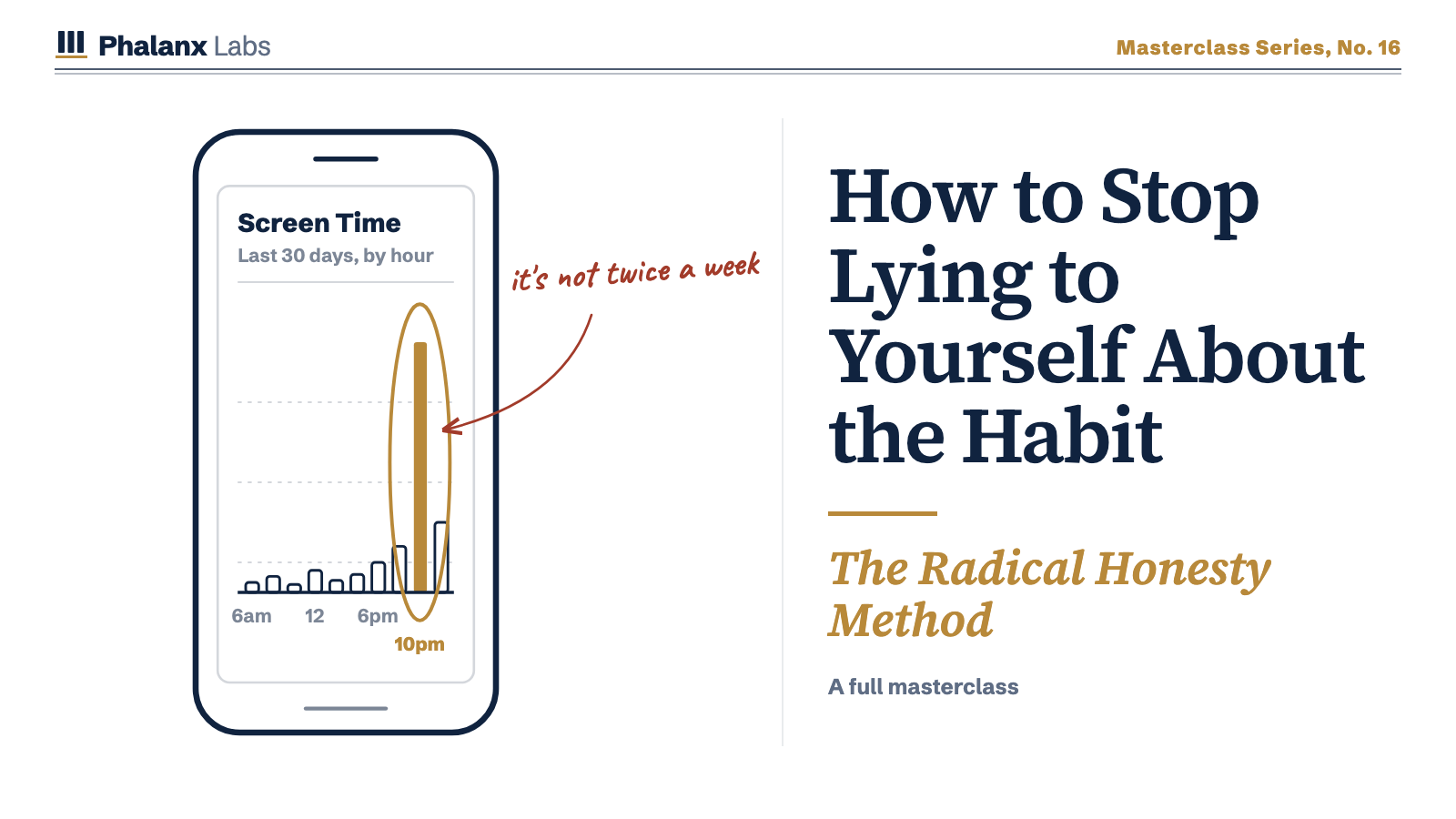
- Porn or scrolling: the screen time report on your phone, by app and by hour.
- Weed, nicotine or vapes: what you bought, from your bank or your messages.
- Gambling: your deposit history on every site, all of them.
Write down how much, how often, and what time of day.
Most people are shocked by this. They thought it was twice a week, and it's five nights. They thought it was a bit of money, and it's more than their car payment.
Don't argue with the number. It's the first true thing you've written down about the habit in a long time.
Step 2: Write down what the habit does for you
People skip this part, because it feels like making excuses.
But the habit is doing something for you, or you wouldn't keep going back to it. Maybe it calms you down after work and fills the empty evening. Maybe it's the only thing that gets you to sleep, or shuts your head up for an hour.
Write it down plainly. "It's the only time I feel relaxed." "It's how I get through Sunday nights."
Then, next to it, write what it costs you: the mornings, the money from Step 1, the way you talk to your partner the next day, and the thing you keep not doing.
When both sides are written down in your own words, the lie has nowhere to hide. It's hard to say "it's not that bad" to a page that shows you exactly how bad it is.
Step 3: Stop the small lies too, for 30 days
This is the step that sounds pointless, and it works the best.
For the next 30 days, you don't lie about anything. Not just the habit, everything.
If you're late, you say "Sorry I'm late." You don't add that the traffic was terrible.
If you didn't finish the work, you say you didn't finish it, instead of "I'm nearly done."
You'll be surprised how often you do it. Most people tell one or two lies a day without noticing.
Every time you catch one, correct it on the spot. "Actually, that's not true. I left late."
The small lies and the big lies come from the same reflex. Train it on the small ones, where it's easy, and it starts to hold on the big ones.
Step 4: Tell one person the whole truth
Pick one person you trust. A partner, a brother, a close friend.
Sit down and tell them the real numbers from Step 1, without softening them: the exact amount, the exact nights, and the things you hid.
You'll be scared they'll think less of you. Here's what usually happens instead.
A man in recovery was once asked by his wife about something small he'd done a year earlier, back when he was still in the habit. He froze. He had every reason not to tell her, because things were good between them now. But he'd promised her he'd be honest, so he told her. She didn't shout and she didn't leave. She put her hand on his shoulder, thanked him for telling her the truth, and hugged him.
People come closer when you tell them the truth, because they see you're human, the same as them.
One warning. This is not about telling war stories about your worst nights to get a reaction. If you catch yourself enjoying the story, you're performing it, not telling it.
Step 5: Keep a 2-minute honest log every night
Every night before bed, write three lines:
- Did I do the habit today? If yes, how much and when.
- What happened right before.
- What I'll do differently tomorrow.
Write it the way it happened, with you in it. Don't write "work was so stressful I had to drink". Write "work was stressful and I chose to drink."
That small change matters. When you're always the victim of your day, there's nothing for you to change. When you're the one who chose, you're also the one who can choose differently.
Step 6: If you relapse, say it within 24 hours
This is where most people go back to lying.
They relapse on Friday, feel ashamed, and tell nobody. Then the hiding starts again, and by the next Friday it's three nights instead of one.
So set the rule now, while you're calm. If you relapse, the person from Step 4 hears it from you, in plain words, within 24 hours. "I drank on Friday. About six. It started after the call with my boss."
A relapse you say out loud is one you can learn from. A relapse you hide usually leads to the next one.
Step 7: Check your log against the real numbers every week
Once a week, put your log next to your bank statement or your screen time report, and see if they match.
If the log says twice and the bank says four times, don't use it as a reason to hate yourself. Use it to see exactly where you're still lying.
Why does this work?
Because a habit needs to stay half hidden to keep going.
Every lie you tell about it keeps it small in your head. Every truth makes it visible, and you can only change what you can actually see.
You probably know the old story of the sailor who had himself tied to the mast to get past the Sirens. Most people don't know how it ends. In the story, the Sirens could only be defeated if someone heard them and lived to tell the tale. He beat them by telling the story afterwards.
Telling it straight is how you get power over it.
Now, be honest with yourself..
Honesty won't stop a craving on its own. You'll still want it some nights, and you'll still need a plan for those nights. What honesty does is make sure you're working on the real problem, and not the smaller version of it you've been telling yourself.
And if you drink heavily every day, talk to a doctor before you stop. Stopping suddenly can be dangerous.
Start Step 1 tonight. It takes 20 minutes.
Try it out, it works.
This is how we work with clients in our program. From the first week, every client sends us an honest update on how the day went, relapses included. We never punish the truth, we use it. A relapse we hear about the next morning is something we can work with. A relapse that stays hidden for three weeks is the one that turns into a spiral.
Sources
- Anna Lembke, Dopamine Nation: Finding Balance in the Age of Indulgence (Dutton, 2021)
- Anna Lembke, The Official Dopamine Nation Workbook (Dutton, 2024)
- William R. Miller and Stephen Rollnick, Motivational Interviewing: Helping People Change and Grow, 4th edition (Guilford Press, 2023)
- M. A. Maréchal, A. Cohn, G. Ugazio and C. C. Ruff (2017). Increasing honesty in humans with noninvasive brain stimulation. Proceedings of the National Academy of Sciences.
The Behavior Control System
Our 90-day program, private and one-on-one, built around your life.
See our programsField Notes
One letter a week from the lab.