Get through quiet evenings without giving in
A lot of people who are trying to break a habit don't relapse on their worst day: they relapse on a quiet afternoon when there's nothing to do.
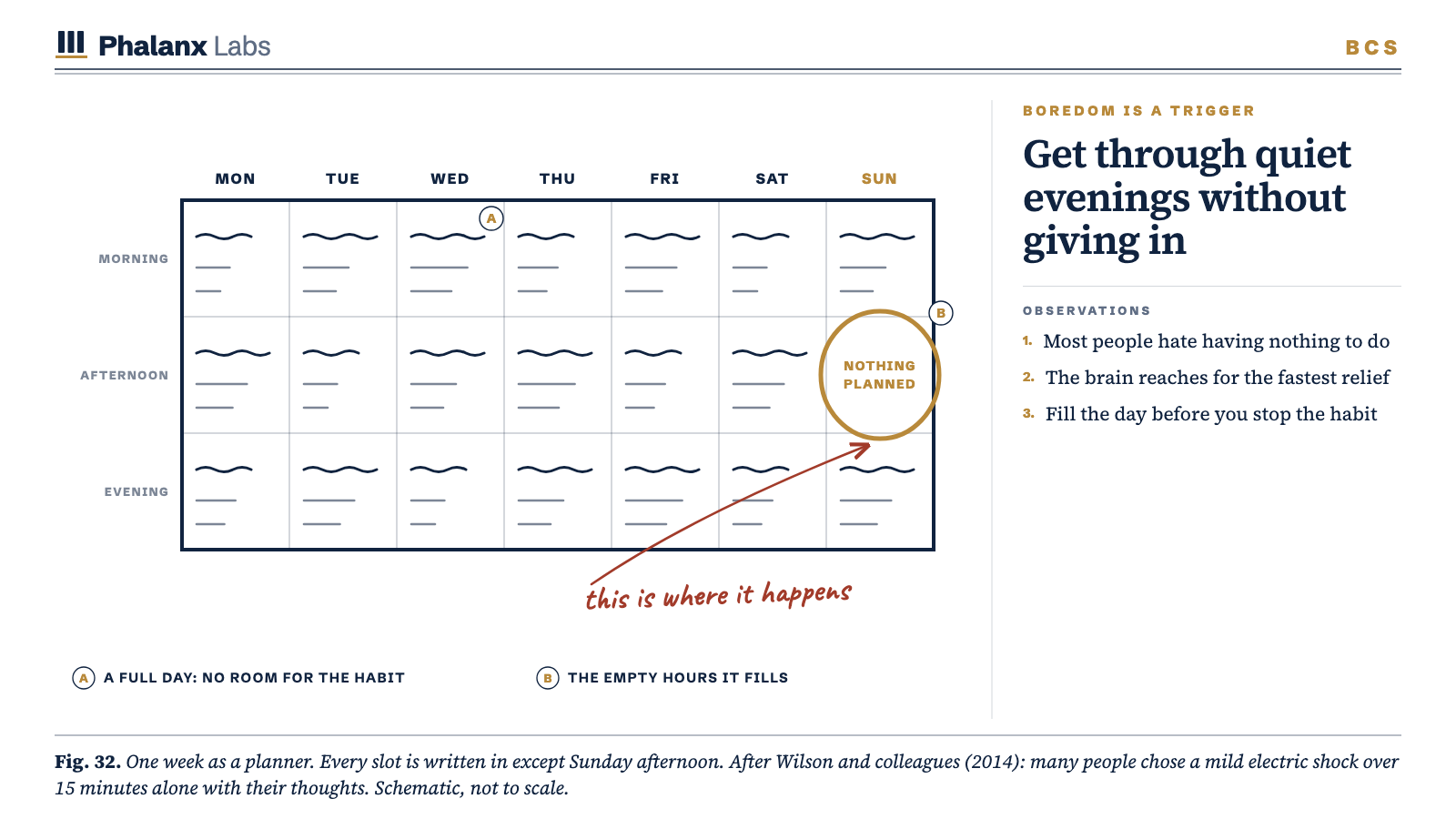
A lot of people who are trying to break a habit don't relapse on their worst day. They relapse on a quiet afternoon when there's nothing to do.
You've seen this yourself.
The hard days, you get through. You're busy and stressed, but you hold on.
Then a quiet evening comes, and nothing's wrong and nothing's happening. You sit there, you pick up your phone, you put it down, you walk to the kitchen and back.
And an hour later, you've done the thing you swore you wouldn't do.
So the question is why does nothing feel so dangerous?
Here's some real science to explain this.
Researchers wanted to know how people cope when they're left with nothing to do but think. So they had people sit alone in a plain room for 15 minutes, with no phone and nothing to read.
Most of them didn't enjoy it, and many said it was unpleasant.
Then the researchers added one thing. Before the 15 minutes, each person was given a mild electric shock, and most said they'd pay money not to feel it again. Then they were left alone in the room with a button that would give them that same shock.
About two thirds of the men and a quarter of the women pressed it. They gave themselves the shock they'd said they would pay to avoid, just so something would happen. One man pressed it 190 times.
Think about what that means.
A lot of people would rather feel pain than feel nothing.
Your brain is built to look for something to do. When nothing's going on, it gets uncomfortable, and that discomfort pushes you to find anything that changes how you feel.
And your brain already knows the fastest way to change how you feel, which is the habit.
It's been doing that job for years. On every bored evening you've ever had, the habit was there. So when the boredom comes, your brain doesn't look around for options. It goes straight to the one it knows.
That's why "I'll just stay in and rest" can be the riskiest plan of your week.
If your pattern is a few drinks on a quiet Saturday, this is possibly how it runs right now.. You cancel plans because you want to stay out of trouble. The afternoon drags, and by six o'clock the only thing that would change how the evening feels is a drink.
Now we say drinking, but this is true of whatever you're trying to stop. The inner working is the same.
And this is the part most people miss. When you stop a habit, the hours it used to fill are still there. If you don't put something else in them, they stay empty, and the boredom pushes harder than it did before.
This is why the first phase of our program builds the day before anything is taken away.
Boredom is one of the biggest triggers for any habit, and a lot of it comes from days spent inside, alone, with nothing planned. So in phase 1, every client builds a set of daily anchors: a long walk outside every day with a good part of it in daylight, training, sleep at fixed times, and the things they've always wanted to do but never had time for.
We do this first, while the habit is still there. By the time clients stop, their day already has something in it.
Now, this doesn't mean you'll never be bored again. You will, and boredom is normal. You can learn to sit with it.
BUT the difference between a bored evening that passes and a bored evening that ends in relapse is usually whether you had something else to reach for.
This is how you stop the empty hours from setting off a relapse.
Sources
- T. D. Wilson, D. A. Reinhard, E. C. Westgate, D. T. Gilbert, N. Ellerbeck, C. Hahn, C. L. Brown and A. Shaked (2014). Just think: the challenges of the disengaged mind. Science.
The Behavior Control System
Our 90-day program, private and one-on-one, built around your life.
See our programsField Notes
One letter a week from the lab.