Make your home stop setting off the habit
Most people trying to break a habit try to change themselves and leave their room exactly as it was, and that's a big part of why the habit keeps winning.
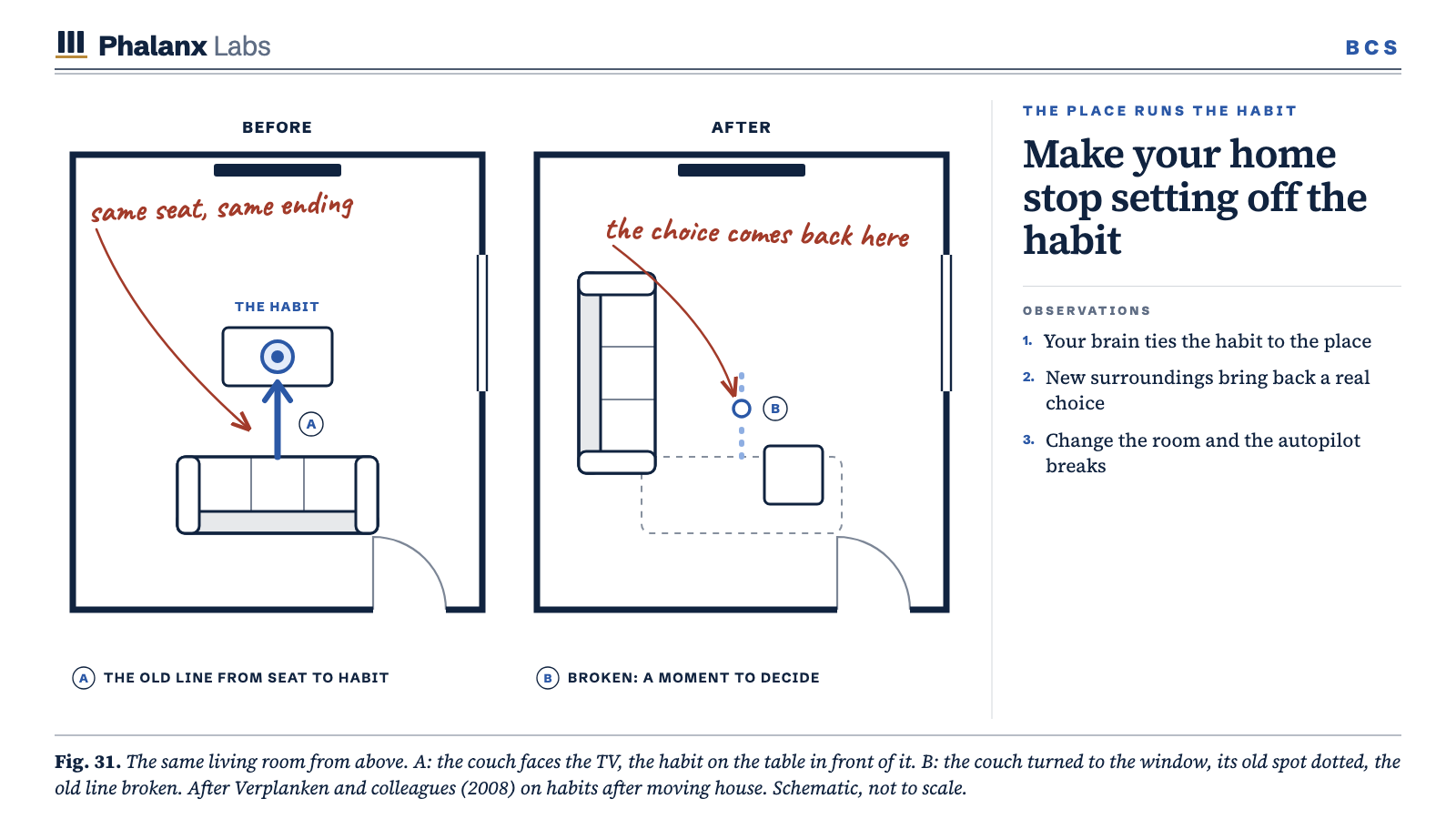
Most people trying to break a habit try to change themselves and leave their room exactly as it was. That's a big part of why the habit keeps winning.
Think about where you usually give in.
Maybe it's the same corner of the couch with the TV on, or your bed with your phone on the pillow.
You've sat in that spot hundreds of times, and every time, the habit came next.
So now, when you sit there, your brain doesn't wait for you to decide anything, because it's already started. Everything about that spot tells it what usually happens next, and the craving starts before you've had a single thought about it.
That's why you can wake up completely sure you won't do it tonight, and still end up doing it. In the morning, you're nowhere near that spot. By the evening, you're sitting in it.
A lot of a habit is tied to the place where it happens. Your brain links the action to everything around it, so it doesn't have to think, which saves it a lot of effort. But it also means the room keeps setting off the habit long after you've decided to stop.
Researchers saw this clearly when they compared people who had recently moved to a new town with people who had lived there for years. Both groups had the same buses, the same bike paths and the same reasons to leave the car at home.
Most of the long-time residents drove to work, even the ones who said they cared a lot about the environment. Their habit was already set.
The people who had just moved were different. The ones who cared about the environment mostly took the bus, cycled or walked. Without their old surroundings, there was no habit to follow, so they had to make a fresh choice, and the fresh choice matched what they actually wanted.
So once the old surroundings were gone, people acted on what they wanted, instead of what they'd always done.
You don't have to move town to get some of that effect. But you do have to change the place where the habit lives.
If a glass of wine on the couch after work is your pattern, the couch is doing half the work. Now we say wine, but this is true of whatever you're trying to stop. The place sets it off the same way.
This is why one of the first things we do in phase 2 of our program sounds almost too simple.
We go through every place where the habit happens, and we change it. Clients move the furniture around at home. The couch faces a different wall, the chair comes off the balcony, the bed gets turned around and the phone charges in another room. We change the route home so it doesn't pass the shop or the bar.
The point is to make the place feel new, so your brain can't run the old routine on autopilot. When the spot looks and feels different, there's a moment where you have to actually decide, and that moment is where you get the choice back.
Some places can't be changed. You can't stop using your car or sleeping in your bed. For those, we do something different. We put reminders of why you're stopping right where the habit used to happen, so the place starts to remind you of what you're working towards instead of the habit.
Now, this doesn't make the habit disappear on its own. Moving a couch won't stop a craving that's been building all day. It's one part of the work, and we do it alongside mapping your triggers and building a plan for each one.
But it takes away a lot of the cravings that seem to come out of nowhere.
This is how you stop your own home from setting off the habit.
Sources
- Wendy Wood, Good Habits, Bad Habits (Farrar, Straus and Giroux, 2019)
- B. Verplanken, I. Walker, A. Davis and M. Jurasek (2008). Context change and travel mode choice: combining the habit discontinuity and self-activation hypotheses. Journal of Environmental Psychology.
The Behavior Control System
Our 90-day program, private and one-on-one, built around your life.
See our programsField Notes
One letter a week from the lab.