Stop letting your last relapse set up the next one
Most people think guilt is what keeps them in line after a relapse, but the research says it often does the opposite.
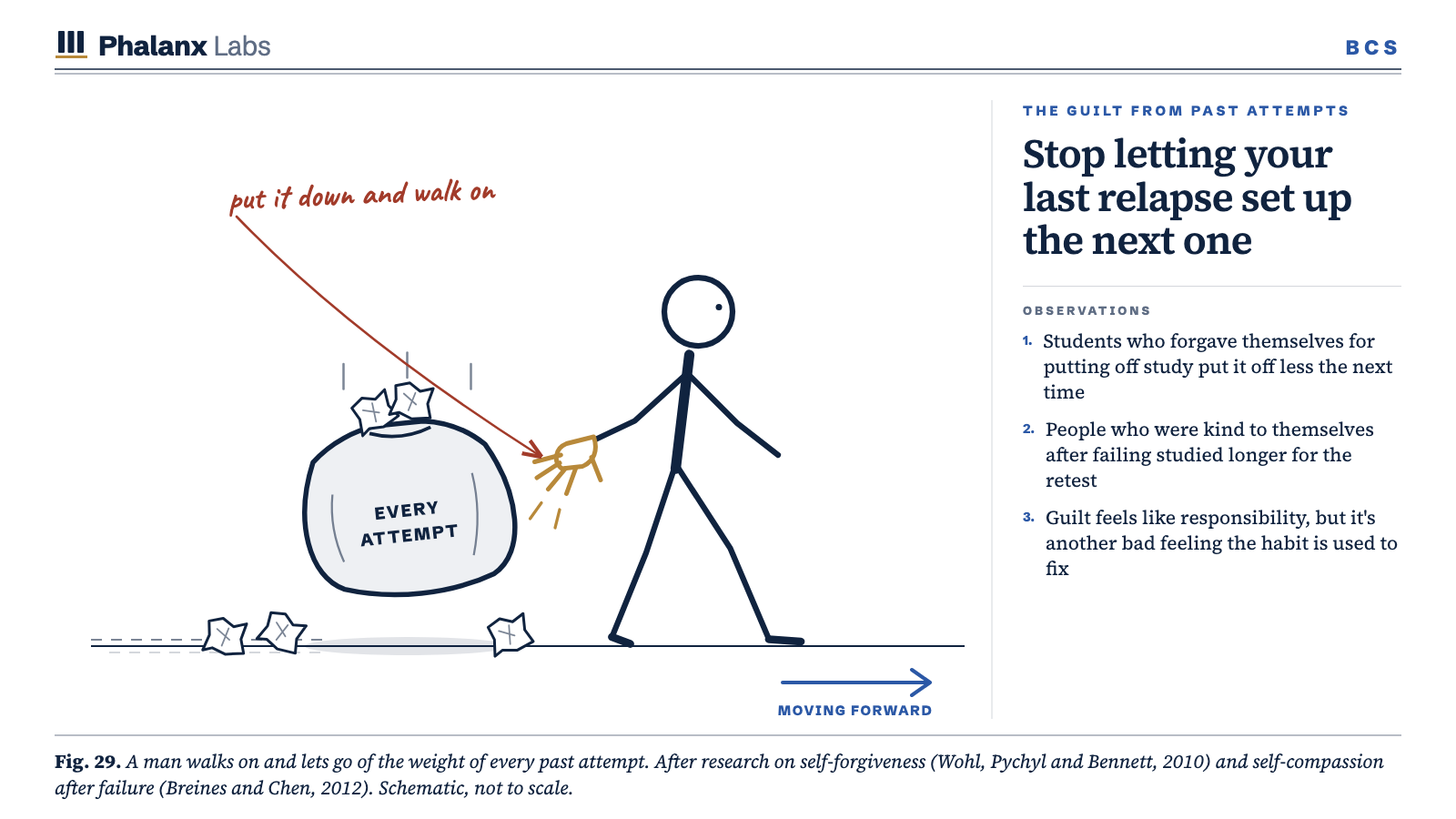
If you've tried to break a habit many times, you probably carry a long list of failed attempts around with you. Most people think that guilt is what keeps them in line. The research says it often does the opposite.
You've probably felt this. You relapse, and the next morning you go through it all again: every promise you broke, every time you said this would be the last. You call yourself pathetic, because you think that if you feel bad enough, you won't do it again.
And then a few days later, on a bad evening, you do it again, and the guilt gets heavier.
So why does this happen?
Researchers followed a group of first-year college students through two exams. Before the first one, many of them put off studying. Afterwards, the researchers asked how much each student had forgiven themselves for that. Before the second exam, the students who had forgiven themselves procrastinated less than the ones who were still hard on themselves. The researchers' explanation was that forgiving themselves took away some of the bad feeling around the subject, so they didn't have to avoid it as much.
In another set of studies, people who failed a hard test and were then encouraged to be kind to themselves about it went on to study longer for a second test than people who were told to boost their self-esteem or were given nothing.
Now think about what that means for your habit. Guilt feels like responsibility, but a lot of the time it works as just another bad feeling, and for most people, the habit is how they deal with bad feelings. So the shame from the last relapse becomes part of what sets up the next one.
There's a second problem. Every time you go back over your failures, you're also telling yourself who you are: someone who always gives in. And people tend to act in line with who they believe they are.
So instead of keeping you on track, the guilt often ends up holding the old version of you in place.
This is why one of the exercises in phase 3 of our program is a letter.
By phase 3, clients have rebuilt their day and learned to handle their triggers and cravings, and we're working on who they are without the habit. Part of that is dealing with the past. Each client writes a letter to themselves about every failed attempt, every broken promise, and all the guilt and frustration, with nothing held back. And then they forgive themselves for it, in writing.
That doesn't let you off the hook, because the letter names exactly what you did. What it does is put it behind you, so you stop carrying it into every evening.
Then they repeat one line: "I am not my past. I am moving forward."
None of this replaces the work of the first two phases. Forgiving yourself without the routine and the skills is just a nice letter. BUT once that work is done, letting go of the guilt is what lets the new version of you take over from the old one.
This is how you stop your past attempts from deciding your next one.
Sources
- M. J. A. Wohl, T. A. Pychyl and S. H. Bennett (2010). I forgive myself, now I can study: how self-forgiveness for procrastinating can reduce future procrastination. Personality and Individual Differences.
- J. G. Breines and S. Chen (2012). Self-compassion increases self-improvement motivation. Personality and Social Psychology Bulletin.
The Behavior Control System
Our 90-day program, private and one-on-one, built around your life.
See our programsField Notes
One letter a week from the lab.