How to set up a morning that holds all day
If you usually relapse in the evening, you probably think the evening is the problem, but a lot of the time the day went wrong in the first hour.
The method: The Morning Anchor
Contents11 sections
- Step 1: Write down your first hour as it is now
- Step 2: Take the phone out of the first hour
- Step 3: Get up at the same time every day
- Step 4: Pick your anchor
- Step 5: Same time, same place, same order
- Step 6: Decide on the bad-day version
- Step 7: Put another anchor every four to six hours
- Step 8: Plan the gaps in the morning
- Step 9: Give it twelve weeks
- Why does this work?
- Sources
If you usually relapse in the evening, you probably think the evening is the problem.
But the evening is usually just where the problem shows up. A lot of the time, a day that ends in a relapse went wrong in the first hour.
Think about how your mornings go right now. The alarm goes off, you reach for your phone before you're even out of bed, and you spend twenty minutes scrolling. You get up late, rush, skip breakfast or grab something on the way, and you're already behind before work has started.
From there, the day happens to you. Meetings, messages, whatever lands on your desk. There's no plan for the gaps, so when one opens up, nothing fills it. By the evening you're tired and wound up, and you've got a long empty stretch in front of you with nothing in it. That's when the habit shows up.
Most people don't realize that mornings run almost completely on autopilot. One researcher who has spent her career studying habits says she'd bet the first fifteen minutes you're awake go almost exactly the same way every day. You're half asleep and in a rush, so you don't decide much. You just do what you did yesterday.
That's bad news if your morning is the phone in bed and a rushed start. But it's also good news. Whatever you put into that first hour, once it's set, runs without you having to decide anything.
There's another reason the morning matters. When people are under stress, they fall back on their habits, good or bad. In one study, students reported their breakfast and their reading every morning for seven weeks, two of which were exam weeks. During the exams, the students who usually ate a healthy breakfast were even more likely to eat it, and the students who usually ate pastries were more likely to eat pastries. Under pressure, they just did whatever they always did.
The same will happen to you. On your worst day you'll fall back on whatever your routine is, so the routine has to be built before the bad day comes.
This post is not about theory though. Here's exactly how to set it up.
Let's begin.
Step 1: Write down your first hour as it is now
Tomorrow, write down exactly what you do from the moment you open your eyes until you leave for work or sit down to start. What time you woke up, what you picked up first, how long you were on it, what you ate, how you felt when you started work.
Don't change anything yet. You need to see your real morning on paper before you fix it, because most people are surprised by how much of it goes to the phone.
Step 2: Take the phone out of the first hour
For a lot of people, checking the phone is the first habit of the day. They wake up and reach for it before they've even sat up. That sets the tone for the day, because the very first thing they do is go looking for something new and quick.
Charge it in another room overnight and use a cheap alarm clock instead. Don't open messages, news or social media until your anchor (step 4) is done.
Step 3: Get up at the same time every day
Pick a wake-up time you can keep seven days a week, weekends included. A fixed time is what lets the rest of the morning become automatic.
Step 4: Pick your anchor
Your anchor is the first thing you do every morning that makes you feel in control of the day. It's the piece the rest of the day is built around.
Pick one:
- A workout
- A walk outside in daylight
- Meditation or prayer
- A cold shower followed by ten minutes of writing out the day
Pick the one that makes you feel strongest and clearest afterward, not the one that sounds most impressive. Do it within the first hour of waking.
Step 5: Same time, same place, same order
In a study of new gym members over twelve weeks, the people who went at the same time every day, like "every morning at 7", said exercise had become automatic by the end. They didn't have to think about it or remind themselves. The people who went whenever they found time were still having to push themselves to go.
It's the same with medication. In one study, among women who never missed a pill, 90% took it at a set time each day. Among those who missed two or more a month, only 44% did. It didn't matter what time they picked. What mattered was that it was the same time.
So do your anchor at the same time, in the same place, in the same order every day. The time and place become the trigger, and after a while you'll find yourself doing it before you've thought about it.
Step 6: Decide on the bad-day version
Some mornings you'll wake up late, sick or after a terrible night. Decide now what the smallest version of your anchor is. If your anchor is a 45-minute workout, the bad-day version might be ten minutes of push-ups and a walk around the block.
The rule is that the anchor happens every day, even if it's small. Skipping it completely on the hard days is how the routine falls apart.
Step 7: Put another anchor every four to six hours
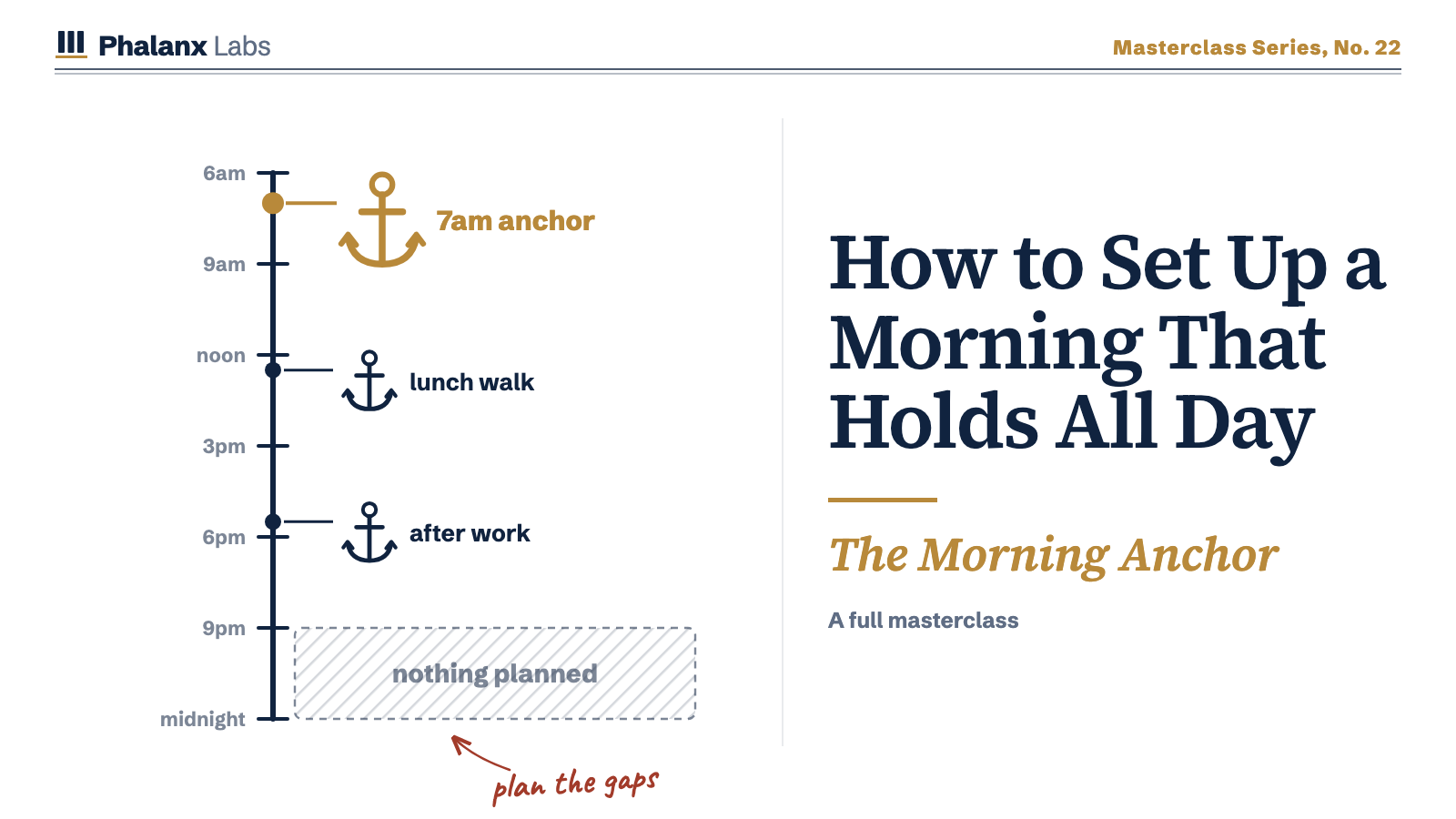
The morning is your main anchor, but it won't carry you to midnight on its own. Plan one more fixed thing every four to six hours: a walk at lunch, a workout after work, a meditation before dinner, a phone call at 9pm.
Put one right before the hour you usually give in. If you crave at 9pm, have something planned at 8:30.
You're far less likely to have a drink at 7 if you know you've got a training session at 8. Now we say drink, but the same goes for whatever you're trying to stop.
Step 8: Plan the gaps in the morning
Think back to the last few times you relapsed. Most of the time, it happened in time that had nothing planned in it. A free evening, a slow afternoon, a weekend with no plans.
So while you're doing your anchor or straight after it, write down what fills every gap in today, especially the evening. It doesn't have to be impressive. Cook dinner, call your brother, read for half an hour. It just has to be decided.
Step 9: Give it twelve weeks
The gym members in that study had been at it for twelve weeks by the time it felt automatic. So expect the first few weeks to feel like effort. That's normal, and it gets easier every time you repeat it.
Why does this work?
Your mornings run on autopilot, and you get to choose what goes on autopilot. And because you fall back on your routine when you're stressed, a strong morning is what holds you up on the bad days.
There's one more piece. There's an experiment where rats were given exactly the same amount of food over an hour, but some of them got it at regular times and the others got it at random. The rats fed at random had higher stress hormones, even though they had just as much food. A day with no shape does the same thing to you, and stress is one of the biggest triggers there is.
Now, be honest with yourself..
A good morning won't stop cravings on its own. You still need to know your triggers and have a plan for the moments you usually give in.
And if you drink heavily every day, talk to a doctor before you stop. Stopping suddenly can be dangerous.
Try it out, it works.
In phase 1 of our program, every client builds an anchoring routine. We start the day with the thing that makes them feel strongest, then put a fixed anchor every four to six hours through to the evening. We do this before we ask anyone to stop, because relapses happen in empty time, and it's much easier to break a habit when the day it lives in has some structure.
Sources
- Wendy Wood, Good Habits, Bad Habits (Farrar, Straus and Giroux, 2019)
- Robert M. Sapolsky, Why Zebras Don't Get Ulcers, 3rd edition (Henry Holt, 2004)
The Behavior Control System
Our 90-day program, private and one-on-one, built around your life.
See our programsField Notes
One letter a week from the lab.