How to stop your phone from pulling you back
Losing hours to your phone isn't a weakness of will: you're carrying a machine that works exactly like a slot machine, so you take it apart one piece at a time.
The method: The Phone Lockdown
Contents11 sections
- Who is this for?
- Step 1: Find out how often you really pick it up
- Step 2: Find your doorways
- Step 3: Take away the opportunity
- Step 4: Take away the surprise
- Step 5: Slow down the repeat
- Step 6: Keep the phone out of the three places it catches you
- Step 7: Ask what you're trying to get away from
- Step 8: Check your numbers every Sunday
- Why does this work?
- Sources
(Works for porn, scrolling, gambling, weed, alcohol, any habit your phone leads you back to. It's what we set up with clients so the phone stops being the way back into the habit.)
Who is this for?
- You pick up your phone "for a second", and an hour later you're somewhere you swore you wouldn't go
- The phone is the first thing you touch in the morning and the last thing you put down at night
- You've deleted the apps before, and downloaded them again within a week
- Deep down, you think the problem is that you have no self-control
If this is you, read on.
Losing hours to your phone is not a weakness of will.
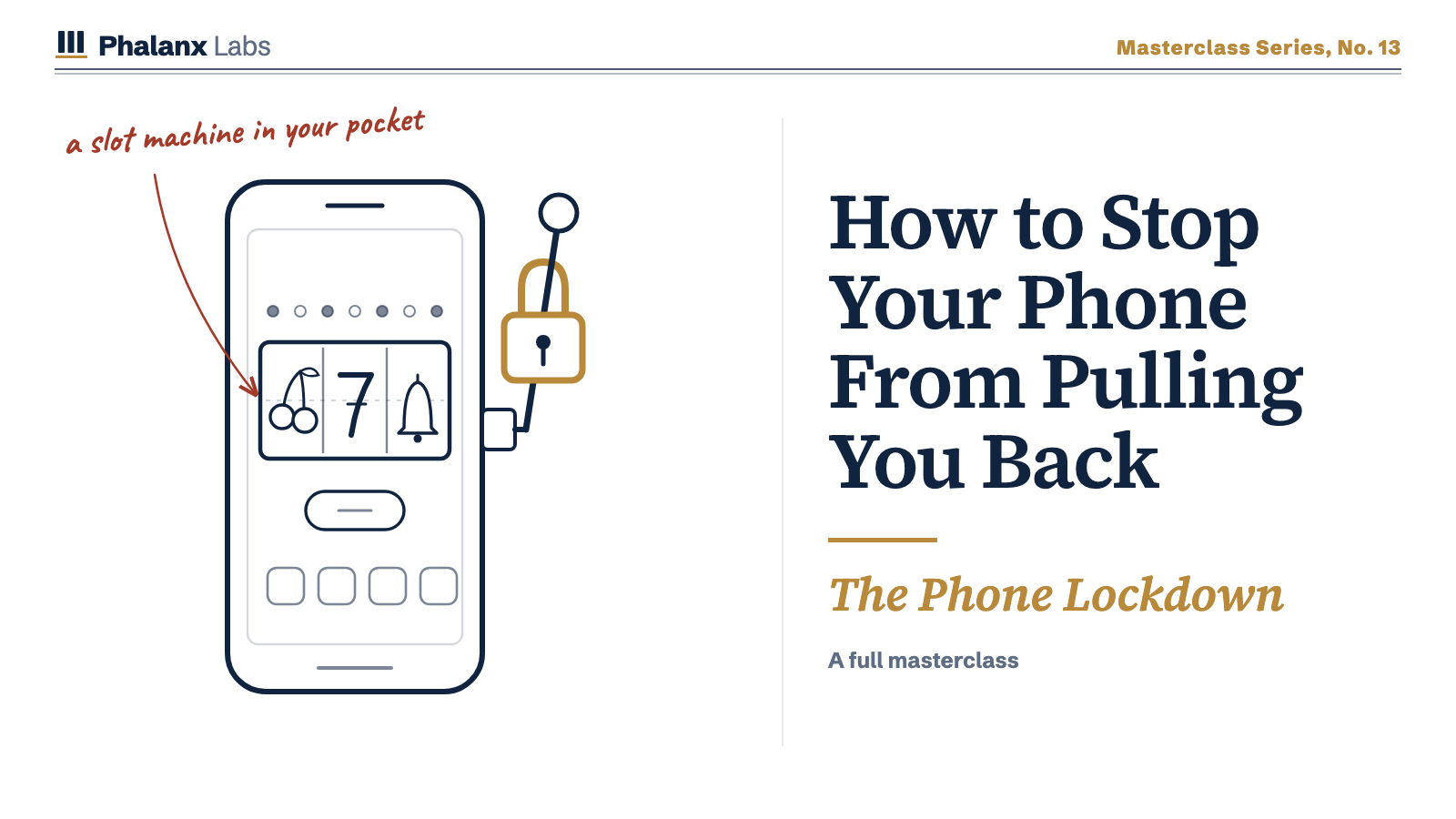
It's what happens when you carry a machine in your pocket that works exactly like a slot machine.
Think about how it usually goes..
You're in bed, or on the couch, or waiting for something. You're a little bored and a little tired, so you pick the phone up to check one thing.
That one thing turns into a feed, and the feed turns into another app. For a lot of people, that's where the habit is waiting: the porn, the betting app, the delivery app that brings a bottle to your door, or the message to the guy who sells you weed.
At no point did you decide to relapse. You only meant to check your phone.
To understand why this keeps happening, you need to know how a slot machine works.
People who design slot machines say every machine runs on three things. First, there's an opportunity: something good might happen. Second, the reward is unpredictable, so you don't know if it'll come this time or what it'll be. Third, you can repeat it straight away and spin again right now.
Your phone has all three.
Every time you pick it up, something good might be waiting for you, like a message, a like or a video. Most of the time there's nothing worth having. But every so often there is, and because you never know which time it'll be, you keep checking. Americans check their phones about 46 times a day on average.
There's an experiment where mice pressed a lever for food that came at random times. They kept pressing long after the food stopped coming. Rewards that come at random build some of the strongest habits there are.
And on a phone, you can check again in a second. You pull down to refresh or scroll one more time, and because the feed never ends, there's no natural point where you stop.
There's one more part to this, and it's the part that matters most for you.
A researcher spent years talking to people addicted to slot machines. Most of them said they weren't playing to win at all. They were playing to disappear. They called it "the zone", a state where time stops, the world goes quiet and nothing else matters.
That's what the phone really gives you at 11pm. The videos and the feed matter less than the way out it gives you from the stress, the boredom or the bad feeling for a while. And when the zone stops working, the habit is one tap away.
So instead of trying to resist the phone harder, you're going to take the slot machine apart, one piece at a time, and close every way from the phone back to the habit.
This post is not about theory though. Here's exactly how to set it up.
Let's begin.
Step 1: Find out how often you really pick it up
Go into your phone's settings and find the screen time page. Most phones show how many times a day you pick the phone up, and which app you open first.
Look at the last week and write down three numbers: your pickups per day, the time of your first pickup and the time of your last.
Don't change anything yet. Just look.
Step 2: Find your doorways
Think back to the last five times you relapsed. For each one, write down what you were doing on your phone in the ten minutes before.
You'll see a pattern. For most people, it's two or three apps that lead to the habit: the feed that leads to porn, the sports app that leads to a bet, the group chat that leads to a drink, or the food delivery app that also sells alcohol.
These are your doorways. The habit itself might not even be on your phone, but the way to it almost always is.
Step 3: Take away the opportunity
Delete every doorway app completely, rather than logging out or hiding it in a folder.
If you need one of them for work, use it only on a laptop, at a desk, during work hours.
Then lock what's left. Put a blocker on the phone's browser and give the password to someone else. If you gamble, self-exclude from every betting site. If a delivery app sells alcohol, delete it and order food with a phone call for the next three months.
We covered this kind of binding in No. 1 of this series. Here, you're doing it for the one device you carry everywhere.
Step 4: Take away the surprise
Turn off every notification on your phone except calls and messages from real people you know. That means no likes, no news, no app alerts and no red badges on the icons.
Every notification is a little spin of the slot machine, telling you something might be waiting. When you turn them off, you take away the surprise, and with it most of the reason to keep checking.
Step 5: Slow down the repeat
The slot machine works because you can spin again in a second, so make every repeat slower.
- Log out of every app you keep, every time you finish with it, so getting back in takes a password
- Move every app you keep off your home screen, so it holds only tools: the phone, messages, maps, the camera and the calendar
- Use the browser version of any feed you can't delete, never the app. It's slower and clunkier, which is the point
- Turn on grayscale, because the colors are part of what makes it exciting
Each of these only adds a few seconds, but that's enough to break the autopilot. You'll find you put the phone down half the time without ever opening the app.
Step 6: Keep the phone out of the three places it catches you
Most phone checking happens at three moments: when you wake up, when you get into bed and when you're bored.
- Waking up: the phone charges outside your bedroom, and you use a cheap alarm clock
- Bed: the phone stays outside the bedroom at night, no exceptions. If you need it for an emergency, leave the ringer on in the hall
- Bored: the phone stays out of the bathroom, and when you're waiting somewhere, you carry a book or you just wait
The bathroom might sound like a small thing, but every gap in the day you fill with the phone is a gap the habit can use.
Step 7: Ask what you're trying to get away from
This is the step that makes the rest hold.
Every time you catch yourself reaching for the phone for no reason, stop for five seconds and ask yourself: "What am I trying not to feel right now?"
Maybe you're bored, lonely, stressed, anxious or angry. Write the one word in a note on your phone.
Remember the zone. If the phone is how you escape a feeling, taking it away leaves the feeling with nowhere to go. After two weeks of notes, you'll know exactly which feelings send you to the phone. Those are your real triggers, and each one needs its own plan.
Step 8: Check your numbers every Sunday
Once a week, open the screen time page again. Are your pickups going down? Is your first pickup later and your last one earlier?
Then check that no doorway app has come back. They have a way of getting reinstalled at 1am.
Why does this work?
Because you take the slot machine apart piece by piece. With no doorways, there's less opportunity. With no notifications, there's less surprise. Logging out and a plain home screen make every repeat slower. And keeping the phone out of your bed and your bathroom means the empty moments stop leading you back to it.
The phone becomes a tool again.
Now, be honest with yourself..
The first week will feel strange. When you pick the phone up and nothing's there, you'll want to check again, harder. It's the same thing you do when you press an elevator button and it doesn't light up: you press it five more times. That urge fades within a few days if you hold the line.
This won't fix the feelings you were escaping into the phone, but it'll show you what they are.
And if you drink heavily every day, talk to a doctor before you stop. Stopping suddenly can be dangerous.
Delete your doorway apps tonight. It takes five minutes.
Try it out, it works.
This is part of what we set up with clients in the first two phases of our program. In phase 1, the phone comes out of the bedroom early, before we ask anyone to stop the habit. In phase 2, we go through every place the phone still leads to the habit and close it, and we build a plan for the feelings the phone was covering.
Sources
- Michael Easter, Scarcity Brain (Rodale Books, 2023)
- Natasha Dow Schüll, Addiction by Design: Machine Gambling in Las Vegas (Princeton University Press, 2012)
- Wendy Wood, Good Habits, Bad Habits (Farrar, Straus and Giroux, 2019)
The Behavior Control System
Our 90-day program, private and one-on-one, built around your life.
See our programsField Notes
One letter a week from the lab.