How to handle stress without the habit
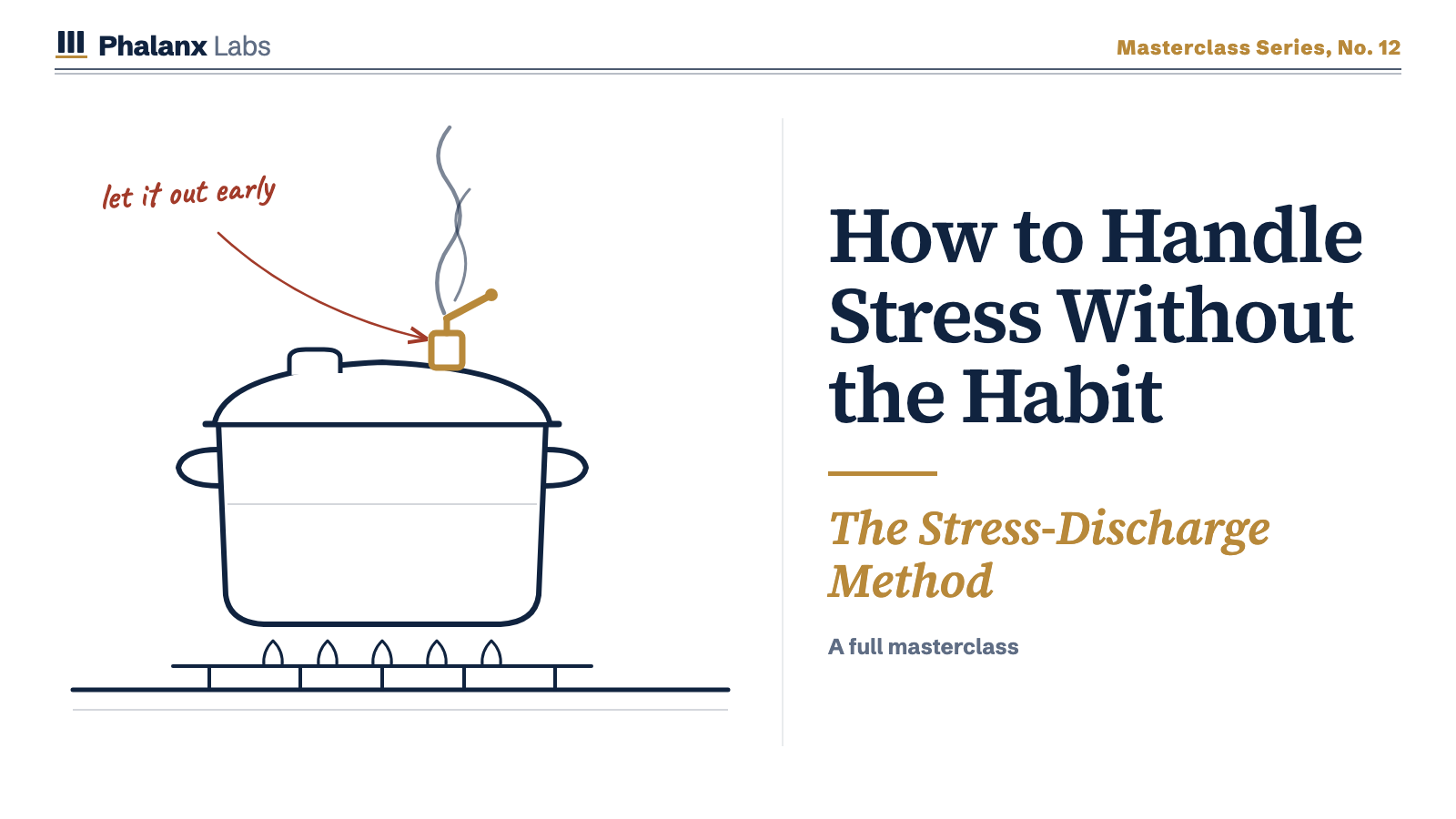
A stressful day often ends in a relapse at night, so you give the stress somewhere else to go, earlier in the day, before it reaches the evening.
The method: The Stress-Discharge Method
Contents11 sections
- Who is this for?
- Step 1: Score your stress three times a day
- Step 2: Check your "shoulds" and "wants"
- Step 3: Build your outlet list
- Step 4: Let some of the stress out before you get home
- Step 5: Know what's coming this week
- Step 6: Find the part you can control
- Step 7: Check the direction every Sunday
- Step 8: Keep one tool for the nights it still gets to you
- Why does this work?
- Sources
(Works for porn, alcohol, weed, nicotine, scrolling, gambling, any habit. It's what we set up with clients so a stressful day doesn't end in a relapse at night.)
Who is this for?
- You're fine all day, and then the habit wins the moment you get home
- The worse the week at work, the harder it is to stop
- You've told yourself "I'll stop when things calm down", and things never calm down
- Deep down, you think the problem is that you can't handle pressure
If this is you, read on.
Giving in at the end of a stressful day is not a weakness of will.
It's what happens when the habit is the only way you have left to get the stress out of your body.
Think about how a hard day usually goes..
You're up early, and from the first email it's one problem after another. A deadline gets moved up, someone snaps at you in a meeting, and you skip lunch because there's no time. You hold it together all day, because you have to.
Then you get home, and the first thing you want is the habit.
Most people think that's the moment they lost. But you lost hours before that, because all day the stress was building and you had nowhere to put it.
There's an old set of experiments that shows exactly this. Two rats get the same mild electric shocks, in the same pattern. One of them has nothing to do. The other can run over and chew on a piece of wood every time a shock comes.
The rat with nothing to do is far more likely to get stomach ulcers. The one that can chew on the wood mostly doesn't. It's the same with a rat that can eat something, or run on a wheel.
Both rats got exactly the same stress. The only difference was that one of them had somewhere to put it.
Experiments like these found other things that made the shocks easier to take. When a bell rang just before each shock, the rat knew when the next one was coming, so it could relax the rest of the time. When the rat had a lever it believed would stop the shocks, it coped better, even when the lever wasn't connected to anything. Studies of monkeys and of people point the same way for one more thing: stress is easier to carry when things seem to be getting better rather than worse.
Now think about what this means for your habit.
For a lot of people, the habit is doing the same job the piece of wood did for that rat. It's the one outlet they have left, so every bad day ends with it. When researchers asked men who had relapsed on alcohol what set it off, a bad emotional state was the most common answer.
That's why "just don't do it" fails on hard days. You take away the only outlet and put nothing in its place, while the stress keeps coming.
So instead of fighting the habit at 9pm, you get the stress out of your body earlier in the day, in other ways, so there's less of it left by the evening.
This post is not about theory though. Here's exactly how to set it up.
Let's begin.
Step 1: Score your stress three times a day
Set three alarms on your phone: one at noon, one at 5pm and one an hour before bed.
When each one goes off, write a number from 0 to 10 in your notes. 0 is completely calm. 10 is the worst you've ever felt.
Do it for a week. Don't change anything else yet.
Most people find the number climbs all afternoon and peaks right around the time they get home. That's the part of the day this method goes after.
Step 2: Check your "shoulds" and "wants"
Take yesterday and write down what you did, hour by hour, from waking up to going to sleep.
Next to each hour, write S if it was something you had to do, and W if it was something you actually wanted to do.
If almost every hour is an S, you've found a big part of the problem. A day that's all obligation, with nothing in it for you, builds up stress until the habit feels like the only reward you get. Addiction counselors use this exact exercise, because they see this pattern so often.
Step 3: Build your outlet list
Write down five outlets you could use. Pick at least one from each of these three kinds:
- Your body: something that gets you moving for 20 to 30 minutes, like a run, a bike ride, a fast walk or the gym
- Your attention: something that takes all of your focus, like drawing, an instrument, cooking a proper meal or fixing something
- A person: someone who's on your side, who you can call or see and just talk to
Two rules for every outlet on the list.
First, it has to be something you actually want to do. When rats were allowed to run on a wheel whenever they liked, it was good for them. When they were forced to run the same amount, their stress went up. If you hate running, don't put running on the list.
Second, it can't hurt anyone, including you. Taking it out on your partner or your kids gets the stress out too, and it costs you far more.
Step 4: Let some of the stress out before you get home
This is the most important step.
Put one outlet from your list between the end of work and walking through your front door, every working day. That could be the gym on the way home, walking the last 20 minutes, or calling a friend from the car before you go inside.
The point is to empty some of the stress before you reach the place and the time where you usually give in. The calm you get from exercise lasts a few hours to about a day, so you need it every day, not once a week.
If your 5pm score is a 7 or higher, do the longest outlet on your list that day.
Step 5: Know what's coming this week
Every Sunday evening, write down the stressful things you already know are coming this week. It might be a board meeting, a deadline or a call you're dreading.
Next to each one, write two things: when it will be over, and which outlet you'll use straight after.
Now the stress is predictable. You know when it's coming, which means you also know when it isn't, so you can relax in between, and you already have a plan for the evening after it. That's what the bell did for the rats.
Step 6: Find the part you can control
Pick the thing stressing you most this week and write down one small part of it you can control. It could be one email you send first thing, one boundary you set, or one hour you block out to deal with it.
Even a small amount of control lowers the stress. Remember that the lever helped the rats even when it wasn't connected to anything.
One warning, though. Don't do this for something really bad that was out of your hands. If you convince yourself you could have stopped it, you just add blame on top of the stress.
Step 7: Check the direction every Sunday
At the end of each week, look at your scores. Are the afternoon numbers lower than last week? Are there fewer days that ended at an 8?
Write down one thing that got better, however small.
Feeling that things are getting better makes the same amount of stress easier to carry. Picture two people who both have 25 problems to deal with this week. The one who had 50 last week feels relief, and the one who had 10 feels crushed, even though their weeks are exactly the same.
Step 8: Keep one tool for the nights it still gets to you
Some days will still be too much. If your score before bed is a 7 or higher and the craving hits, use the body-reset method from No. 3 of this series: cold water on your face, slow breathing, then get up and change what you're doing.
Why does this work?
Because on a bad night, what's really pushing you is a whole day's worth of stress with nowhere to go, and the habit is just the one outlet you have left.
When you give that stress somewhere else to go, earlier in the day, and make the stress itself more predictable and more in your control, there's far less of it pushing you at 9pm. The craving still comes, but it's more like a 4 than a 9.
Now, be honest with yourself..
This won't make your job less stressful, and it won't stop every craving. Some weeks will be brutal no matter what you do. What it does is stop a stressful day from automatically turning into a relapse, because the habit is no longer the only way out.
And if you drink heavily every day, talk to a doctor before you stop. Stopping suddenly can be dangerous.
Set the three alarms today. It takes one minute.
Try it out, it works.
This is part of what we set up with clients in the first two phases of our program. In phase 1, we build the outlets into the client's day, so the stress has somewhere to go before the evening. In phase 2, we find the exact stresses that set his habit off and plan a response for each one.
Sources
- Robert M. Sapolsky, Why Zebras Don't Get Ulcers, 3rd edition (Henry Holt, 2004)
- G. Alan Marlatt and Dennis M. Donovan (eds.), Relapse Prevention: Maintenance Strategies in the Treatment of Addictive Behaviors, 2nd edition (Guilford Press, 2005)
- David Capuzzi and Mark D. Stauffer, Foundations of Addictions Counseling, 2nd edition (Pearson, 2014)
The Behavior Control System
Our 90-day program, private and one-on-one, built around your life.
See our programsField Notes
One letter a week from the lab.