Turn your own words against the craving
The thought that gets you to relapse usually sounds like plain common sense, and it feels true because you've heard it so many times.
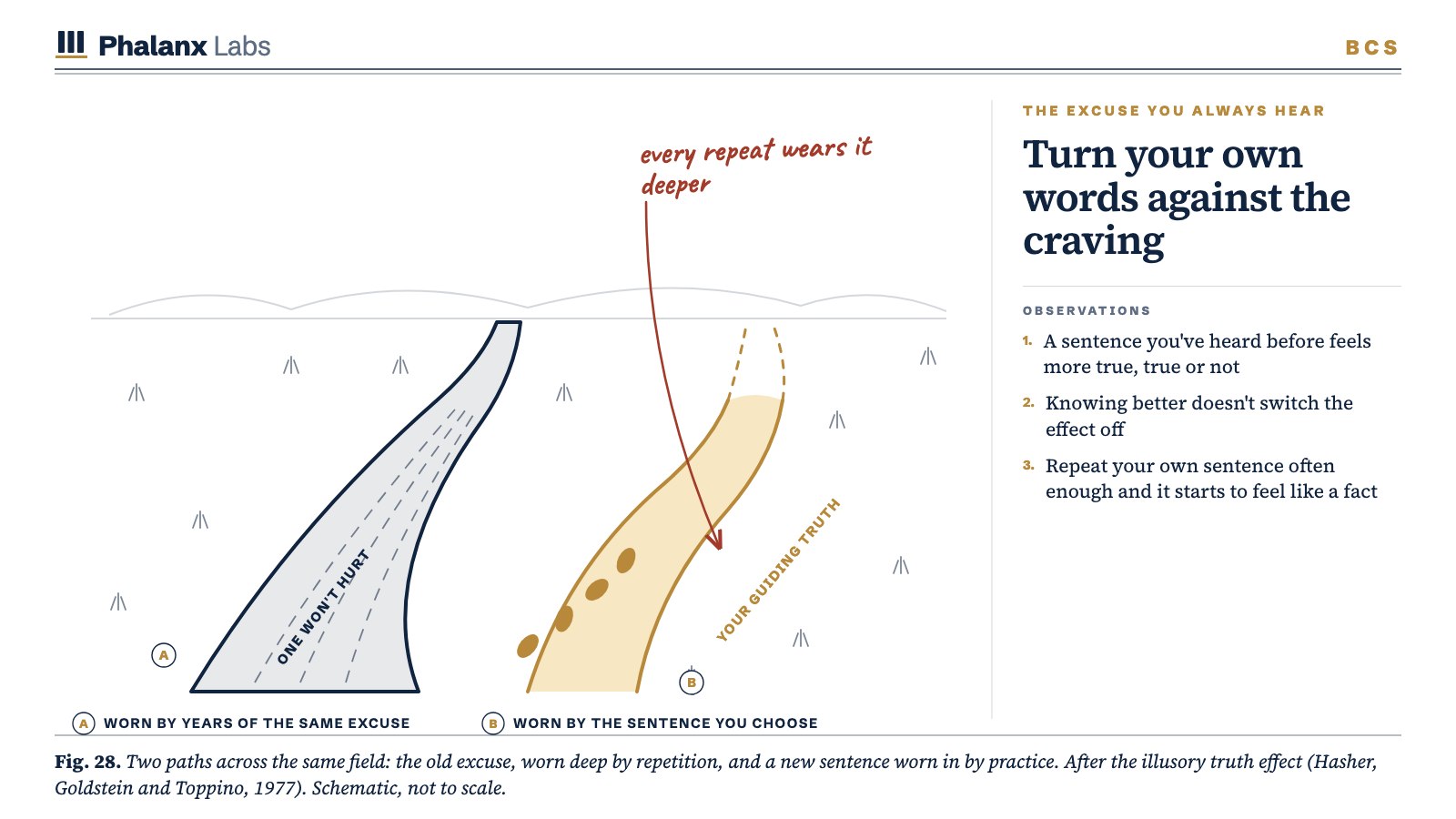
The thought that gets you to relapse usually sounds like plain common sense.
"It's been a long week. One won't hurt."
You've heard it so many times that it's stopped feeling like a thought and started feeling like a fact.
You've seen this already. It's Friday evening, you've had a hard week, and you've been doing well. Then that sentence shows up, calm and reasonable, and you find yourself agreeing with it before you've even noticed it's there.
Ten minutes later you've given in. And the next morning you can't work out how something so obviously wrong felt so obviously right.
So why does this happen?
There's a reason that sentence feels true, and it has nothing to do with whether it is.
Researchers once gave people a list of statements and asked them to rate how true each one sounded. Some were true and some were false. They brought the same people back a couple of weeks later, and again after that, and mixed some of the old statements in with new ones.
The statements people had seen before were rated as more true every time they came back. It didn't matter whether they were actually true or false. Hearing them again made them feel truer.
Later studies found something even more uncomfortable. The effect still showed up when people already knew the right answer. Knowing better didn't protect them.
Researchers think the reason is simple. Your brain uses familiarity as a shortcut. A sentence you've heard before is easier to process, and something that's easy to process feels right. Most of the time that shortcut saves you effort. Here, it works against you.
Now think about your habit.
How many times have you heard "one won't hurt"? Or "I'll start again on Monday"? Or "everyone does it, it's not a big deal"?
Probably hundreds of times, maybe thousands. Every time you gave in after one of those sentences, you heard it again, and you acted on it. So by now it's one of the most familiar sentences in your head, and to your brain, familiar feels true.
That's why arguing with it in the moment rarely works. You're trying to beat a sentence you've rehearsed for years with a reason you came up with thirty seconds ago. The old sentence feels true because you know it so well. Your new reason feels weak because you've barely heard it.
The craving doesn't have to come up with a clever argument. It only has to use the one that's worked a thousand times before.
This is a big part of what we do in phase 2 of our program.
First, we find the sentences. Clients write down every excuse that has come before a relapse, in their own words. "Just one more time." "I'll start Monday." "It's harmless, everyone does it." Most people are surprised by how short the list is. The same four or five sentences have been doing almost all the work.
Then clients learn to treat them as a script they've heard before. When one shows up, they recognize it and name it, instead of getting into a debate with it.
Then we give them a sentence of their own. Each client writes what we call a guiding truth, a short statement of who they are now and what they've decided, and they answer every excuse with it.
And then they repeat it, every day, and every time one of the old sentences turns up.
Because the same thing that made the excuse feel true works for the new sentence too. The more often you hear it, the more it starts to feel like a fact. Over time, the old sentences get weaker because they stop paying off, and the new one gets stronger because you keep coming back to it.
This is how you stop an excuse from deciding for you.
Sources
- L. Hasher, D. Goldstein and T. Toppino (1977). Frequency and the conference of referential validity. Journal of Verbal Learning and Verbal Behavior.
- L. K. Fazio, N. M. Brashier, B. K. Payne and E. J. Marsh (2015). Knowledge does not protect against illusory truth. Journal of Experimental Psychology: General.
The Behavior Control System
Our 90-day program, private and one-on-one, built around your life.
See our programsField Notes
One letter a week from the lab.