Your mind checks every promise against your past
The bigger the promise you make to yourself after a relapse, the faster it tends to fall apart, and research on positive self-talk shows why.
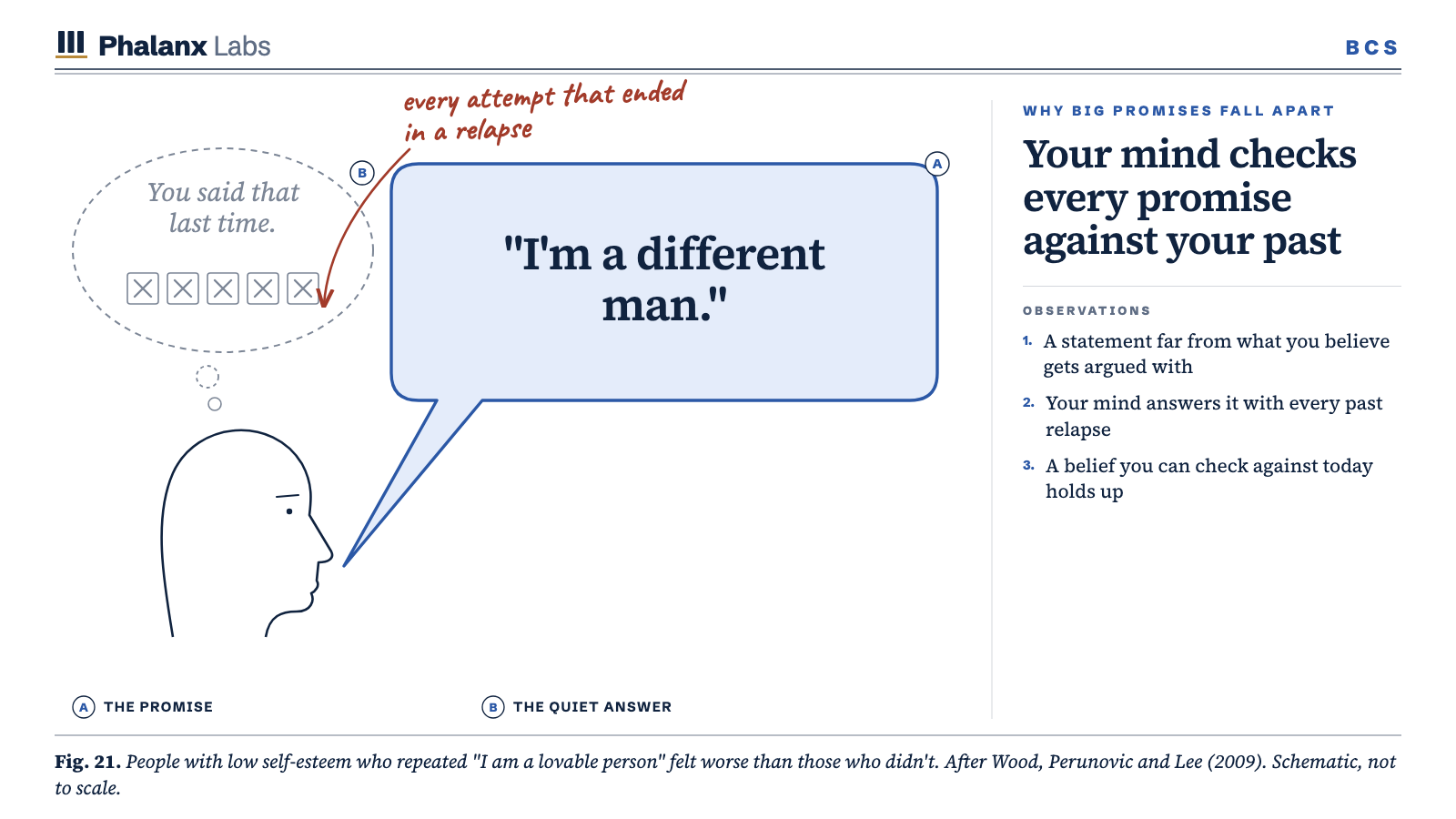
You wake up the morning after a relapse and tell yourself, "That's it, I'm done. From today, I'm a different man."
And somewhere in the back of your head, a quieter voice says, "You said that last time."
Why does a promise that's meant to make you feel stronger so often leave you feeling worse?
We see this all the time. The bigger the promise a man makes to himself after a relapse, the faster it seems to fall apart.
A psychologist called Joanne Wood studied something very close to this in 2009. She and her colleagues wanted to find out whether positive self-talk actually works, and for whom.
They took people with low self-esteem and people with high self-esteem, and asked some of them to repeat one sentence to themselves: "I am a lovable person." Then they measured how everyone felt.
The people who already felt good about themselves felt a little better after repeating it.
But the people with low self-esteem felt worse. They felt worse than people with low self-esteem who hadn't repeated anything at all.
Saying something kind about themselves had made them feel worse about themselves.
The researchers' explanation was that when you hear a statement that's far from what you already believe about yourself, your mind doesn't just accept it. It starts arguing with it, and to do that, it goes looking for evidence that the statement is wrong.
So a man with low self-esteem says "I am a lovable person," and his mind answers with every time he felt unloved.
In a later part of the research, they let people with low self-esteem think about the ways the statement might not be true, as well as the ways it was. Those people felt better than the ones who were told to focus only on how it was true.
Now think about what this means if you've tried to stop before, maybe a few times, maybe more times than you want to count.
When you say, "I'm done forever," your mind does exactly what it did in that study. It checks the sentence against what it knows, and it finds every attempt that ended in a relapse.
So the promise you made to feel stronger ends up reminding you of every time you didn't keep it. Then you feel worse, and when you feel worse, the habit starts to look like relief.
This is why you can't just decide to believe in yourself again. Your mind won't accept a belief it has no evidence for.
So what do we do about it in our program?
Most of this work happens in phase 3, and it's in phase 3 for a reason.
First, you write down the beliefs about yourself that are tied to the habit. Things like "I always fail after a couple of weeks, so I'll never break free," or "I just don't have the willpower."
Then you ask one question of each one: "Is this really true?"
Then you replace it with something you can actually believe. Instead of "I'm a new man," it's something like "I can take small, focused actions every day, and each day counts toward where I'm going." Your mind can check that sentence against today, and it holds up.
And by phase 3, your mind has something to check it against. You've spent the first two phases rebuilding your days and learning to handle your triggers and cravings, so you have weeks of real evidence that you can do this.
That's why we don't start with identity. If you try to build a new self-image with nothing under it, your own mind argues it down. When there are weeks of proof under it, there's far less for your mind to argue with.
None of this means a better sentence will stop a craving on its own. It won't.
But it stops you from making things worse every time you try to talk yourself up, and it gives you a belief about yourself that can actually last.
This is how you start believing yourself again.
Sources
- J. V. Wood, W. Q. E. Perunovic and J. W. Lee (2009). Positive self-statements: power for some, peril for others. Psychological Science.
The Behavior Control System
Our 90-day program, private and one-on-one, built around your life.
See our programsField Notes
One letter a week from the lab.