Case file 19
Through Christmas and New Year without cocaine
Name withheld
- Came in with
- Cocaine
- Program
- 90-Day Behavior Control System, with a specialist
- Where it stood at last contact
- No relapse since the start; some minor cravings, handled "with ease"; feeling better mentally and physically; next goal: concentrating for longer
- On record
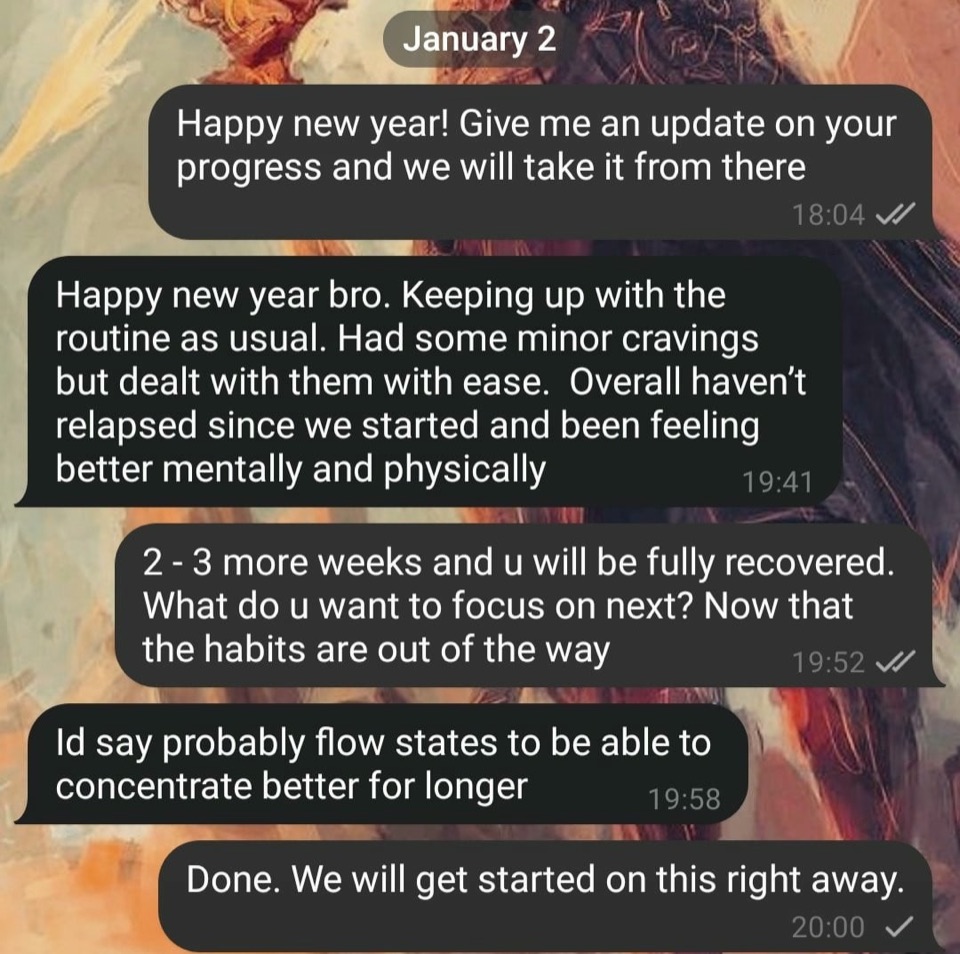
- Written update (screenshot): one short exchange with the specialist on 2 January
Two days into the new year, this client's specialist sent a short message: happy new year, and how's it going? The client's answer was four lines long. The routine was holding. There had been a few minor cravings, and none of them had been a problem. There had been no relapse since the start, which meant no cocaine through a season of parties, late nights and New Year's Eve. Then the specialist asked what the client wanted to work on next. With cocaine no longer taking their weekends and the days after them, they wanted to be able to concentrate for longer.
This file follows what the record shows: a routine that held through the holidays, cravings that had become manageable, and a person ready to aim at something beyond stopping.
Big weekends, and the week it took to pay for them
What the client asked for next tells us what had been missing. "Id say probably flow states to be able to concentrate better for longer." People don't ask for that unless concentrating for any real length of time has been hard. And the client's update says they'd "been feeling better mentally and physically", which means that for a while before, they'd been feeling worse on both.
With cocaine, that's a picture we see a lot. The nights were only part of the cost. The days after were the rest: a crash in mood and energy, broken sleep, and a few days of feeling flat, foggy and short-tempered. Work that needed real focus suffered first. By the end of the week, after days of feeling flat and getting little done, the next big night felt earned. Each part of the cycle made the next one more likely.
Most of those nights started with a drink. Cocaine was rarely the plan at the start of the evening. A few drinks in, the decision got made by someone in no state to make it, and the message to the number in their phone went out.
Their earlier attempts aren't on record. If they were like most people's, they'll sound familiar: a weekends-only rule, a promise made on a bad Sunday, a number deleted and then dug out again a few weeks later. Each one tried to force cocaine out while the drinking, the empty evenings and the flat days around it stayed exactly where they were.
What we found: cocaine lived in the unplanned nights
The first call was about finding what kept cocaine in the client's life. Much of the answer was time with nothing planned in it: the end of a long week, an evening with no fixed end, a weekend with nothing booked. Those were the times when one drink became several and the message got sent. Tiredness made it worse, and the days after each night kept them tired.
So the plan was built around structure. The client would rebuild their sleep, their body and their day before stopping anything, until there were few places left for cocaine to fit. On Day 15 cocaine would stop, and so would the drinking that came before it, because a night that started with drinks too often ended with cocaine. Anyone who drinks heavily every day talks to a doctor before stopping. For this client the drinking went with the nights out, and their specialist checked that on the first call.
The attention training that runs through the program would matter more than usual too, because someone who can keep their mind on one thing is more likely to notice a craving before acting on it. Ahead of the start date, they put their commitment in writing.
Phase 1, Days 1 to 30: a week with fixed points in it
The first week. From Day 1 the client wrote up each evening for their specialist, who read every entry. The basics went in quickly: fixed sleep times, daylight early, dimmer evenings, no phone in the bedroom, daily walks and training. Late nights and the days after them had wrecked their sleep for a long time, so getting to bed and up at the same times came first.
The sitting practice. One small piece of that first week mattered more for this client than for most: a short daily sitting practice that trains attention. At first they could hardly stay with it for a few minutes. Their mind kept jumping to the next thing, which is exactly why it was there. It was the first daily practice aimed straight at their scattered attention, and it's where the goal they named in January first started.
The routine. In the second week their eating changed, and then the day was given a timetable from morning to night. Friday and Saturday got fixed points too, because those were the nights cocaine had always taken. This is the routine the client would still be "keeping up with" in January. At first it felt rigid, and they said so in their entries. By the end of the second week it had started to feel like a normal week.
The written work came next. They learned how a habit repeats itself and why a full stop beats cutting back, which ended the weekends-only rule for good. They wrote down every quick, easy source of a good feeling they leaned on, cocaine, the drinks and everything else, and traced the history of their cocaine use honestly. On Day 14 they read the rule that relapses follow skipped daily habits and broken routines. For this client it became a guide: if the routine held, the rest would follow.
Day 15 and the weeks after. Cocaine and the drinking stopped on Day 15. The cravings in the first weeks weren't minor yet. The client felt flat, low on energy and short-tempered, and things that should have been enjoyable didn't feel like much. Their sleep was worse than it felt in the second and third weeks, and the log showed it even on days they thought they were fine. The cravings came hardest on Friday evenings and around payday. The client stuck to the routine through them, and on the difficult days they messaged their specialist, who could see from the log which parts of the week had too little in them.
Later in the month came cold and heat, a hobby with goals that kept rising, a calming practice and more attention work. The last lessons explained why the brain ties cocaine to the people, places, times and moods it was used with, which is why a Friday evening could set off a craving on its own. The month ended with the Day 28 call.
Phase 2, Days 31 to 60: why the cravings became minor
By January the client was calling their cravings "minor" and saying they'd "dealt with them with ease". That didn't happen by itself. It came out of the work in the second phase.
Day 31: the trigger map. The client listed everything that set cocaine off. Most of it was about time and tiredness: Friday at the end of a big week, payday, an evening with nothing planned, the third drink. A few bars were on it, and a few friends they'd always used with, one in particular. So was cash in their pocket on a night out. Boredom was there, along with the feeling of being stuck on something hard, and the flat mood that the days after a big night used to bring.
Day 32: the reset. Whatever could go, went. The number was deleted, along with the old messages it could have been found in again. Contacts that only existed for buying went too. Drink left the house, and so did anything they'd kept for using. They stopped carrying cash on nights out, and the bars that always ended in cocaine came off their list. What couldn't go was rearranged or planned for.
Building the responses. Each trigger still standing after the reset needed an answer, and the client spent the following weeks building them. Friday evenings got something fixed in them. Payday got a plan. The nights out they couldn't skip got a plan made in the afternoon, sober: where they'd be, how they'd get home and when they'd leave. A message from that one friend got a response decided in advance. And the stuck feeling, which used to send them looking for a night out, got its own response.
They also worked on the thoughts that come just before giving in: they'd earned it after the week they'd had, one night wouldn't undo anything, they'd be strict again on Monday. The client picked out the main one and wrote out an answer to it on a day when they felt fine, so it would be ready on a day when they didn't. For the craving itself, they learned practices to settle their breathing, ease the tension in their body and get through the worst of it.
By Day 52 every trigger that couldn't be removed had its own matched response. Next came a week of using them on real days and writing down each craving. For this client, that week and the days around it fell over Christmas and New Year.
Christmas and New Year: the hardest stretch of Phase 2
For many people trying to stop cocaine, the end of the year is where the attempt falls apart. There are parties, old friends back in town, drinks handed to you everywhere and days off with no shape to them. For this client, New Year's Eve had been the biggest night of the year for cocaine.
Their specialist talked the holidays through with them in advance: which nights would be hardest, which invitations to turn down and which to go to with a plan, what the routine would look like on days off, and how they'd get home. Not every part of the routine survived every day. But the parts that mattered held, and so did the responses.
The hardest moment came on New Year's Eve, when the friend from their trigger map sent a message asking about plans for the night. It was the exact message they'd built a response for, and they used it. They spent the evening somewhere they'd chosen, with a time to leave already set. The craving was there, but it was smaller than they'd expected, and it passed. Once you've used a response many times on ordinary days, you don't have to think much to use it on a hard one.
The update on 2 January shows how it went. "Keeping up with the routine as usual." Written on the second day of the year, "as usual" tells us the routine got through the holidays in one piece. "Overall haven't relapsed since we started." The second progress call closed the phase, and Phase 3 began with the new year.
Phase 3, Days 61 to 90: something to aim at besides stopping
The last phase is about who the client is without cocaine, and what they want to do with the time and attention it used to take. For a long time they'd seen themselves as someone who worked hard all week and had earned a big weekend. That picture had always come with the days after. Now they had weeks of clear Mondays to put against it.
The specialist's question in January was part of this work, and the client's answer fits the case. Cocaine and the days after it had kept their attention scattered for a long time. Now they wanted the opposite: the ability to stay with hard work for long stretches without breaking off. Their specialist agreed to start on it straight away.
The 2 January exchange is the last thing on record, so what follows came after it and isn't in the client's words. The concentration goal became the main focus of the rest of the phase, and their days were reshaped around longer, protected stretches of focused work, built up gradually. Alongside it came the work this phase always includes: a look back at why earlier attempts hadn't lasted, and a new view of themselves built from what they actually did each day. They rehearsed the situation most likely to throw them after the program, a big celebration with drinks and people who still used. They finished by setting their Day 90 view of themselves against their Day 1 account, and made a plan for after the 90 days.
Where the client was on 2 January
The update from 2 January, in the client's words:
"Keeping up with the routine as usual. Had some minor cravings but dealt with them with ease. Overall haven't relapsed since we started and been feeling better mentally and physically."
And on what came next: "Id say probably flow states to be able to concentrate better for longer."
Why it held through the holidays
- The routine came first and stayed first. It's the first thing the client mentions in the update. Their week had fixed points, Friday and Saturday included, so cocaine had fewer gaps to fill.
- Cocaine and the drinking stopped together. Most of the client's nights had started with a drink, so stopping both removed the step that usually came first.
- The holidays were planned for. The client went into the hardest weeks of the year with the routine, the responses and a decision about New Year's Eve already in place.
- Practiced responses made the cravings small. By January, cravings still came, and the client dealt with them "with ease". The work in the second phase is what made that possible.
- The client had something to aim at next. Wanting to concentrate for longer gave the time and attention cocaine used to take a new place to go.
For anyone who loses the week after a big night
If cocaine comes into your life on nights out, a few drinks in, and you spend the days after it foggy, flat and behind, this case is worth thinking about. What carried this client through was a routine built weeks earlier and practiced every day, the drinking stopped alongside the cocaine, and a plan for the hardest nights made before they arrived.
It also shows that cravings don't have to disappear for things to be going well. This client still had them in January, even over the holidays. What had changed was that they'd become minor and manageable, and the client was already thinking about what to build with a clear head.