How to make any habit hard to reach
Giving in at 10pm isn't a weakness of will: it's what happens when you have to win the same argument with yourself every night, so the fix is to make the habit hard to reach before the craving shows up.
The method: The Self-Binding Method
Contents10 sections
- Who is this for?
- Step 1: Bind yourself while you're calm
- Step 2: Space. Put distance between you and the habit
- Step 3: Time. Lock down your danger hours
- Step 4: Category. Cut what LEADS to the habit
- Step 5: Make the last few seconds awkward
- Step 6: Write a 60-second checklist (borrowed from pilots)
- Step 7: Inspect your binds every week
- Why does this work?
- Sources
(Works for porn, alcohol, weed, nicotine, scrolling, gambling, any habit. It's the first system we set up with every client.)
Who is this for?
- You wake up promising "not tonight" and give in by the evening
- You've tried willpower, apps, start dates.. and you're back at day one
- The habit is always within reach. In your pocket, in the next room, one tap away
- Deep down, you think the problem is that you're weak
If this is you, read on.
Giving in at 10pm is not a weakness of will.
It's what happens when you have to win the same argument with yourself every single night, at the time of day you're most tired.
Think about how your day actually goes..
In the morning you're clear. You remember how bad last night felt and you mean it when you say "not tonight."
Then evening comes. You're drained, the day was long, and the thing you swore off is in the next room. So you fight it. Some nights you win. But you only have to lose once, and the next morning you call yourself weak.
Here's what most people never realize.
Researchers once followed people through their normal days to see how the ones with the most self-control actually use it. They expected them to be fighting urges all day and winning.
They weren't. They were barely fighting at all. Their lives were simply set up so the temptation rarely showed up.
That's the whole game.
The disciplined guy isn't stronger than you. He just isn't standing next to the bottle every night.
And it goes deeper than that..
Another study gave people stale, week-old popcorn at the movies. The ones who always eat popcorn at the movies ate just as much stale as fresh. They hated it, and they ate it anyway, because the lights were down and the bag was in their hand.
That's your habit. Same couch, same time, same reach. By the time you "decide", your hand is already moving.
But here's the part that matters. When those same people had to eat with their other hand, they suddenly ate far less. The routine got awkward, they started paying attention, and they stopped eating popcorn they didn't even like.
So you don't need more willpower.
You need to make the habit hard to reach BEFORE the craving shows up.
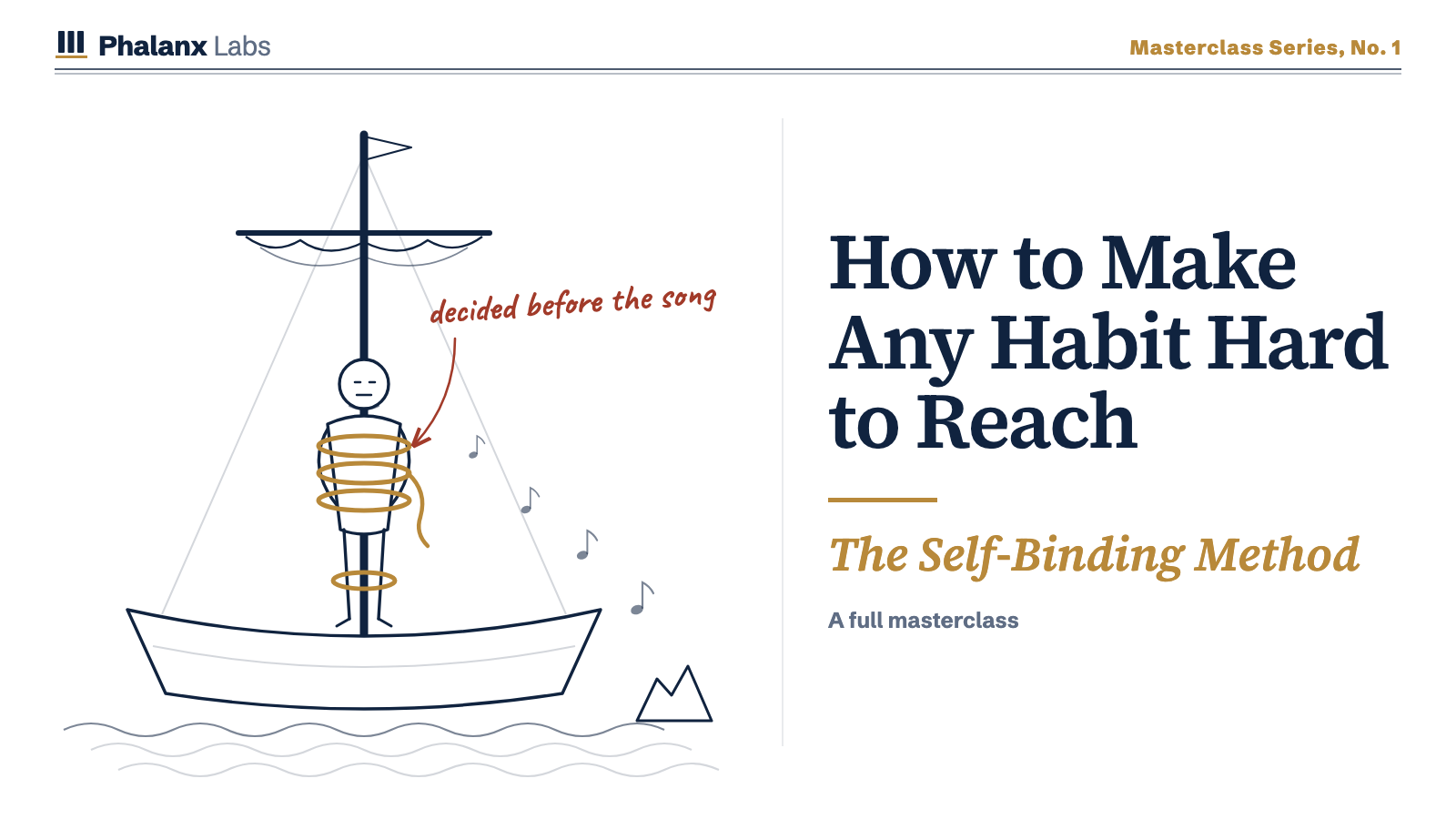
This is called self-binding. It's the old story of the sailor who had his crew tie him to the mast so he could sail past the Sirens. He knew he'd lose his head the moment he heard them sing, so he made the decision while he still had it.
You're going to do the same thing.
This post is not about theory though. Here's exactly how to set it up.
Let's begin.
Step 1: Bind yourself while you're calm
Pick a morning when you feel good. Never at night, and never the morning after a relapse.
When you're calm, you can't feel how strong the craving will be later. So you leave yourself loopholes. "I'll keep one bottle for guests." "I'll keep the app, I just won't open it."
Your 10pm self will find every single one of them.
So write every decision down, and assume the man who has to live with it is tired, stressed and looking for an excuse.
Step 2: Space. Put distance between you and the habit
Write down the 3 places you give in most. For most guys it's the couch after dinner, bed with the phone, and the car on the way home.
Now make the habit at least one real effort away from each of them. Hiding it doesn't count, because you know where you hid it.
- Alcohol: none in the house, and change your route so you don't pass the store. If you travel, call the hotel ahead and ask them to empty the minibar.
- Weed or a vape: throw it out, don't put it in a drawer. Delete the number you buy from.
- Porn or scrolling: the phone charges in the kitchen, the laptop goes in its bag after 9pm, and blockers go on everything with the password held by someone else.
- Gambling: self-exclude from every site and venue you use, and ask your bank if it can block gambling payments.
The rule for all of it: undoing the bind must take more effort than keeping it. Delete the account, don't log out. Throw it away, don't put it on a high shelf.
Step 3: Time. Lock down your danger hours
There's an experiment where rats were given access to a drug for either one hour a day or six. The six-hour rats kept taking more and more. The one-hour rats stayed steady.
The more hours you leave open, the bigger the habit grows.
You're stopping completely, so you're not using time to allow the habit. You're using it to guard the hours you're most likely to give in. For most guys, that's from the moment they walk in the door to the moment they fall asleep.
- Phone downtime at 9:30pm, with the passcode held by someone else
- Delivery and betting apps blocked after 8pm
- The first hour after work planned every single day, because an empty evening is where a lot of relapses start
Step 4: Category. Cut what LEADS to the habit
This is the step most people skip.
A gambler who quits betting but still watches every game, reads the sports pages and listens to sports radio is still walking straight back toward a bet.
What comes right before yours?
The midnight YouTube rabbit hole that ends somewhere else. The bar where it's always "just one". The friend who always has weed. The podcast with the betting tips.
Write the list, and treat everything on it like the habit itself, at least for the first few months.
Step 5: Make the last few seconds awkward
Remember the popcorn and the other hand.
Break the autopilot around your habit wherever you can:
- Sit in a different chair in the evening
- Switch your phone to grayscale
- Anything that can't leave the house goes in a box that takes two hands and a minute to open
None of these will stop a big craving on their own. What they do is break the sequence that runs before you even notice it.
Step 6: Write a 60-second checklist (borrowed from pilots)
Pilots don't trust their memory when the pressure's on. They run a short checklist at set moments, only the few things that are most dangerous to skip, and it's kept short enough to do in about a minute so nobody starts skipping steps.
Your set moment is when you walk in the door after work.
Your checklist:
- Phone on the charger in the kitchen
- Nothing in the house I don't want tonight
- My next 2 hours, written down
- One message to someone who knows I'm stopping
- My plan if the craving gets strong
Put it on your lock screen or the inside of your front door, and run it every day, even on the good days. Pilots don't skip the checklist because the weather is nice.
Step 7: Inspect your binds every week
Your 10pm self is creative. A new app gets downloaded. Someone gives you a bottle at dinner. A friend mentions a new site.
Once a week, for 10 minutes, walk through your 3 places and your Step 4 list, and close whatever has opened up again.
Why does this work?
Because you stop asking a tired brain to win a fight every night.
Every bind puts time and effort between the want and the act. And in that gap, the autopilot switches off and YOU get your choice back.
That's why the people with the most self-control barely have to use it.
Now, be honest with yourself..
This isn't magic. You'll still want it some nights, and if your addiction is severe, binds alone won't carry you. What they buy you is the gap. What you do inside that gap is a different skill, and we'll cover it in another post.
And if you drink heavily every day, talk to a doctor before you stop. Stopping suddenly can be dangerous.
Set this up this week. It takes about an hour.
Try it out, it works.
This is the first thing we set up with clients in phase 1 of our program. We map every place and every hour the habit happens, go through that list until the habit is hard to reach, and then build everything else on top of it.
Sources
- W. Hofmann, R. F. Baumeister, G. Förster and K. D. Vohs (2012). Everyday temptations: an experience sampling study of desire, conflict, and self-control. Journal of Personality and Social Psychology.
- D. T. Neal, W. Wood, M. Wu and D. Kurlander (2011). The pull of the past: when do habits persist despite conflict with motives? Personality and Social Psychology Bulletin.
- S. H. Ahmed and G. F. Koob (1998). Transition from moderate to excessive drug intake: change in hedonic set point. Science.
- Anna Lembke, Dopamine Nation: Finding Balance in the Age of Indulgence (Dutton, 2021)
- Atul Gawande, The Checklist Manifesto (Metropolitan Books, 2009)
The Behavior Control System
Our 90-day program, private and one-on-one, built around your life.
See our programsField Notes
One letter a week from the lab.