How to stop giving in to cravings without saying no
Your brain judges a reward by how close it is, so “no” fights the habit at the moment it looks biggest, while “not yet” pushes it a little further away and lets the craving come down.
The method: The “Not Yet” Method
Contents12 sections
- Who is this for?
- Step 1: Write your card before the craving
- Step 2: When it starts, say "not yet"
- Step 3: Rate it from 1 to 10
- Step 4: Watch it while you wait
- Step 5: Look at the whole year, not this one time
- Step 6: When the 15 minutes are up, rate it again
- Step 7: Keep going to the end
- Step 8: If it's too strong, change where you are
- Step 9: Practice on the small ones
- Why does this work?
- Sources
(Works for porn, alcohol, weed, nicotine, scrolling, gambling, any habit. It's what we teach every client once the habit is hard to reach.)
Who is this for?
- The craving hits and saying no feels impossible, so you give in
- Earlier in the day you're sure you won't do it, and a few hours later you're doing it anyway
- You can go days without it, then one craving wipes it all out
- Deep down, you think you just don't want it badly enough
If this is you, read on.
Giving in to a craving is not a weakness of will.
It's what happens when your brain is shown a reward that's right in front of it and asked to say no to it forever.
Think about how it usually goes for you..
Earlier in the day, you're clear. Not today. You've thought it through, and you mean it.
Then, hours later, something sets it off. A long day, an empty house, the phone lighting up in bed. Your chest gets tight, your hands get restless, and a voice says "just this once".
And the thing you were so sure about a few hours ago suddenly feels small, while the habit feels huge.
So you tell yourself no. And the harder you push, the louder it gets, until giving in feels like the only way to make it stop.
Afterwards, you're clear again, and you can't understand how you changed your mind so fast.
Here's what's actually happening.
Your brain judges a reward by how close it is, much more than by how good it is.
Something you can have right now looks enormous. The same thing an hour from now looks a lot smaller. And something good that's weeks or months away, like your health, your focus or your self-respect, barely registers next to it.
This is why you can be completely sure earlier in the day and change your mind later. When you're deciding ahead of time, both the habit and the life you want are far away, so you can see which one is bigger. When the craving hits, the habit is right there, and it looks bigger than everything else for as long as it's within reach.
Researchers have watched this happen in people and in animals. Offer someone a small reward soon or a bigger one later, and when both are far off, they pick the bigger one. Bring the small one close enough to grab, and they switch.
And the habit makes it worse. In one study, people were asked to imagine they'd won a lottery ticket and could take less money now or the full amount in a week. About one in five active drug users took the smaller amount now. Almost nobody who'd stopped did. Smokers do the same thing, and the more they smoke, the more they do it.
That matters, because when the craving hits and you say no, you're fighting your brain at the exact moment the habit looks biggest. And you're asking it to give up that reward for good. It's a reward it can have right now, up against a promise that has to last forever, and your brain is going to pick the reward almost every time.
But here's what most people never notice.
A craving that you don't act on doesn't keep climbing. It rises, it peaks, and it comes back down on its own.
You already know this. Think of a time you couldn't give in, on a flight, at a family dinner, in a long meeting. The craving came, and at some point it was gone. You didn't do anything. It just passed.
A doctor once drew this on a whiteboard for a patient who swore his head would explode if he didn't smoke. He drew the craving as an arrow climbing toward a cigarette. Then he asked what happened on flights, when the man couldn't smoke. "I guess it went away." So he bent the arrow over at the top and brought it back down. A hump. The patient had been getting through cravings for years without knowing it.
So instead of trying to win the fight with a no, you push the reward a little further away, and you let the craving come down while you wait.
That's what "not yet" does.
"No" asks your brain to give the habit up forever, at the moment it looks biggest. "Not yet" asks for something much smaller: to decide later. And the moment the reward is even a little way off, it starts to shrink.
This post is not about theory though. Here's exactly how to set it up.
Let's begin.
Step 1: Write your card before the craving
Write this on a card that fits in your wallet, or in your phone notes:
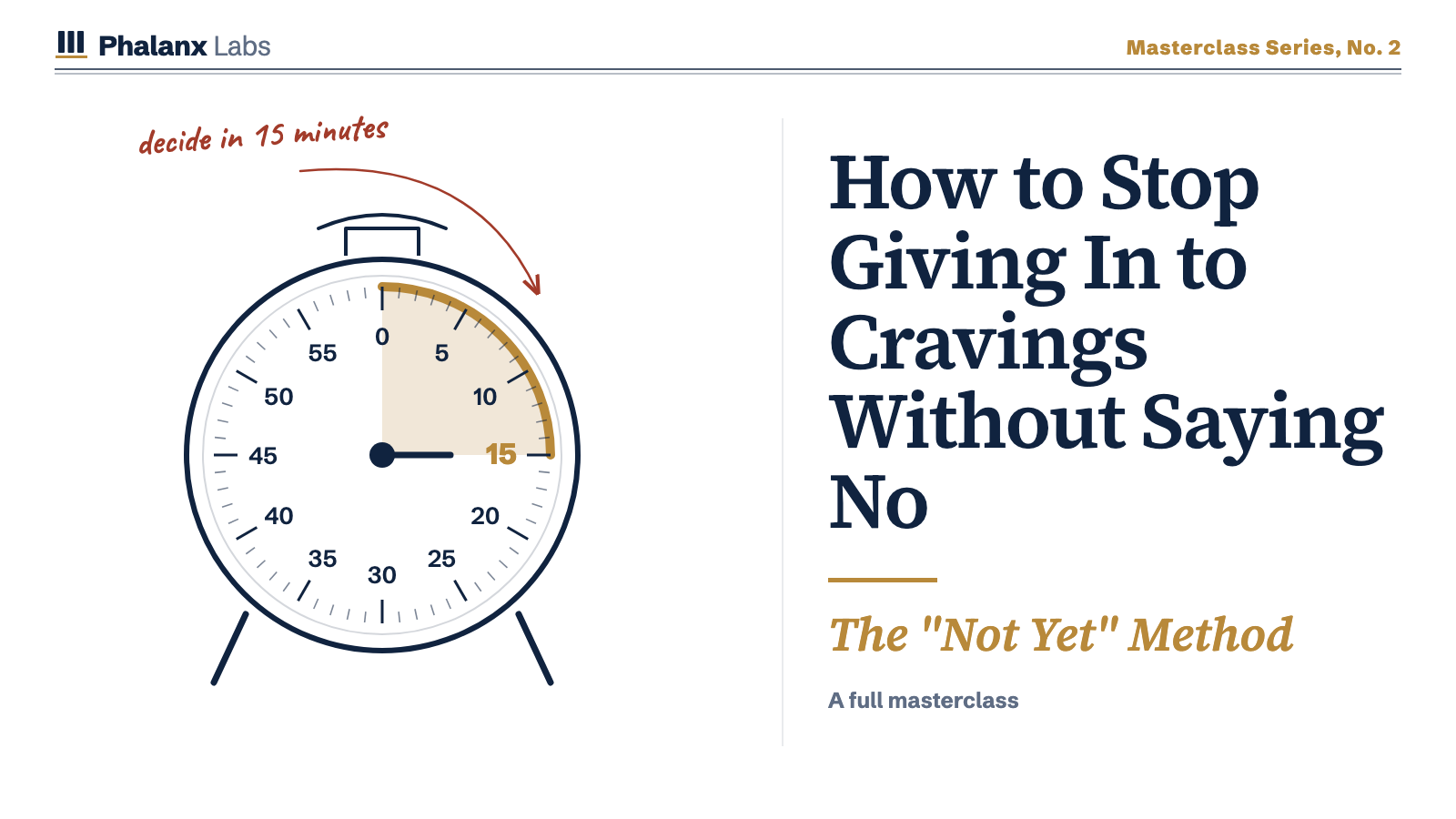
- Not yet. I'll decide in 15 minutes.
- Rate it.
- Where is it in my body?
- This isn't one time. It's every time like this one.
Have a pen and paper, or a note on your phone, where you'll write a number and the time.
Step 2: When it starts, say "not yet"
Don't say no. Say, silently or out loud: "Not yet. I'll decide in 15 minutes."
Write down the time.
It sounds too simple to matter. But you've just moved the reward from right now to 15 minutes away. You haven't given anything up. You've only put off the decision.
Step 3: Rate it from 1 to 10
How strong is it right now? Write the number down next to the time.
When you're craving something, time feels slower. Fifteen minutes can feel like an hour. The numbers show you what's actually happening.
Step 4: Watch it while you wait
Stop what you're doing. Take a few slow breaths and feel the air go in and out.
Then ask yourself: "What does my body feel like right now?"
Don't go looking. Let the strongest feeling come to you, and name it in a word or two:
- Tight chest
- Restless hands
- Heat in the face
- Mouth watering
- The thought "just one"
Don't argue with the craving, don't try to make it go away, and don't reach for something else to fix it. You're just watching it.
Step 5: Look at the whole year, not this one time
Read the last line on your card: "This isn't one time. It's every time like this one."
Because it is. If you give in now, then the next time it feels like this, you'll give in too. This choice is really a choice about all of them.
There's an experiment where students had to choose between a small amount of money now and a bigger amount a week later, once a week for five weeks. When they had to decide all five weeks at once, they picked the bigger, later amount far more often.
So ask yourself: "If I do this every time it feels like this, what does my year look like?" Then ask what it looks like if you don't.
One time is easy to give away. A whole year is much harder.
Step 6: When the 15 minutes are up, rate it again
Write the new number down.
Then decide again. If you still want it, say "not yet" again, and set another 15 minutes.
You'll often find the number has dropped. Sometimes it's gone completely before the second 15 minutes are up.
Step 7: Keep going to the end
Keep saying "not yet" until the craving is gone, or down to a 1 or 2.
Then write down the highest number and how many times you said "not yet".
Step 8: If it's too strong, change where you are
If you're at a 9 or 10 and you feel yourself about to give in, get out of the room. Call someone, or go somewhere the habit isn't available. Then start the 15 minutes again.
Step 9: Practice on the small ones
Don't wait for the worst craving of the week to try this for the first time.
Practice on the small urges. The urge to check your phone. The urge to get up when you're sitting still. Say "not yet" and watch what happens. Every small one you get through makes the next big one easier.
Why does this work?
Because your brain judges a reward by how close it is. "Not yet" moves the habit a little further away, which makes it look smaller. Thinking about the whole year makes what you want look bigger.
And while you wait, the craving does what every craving does. It rises, it peaks, and it comes down.
Every time you give in, you teach your brain that a craving means you act on it. Every time you get to the end of a "not yet", you teach it the opposite: you can have the craving and not act on it.
Think of the craving as a fire, and the habit as the wood you keep throwing on it. Stop adding wood and the fire doesn't go out at once. It burns what's already there. But it burns down.
Now, be honest with yourself..
This won't make the cravings stop tomorrow. For a while after you stop, they'll still come, sometimes just as strong as before. That's normal, and it doesn't mean it isn't working. They fade over weeks, not hours.
And it isn't magic. Some people find it hard at first, and some cravings will be too strong. That's what Step 8 is for.
It also works best when the habit is already hard to reach. If the bottle is in your hand, "not yet" is very hard to say. That's why yesterday's post, on making the habit hard to reach, came first.
And if you drink heavily every day, talk to a doctor before you stop. Stopping suddenly can be dangerous.
Try it out, it works.
This is what we train clients to do in phase 2 of our program. Once the habit is hard to reach, we map every craving, and we practice getting through them until it's the default.
Sources
- George Ainslie, Breakdown of Will (Cambridge University Press, 2001)
- Anna Lembke, Dopamine Nation: Finding Balance in the Age of Indulgence (Dutton, 2021)
- Judson Brewer, The Craving Mind (Yale University Press, 2017)
- Marsha M. Linehan, DBT Skills Training Manual, 2nd edition (Guilford Press, 2015)
- Lane Pederson, The Expanded Dialectical Behavior Therapy Skills Training Manual (PESI Publishing, 2012)
- G. Alan Marlatt and Dennis M. Donovan (eds.), Relapse Prevention: Maintenance Strategies in the Treatment of Addictive Behaviors, 2nd edition (Guilford Press, 2005)
- K. Witkiewitz, S. Bowen, E. N. Harrop, H. Douglas, M. Enkema and C. Sedgwick (2014). Mindfulness-based treatment to prevent addictive behavior relapse: theoretical models and hypothesized mechanisms of change. Substance Use & Misuse.
The Behavior Control System
Our 90-day program, private and one-on-one, built around your life.
See our programsField Notes
One letter a week from the lab.