How to manage your emotions without the habit
For a lot of people, the habit has become the way they act on a bad feeling, and acting on the urge is what keeps the feeling going.
The method: The Emotion Toolkit
Contents10 sections
- Step 1: Learn the six feelings that send you to the habit
- Step 2: Name it in the moment
- Step 3: Write down what the feeling wants you to do
- Step 4: Check the facts
- Step 5: If there's a real problem, solve the problem
- Step 6: Do the opposite of what the feeling wants
- Step 7: Do it all the way
- Step 8: Stay with it until the feeling drops a little
- Why does this work?
- Sources
Think about how it usually goes..
Your partner says something sharp before you leave for work. You don't answer, but it sits with you all day. By the evening you're on the couch going over it again, and the drink, the vape or the phone is already in your hand.
Or nothing happens at all. It's Sunday night, the house is quiet, you feel low and a bit lonely, and you don't even notice you've opened the app until twenty minutes later.
Here's what most people never realize.
Every emotion comes with an urge to do something. That's what emotions are for. Fear makes you want to get away. Anger makes you want to attack, or to keep going over what the other person did. Sadness makes you want to pull back and hide. Shame makes you want to cover things up so nobody sees. These urges are mostly built into us, and they're fast, because for most of history they kept people alive.
For a lot of people, the habit has become the way they act on those urges. When they're sad, they shut themselves away with it, and when they're angry or anxious, they use it to go numb. When they're ashamed, they do it in secret, which gives them more to be ashamed of.
The problem is that acting on the urge keeps the feeling going. If you pull away from people because you feel low, you spend the evening on your own, and that makes you feel even lower. That's how one bad mood turns into a bad week.
There's a set of skills that therapists built for people whose emotions felt completely out of their control. One of the most useful is called opposite action. When a feeling doesn't fit what's really going on, or acting on it won't help you, you do the opposite of what it's pushing you to do, and you do it fully. If you do that again and again, the feeling itself gets weaker.
People who study mindfulness found something that fits with this. When you notice what you're feeling and name it to yourself, you get less caught up in it. You're watching the feeling instead of being carried along by it.
So this method doesn't ask you to stop feeling things or to push them down. It gives you a plan for each feeling that doesn't go through the habit.
This post is not about theory though. Here's exactly how to set it up.
Let's begin.
Step 1: Learn the six feelings that send you to the habit
Most people only have two words for how they feel: "fine" and "stressed". That isn't enough to work with.
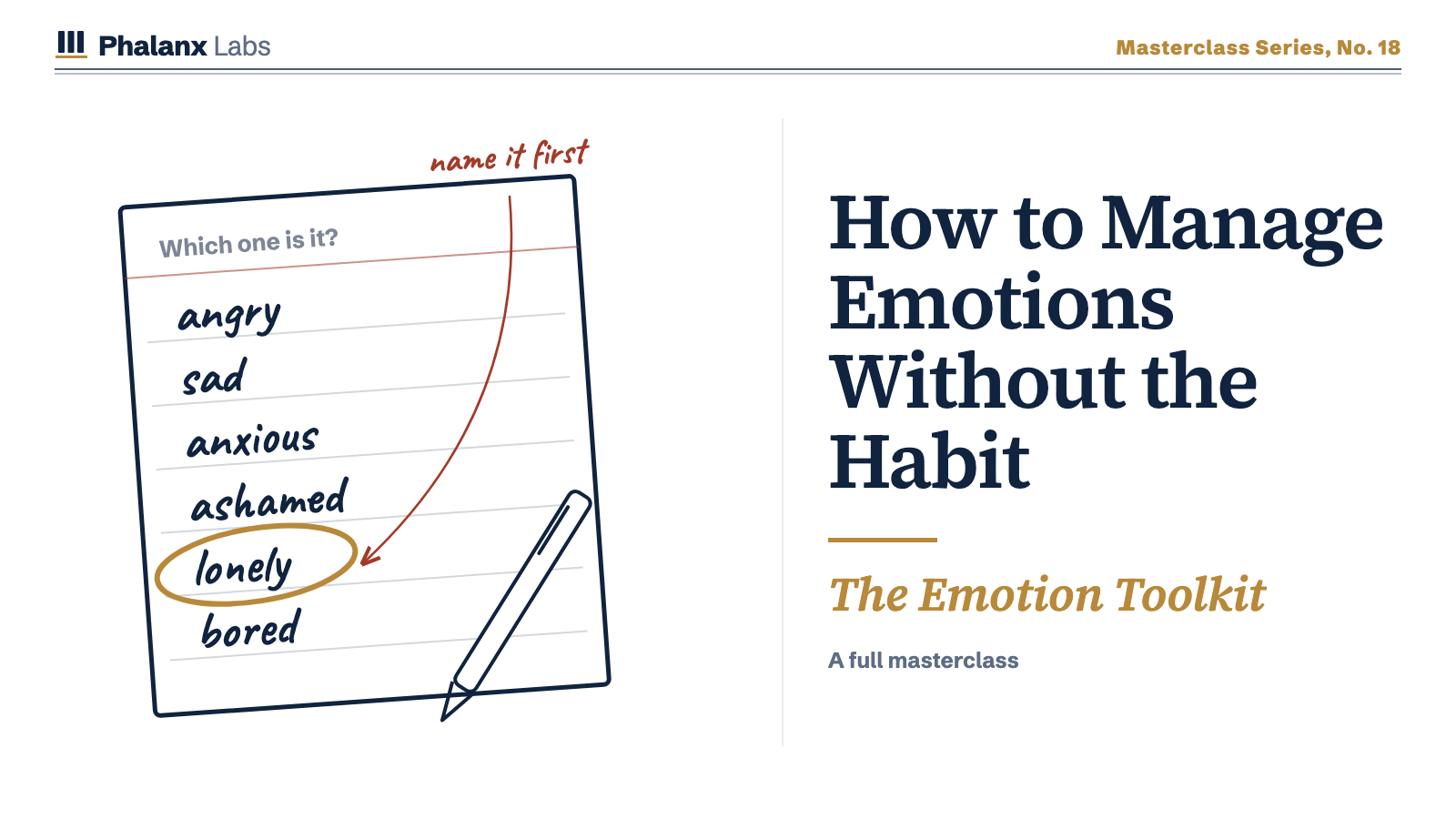
Write these six words on a card or in your notes: angry, sad, anxious, ashamed, lonely, bored.
For the next week, every time you want the habit, stop and ask yourself which of the six it is. Write it down with the time and what just happened. "9:40pm, lonely, nobody texted back." "6:15pm, angry, the meeting with my boss."
After a week you'll see that one or two feelings do most of the damage. That's where you start.
Step 2: Name it in the moment
When the feeling hits, say its name to yourself, silently or out loud. "This is anger." "This is lonely."
Then notice where you feel it in your body. It might be a tight jaw, a hot face, a weight in your chest or legs that won't keep still.
Give it 20 seconds. You aren't trying to get rid of the feeling, you're just looking at it, and that short gap between feeling it and doing something is where every other step happens.
Step 3: Write down what the feeling wants you to do
Ask yourself, "What do I feel like doing right now?"
Be specific. "I want to text her something nasty." "I want to lock the door and get high." "I want to cancel tonight and stay in bed."
That's the urge. Most of the time, the habit is either the urge itself or the next thing that happens after it.
Step 4: Check the facts
Ask yourself two questions.
First, does this feeling fit what actually happened? Being angry because someone lied to you fits. Being furious for three hours because your boss didn't reply to an email probably doesn't.
Second, will acting on it make things better or worse? Even when the feeling fits, getting drunk won't fix whatever caused it.
If the feeling fits and there's a real problem behind it, go to Step 5. If it doesn't fit, or acting on it would make things worse, go to Step 6.
Step 5: If there's a real problem, solve the problem
Sometimes you're sad because something sad happened, or anxious because there's something you really do need to deal with.
Then the habit is just a way of not looking at it. Write the problem down in one sentence, and under it the smallest step you can take on it today, like sending the email or having the conversation you've been putting off.
Step 6: Do the opposite of what the feeling wants
This is the center of the toolkit. Here's what it looks like for each feeling:
- Angry: get away from the person for now instead of going after them, and stop replaying what they did. Do something decent instead of something mean. Relax your face, unclench your jaw, and rest your hands open with the palms up. In skills groups, when people picture someone they're angry with and then relax their face and turn their palms up, a lot of them say the anger drops.
- Sad or low: get active. Call someone, go to the gym, clean the kitchen or do one thing you're good at. Go toward people, not away from them.
- Anxious: if there's no real danger, go toward the thing you're avoiding instead of escaping it. Make the call, or walk into the room.
- Ashamed: stop hiding. Tell one person you trust what happened, someone you know won't reject you.
- Guilty because you really did something wrong: fix it. Apologize, repair what you can, then let it go.
- Lonely: reach out. Text someone first, or go where people are.
- Bored: move. Change rooms, go outside, or start something with your hands.
Step 7: Do it all the way
Half an opposite action doesn't work.
If you go to the gym to lift a low mood and then spend it slumped on a bench scrolling, that's half. If you say "I hear you" to calm an argument, but in a sarcastic voice, that's half too.
So change your posture, your face, what you say and how you say it. Stand up straight and speak in a normal voice.
Step 8: Stay with it until the feeling drops a little
Keep doing the opposite action until you notice the feeling come down, even slightly. Sometimes that takes ten minutes, and sometimes it takes an hour.
And don't fight the feeling while you're doing it. Let it be there. Your brain is learning that the feeling isn't dangerous and doesn't need the habit, and it only learns that if you actually feel it.
The first few times, it may barely work. That's normal. The feeling comes down a bit more each time you practice.
Why does this work?
Because for a lot of people, the habit is how they deal with a feeling. Change what you do with the feeling, and the habit loses its job.
Every time you act on an urge, you teach your brain the urge was right. Every time you do the opposite and nothing bad happens, you teach it something new. Over time the feeling shows up weaker, and when it does show up, the habit doesn't come with it.
Now, be honest with yourself..
This won't stop you feeling bad. You'll still get angry, sad and lonely, because you're a person. Some feelings are big for good reasons, like grief or a breakup, and they take time. If you've felt low for weeks, or you're thinking about hurting yourself, talk to a doctor or a professional.
And if you drink heavily every day, talk to a doctor before you stop. Stopping suddenly can be dangerous.
Start with Step 1 tonight and write the six words down.
Try it out, it works.
This is part of phase 2 of our program. We train clients to notice the situation, the thought and the feeling behind each craving, and then we build a planned response for the feelings that used to end in the habit.
Sources
- Marsha M. Linehan, DBT Skills Training Manual, 2nd edition (Guilford Press, 2015)
- Laura J. Petracek, The DBT Workbook for Alcohol and Drug Addiction (Jessica Kingsley Publishers, 2023)
- Judson Brewer, The Craving Mind (Yale University Press, 2017)
The Behavior Control System
Our 90-day program, private and one-on-one, built around your life.
See our programsField Notes
One letter a week from the lab.