How to get through the first 30 days
Falling apart in the first month is not a weakness of will: it's what happens when you walk into the hardest month without knowing what it looks like.
The method: The First-Month Map
Contents10 sections
- Who is this for?
- Step 1: Pick your day 1 and write down why
- Step 2: Write the map of the month
- Step 3: Mark the hard days in advance
- Step 4: Score the craving every evening
- Step 5: Get through the flat week on purpose
- Step 6: Answer the fourth-week thought before it comes
- Step 7: At the end of the month, review and set the next 30
- Why does this work?
- Sources
(Works for drinking, weed, porn, vaping, scrolling, sugar, any habit you're trying to stop for good. It's what we set up with clients in the first month, so they know what each week will feel like before it arrives.)
Who is this for?
- You've stopped before and made it a week, maybe two, and then it fell apart for reasons you still can't explain
- You felt worse after stopping, not better, and took that as proof you need the habit
- You got to the third week, felt great, and decided you could handle "just one"
- Deep down, you think the problem is that you're weak
If this is you, read on.
Falling apart in the first month is not a weakness of will.
It's what happens when you walk into the hardest month without knowing what it looks like.
Think about how it usually goes..
You stop on a Monday. The first few days are rough, but you're angry enough at yourself to push through.
Then, around the second week, something strange happens. You're not doing the habit, and you still feel awful. You feel flat and irritable, you can't sleep properly, and nothing is enjoyable anymore. You think, "If this is what life without it feels like, what's the point?"
So you go back, and the habit fixes the feeling within minutes, which convinces you even more that you needed it.
But what you were feeling in that second week was your brain adjusting to the habit being gone, and that's not what life without the habit will feel like.
When you do something over and over that floods your brain with reward, your brain pushes back to keep things level. It turns down its own sensitivity, so the habit gives you less, and ordinary life gives you almost nothing. When you stop, the habit is gone, but the turned-down setting is still there. That's the flat, empty feeling.
That setting does come back up, but it takes time.
A doctor who has spent her career treating addiction tells her patients that a month is usually the minimum. In her experience, people feel worst in the first two weeks, and the turning point usually comes at around two weeks. Brain scans of people who had stopped drugs showed their reward chemistry was still below normal at the two-week mark, which is why she doesn't think two weeks is enough.
In one study, men who drank heavily every day and were also clinically depressed stopped drinking for four weeks and got no other treatment for the depression. After a month, most of them were no longer depressed.
So the first month has a shape, and if you know the shape, you can plan for it.
This post is not about theory though. Here's exactly how to set it up.
Let's begin.
Step 1: Pick your day 1 and write down why
Pick a start date in the next three days, close enough that it feels real. "Next month" and "after the holiday" don't count.
The night before, write down on paper the three biggest things the habit has cost you in the last year. Be specific. Instead of "my health", write something like "I fell asleep on the couch three nights a week and missed putting my kids to bed."
Keep that paper. You'll read it in the second week.
Step 2: Write the map of the month
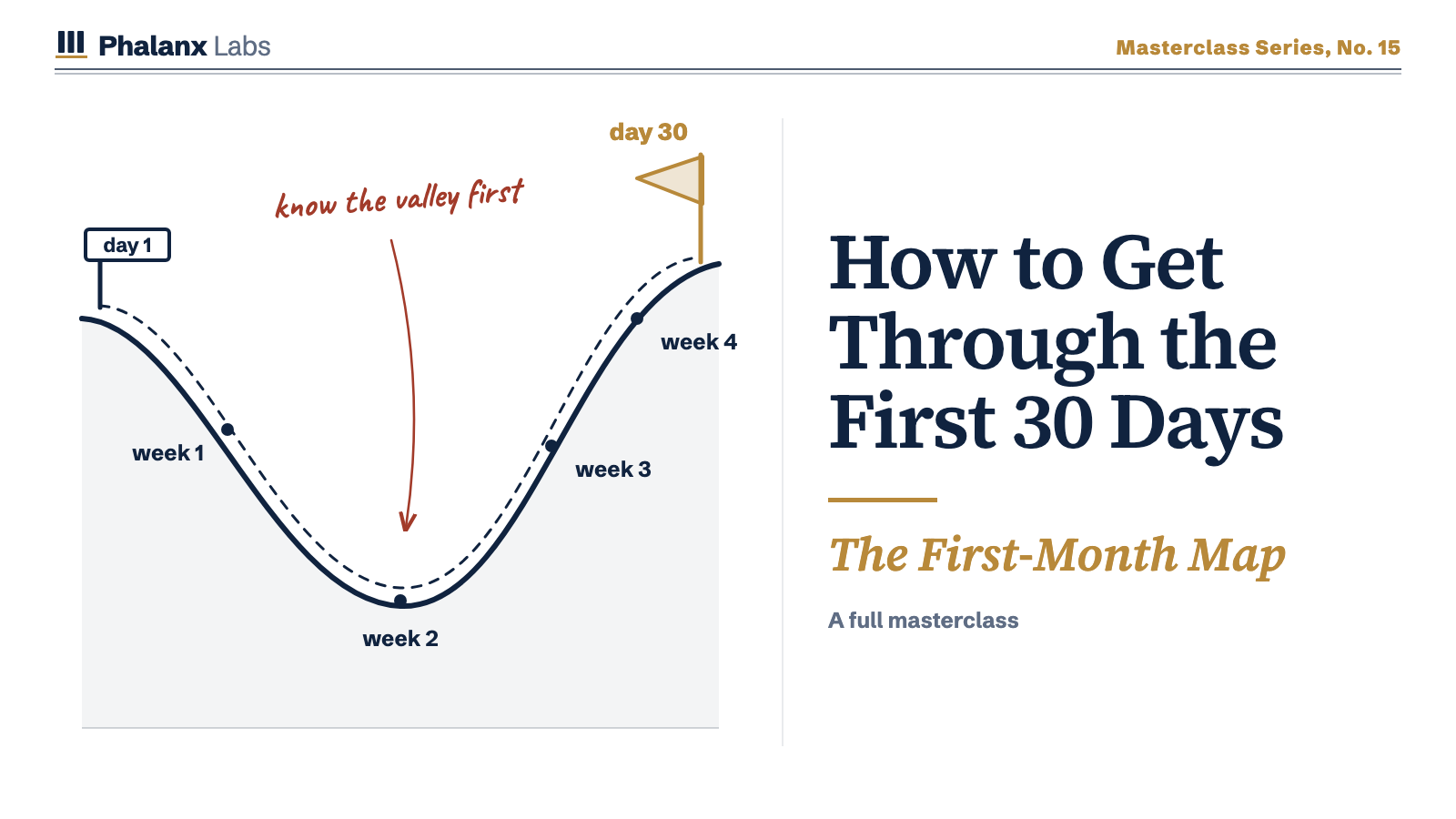
On one page, write the four weeks and what each one usually brings.
The first week: the body. Cravings are frequent and loud, sleep is off, and you might be restless or get headaches. This is the week most people expect.
The second week: the flat. The cravings may ease a little, but your mood drops and things feel gray and pointless. This is the week most people don't expect, and it's where most attempts end.
The third week: the lift. You start to feel better. Sleep improves, mornings are clearer and you get some energy back.
The fourth week: the trap. You feel good enough to think you're fixed. This is when "I've proved I can stop, so one won't hurt" shows up.
Everyone's month is a bit different, and some people move through it faster than others. But when a feeling shows up, you can look at the page and see that it was expected, and that alone takes away a lot of its power.
Step 3: Mark the hard days in advance
Get a calendar and circle the days that will test you:
- The first Friday night and the first weekend
- Any work dinner, wedding, birthday or trip in the next 30 days
- The day you get paid
- The days you'll be alone in the house
Next to each one, write one line: what you'll do instead, and who you'll be with.
Hard days are most dangerous when they catch you by surprise.
Step 4: Score the craving every evening
Every night before bed, write one line: the date, your strongest craving that day from 1 to 10, and what was happening when it hit.
It takes thirty seconds. After a week, you'll see two things. The cravings come at the same times and in the same places, and the numbers go down, even when it doesn't feel like it.
On a bad day in the second week, you can look at this page and see that you were at an 8 on your third day and you're at a 6 now. You're not going backwards, even if it feels like you are.
Step 5: Get through the flat week on purpose
When the second week arrives and everything feels gray, don't just wait for it to pass. Do these:
- Read the paper from Step 1 every morning
- Get outside in daylight within an hour of waking, even for ten minutes
- Move hard every day, enough to sweat
- Keep your evenings booked, with people if you can
- Go to bed at the same time every night
- Expect ordinary things to feel boring. That's your brain turning its sensitivity back up, and it takes a while
Don't make any big decisions about your life this week. You're seeing everything through the flat.
Step 6: Answer the fourth-week thought before it comes
Write this down now, while your head is clear:
"When I feel good and think one won't hurt, it means the plan is working, not that I'm done."
Then decide what you'll do the moment that thought shows up. Call someone, read your Step 1 paper or go for a walk. Do anything except argue with it.
The thought will sound very reasonable, and it usually comes on a good day rather than a bad one, which is exactly why you write the answer now.
Step 7: At the end of the month, review and set the next 30
At the end of the month, sit down with your evening scores and your calendar. Look at which days were hardest, which times of day, and what helped.
Don't celebrate with the habit. Plenty of people get to the end of the month and "reward" themselves with the thing they've just spent a month stopping.
Then plan the next 30 days the same way, with the map, the hard days and the scores.
Why does this work?
Because most people don't fail in the first month because the habit is too strong. They fail because the month surprises them.
The flat feeling in the second week feels like proof that you need the habit, and the good feeling in the fourth week feels like proof that you don't need to try anymore. Neither one is true. They're both your brain adjusting to life without the habit.
When you know what each week brings, a hard day stops meaning "this isn't working" and starts meaning "this is the second week."
Now, be honest with yourself..
The month won't follow the map exactly. Some people turn the corner in ten days, and some take much longer, especially after years of heavy use. A neuroscientist who stopped smoking weed wrote that everything felt bland for months. Then, about three months in, she was walking down the street and the colors of the fall leaves nearly brought her to her knees.
And if you've stopped for a month and you still feel low, that matters too. It might mean the habit wasn't the main thing behind how you feel, and that needs its own help.
If you drink heavily every day, talk to a doctor before you stop. Stopping suddenly can be dangerous.
Pick your day 1 tonight, and write the map before it starts.
Try it out, it works.
This is how we run the first month with clients in our program. In phase 1, we rebuild sleep, training, food and the daily routine, so the flat weeks have something solid under them. We track the cravings every day, and we plan the hard days before they come.
Sources
- Anna Lembke, Dopamine Nation: Finding Balance in the Age of Indulgence (Dutton, 2021)
- Judith Grisel, Never Enough: The Neuroscience and Experience of Addiction (Doubleday, 2019)
- Marc Lewis, The Biology of Desire: Why Addiction Is Not a Disease (PublicAffairs, 2015)
The Behavior Control System
Our 90-day program, private and one-on-one, built around your life.
See our programsField Notes
One letter a week from the lab.