How to replace the habit with a new one
Going back to the habit after you take it away is not a weakness of will: it's what happens when you take a habit out of your day and leave nothing in its place.
The method: The Swap Method
Contents10 sections
- Who is this for?
- Step 1: Find the moment
- Step 2: Find the job the habit does in that moment
- Step 3: Pick a swap that does the same job
- Step 4: Put the swap where the habit used to be
- Step 5: Write the rule
- Step 6: Do it every time, even when it feels pointless
- Step 7: Check the swap after two weeks
- Why does this work?
- Sources
(Works for drinking, weed, porn, vaping, scrolling, sugar, any habit that fills a moment in your day. It's what we set up with clients so that when the habit goes, something takes its place and there isn't just a hole where it used to be.)
Who is this for?
- You've stopped the habit before, and the space it left was so empty that you ended up filling it with the habit again
- You've tried to replace it with something "healthy", like a run or a book, and it lasted about three days
- You've swapped one habit for another, the drink for food or the weed for the phone, and now you have a new problem
- Deep down, you think the problem is that you have no self-control
If this is you, read on.
Going back to the habit after you take it away is not a weakness of will.
It's what happens when you take a habit out of your day and leave nothing in its place.
Think about how it usually goes..
You decide to stop. The first evening, you get home at the same time, walk into the same kitchen and feel the same tiredness. At 7pm, the moment you'd normally pour the drink, roll the joint or open the laptop, there's nothing to do.
So you stand there, check your phone and pace around the kitchen. The moment is still there, but the thing that filled it is gone.
You last a few days like that, maybe a couple of weeks. Then one evening the moment comes, and the only thing your brain knows how to do in it is the habit.
That's because a habit is more than the thing you do. It's tied to a moment. The time, the place, the feeling and the people around you all set it off, and they keep doing that whether you've decided to stop or not.
When you stop the habit, you take away the action, but the moment that set it off is still in your day. Every evening it shows up and asks for something, and if nothing else answers, the habit will.
Researchers once asked people about two things they'd recently bought: one they actually used, and one they never did. The things that got used had replaced something the person already did, like an e-reader replacing paper books, or a new mop replacing an old one. The things gathering dust, like a new piece of exercise equipment, didn't replace anything. They were just extra.
That's the problem with "I'll go for a run instead." It doesn't replace anything, so it's one more thing to do in a moment that's already asking for something else.
There's a second problem. A swap has to give you something close to what the habit gave you. If it's a big step down, your brain notices and stops bothering with it. That's why carob, which was sold for years as a replacement for chocolate, never caught on.
And there's a third. A swap can turn into a new habit you don't want. Giving smokers a sweet to eat every time they wanted a cigarette has helped people stop smoking. But it also teaches them to eat every time a craving comes, so they trade one problem for another.
So a good swap has to fit the same moment, give you something close to what the habit gave you, and not become a new problem.
This post is not about theory though. Here's exactly how to set it up.
Let's begin.
Step 1: Find the moment
Think back to the last five times you did the habit. For each one, write down the time, where you were, who you were with and what happened just before.
You'll see that most of them happen in two or three moments, like the drive home, the first hour after the kids go to bed, the Sunday afternoon with nothing planned or the minute you get into bed with your phone.
Pick the moment that comes up most. That's the one you swap first. Don't try to swap every moment at once.
Step 2: Find the job the habit does in that moment
This is the step most people skip, and it's why their swaps fail.
Ask yourself: "In the first ten minutes, what does the habit actually give me?"
Be honest. It's usually one of these:
- Relief: it takes the edge off stress or a bad feeling
- A reward: it marks the end of the day, the thing you feel you've earned
- A switch: it tells your body that work is over
- Something to do: it fills an empty, boring hour
- Something for your hands and mouth: the vape, the glass, the joint, the snack
- Escape: for a while, you're somewhere else
Most habits do two or three of these. Write down the main one.
Step 3: Pick a swap that does the same job
Now pick something that does that job, in that moment. It doesn't need to be good for you in general. It needs to do the same job the habit was doing.
- If the job is relief from stress: a hot shower straight after you walk in, ten minutes of hard exercise, or a walk around the block with music in your ears
- If the job is a reward: something you really look forward to, like a good meal, a film you've been saving or a long bath. It has to feel like a treat, or you'll drop it
- If the job is a switch: change your clothes the moment you get home, put the work phone in a drawer and start the same ten-minute routine every evening
- If the job is something to do: something with a start and a finish, booked in advance, like a class, a call with a friend, cooking from scratch or the gym
- If the job is something for your hands and mouth: a cold fizzy drink in a heavy glass, sparkling water with ice and lime, sugar-free gum or a toothpick
- If the job is escape: something that absorbs you and leaves you better off, like a book, a game you play with someone, drawing, or a long podcast on a walk
There are two rules here.
First, it can't be a big step down. If the habit gave you a ten, a swap that gives you a two won't last. Look for something that gives you at least a five or a six.
Second, it can't be a new problem. If you swap drinking for sweets every night, or weed for three hours of scrolling, you haven't really swapped anything.
Step 4: Put the swap where the habit used to be
The swap has to be easier to reach than the habit, in the exact spot where the habit happened.
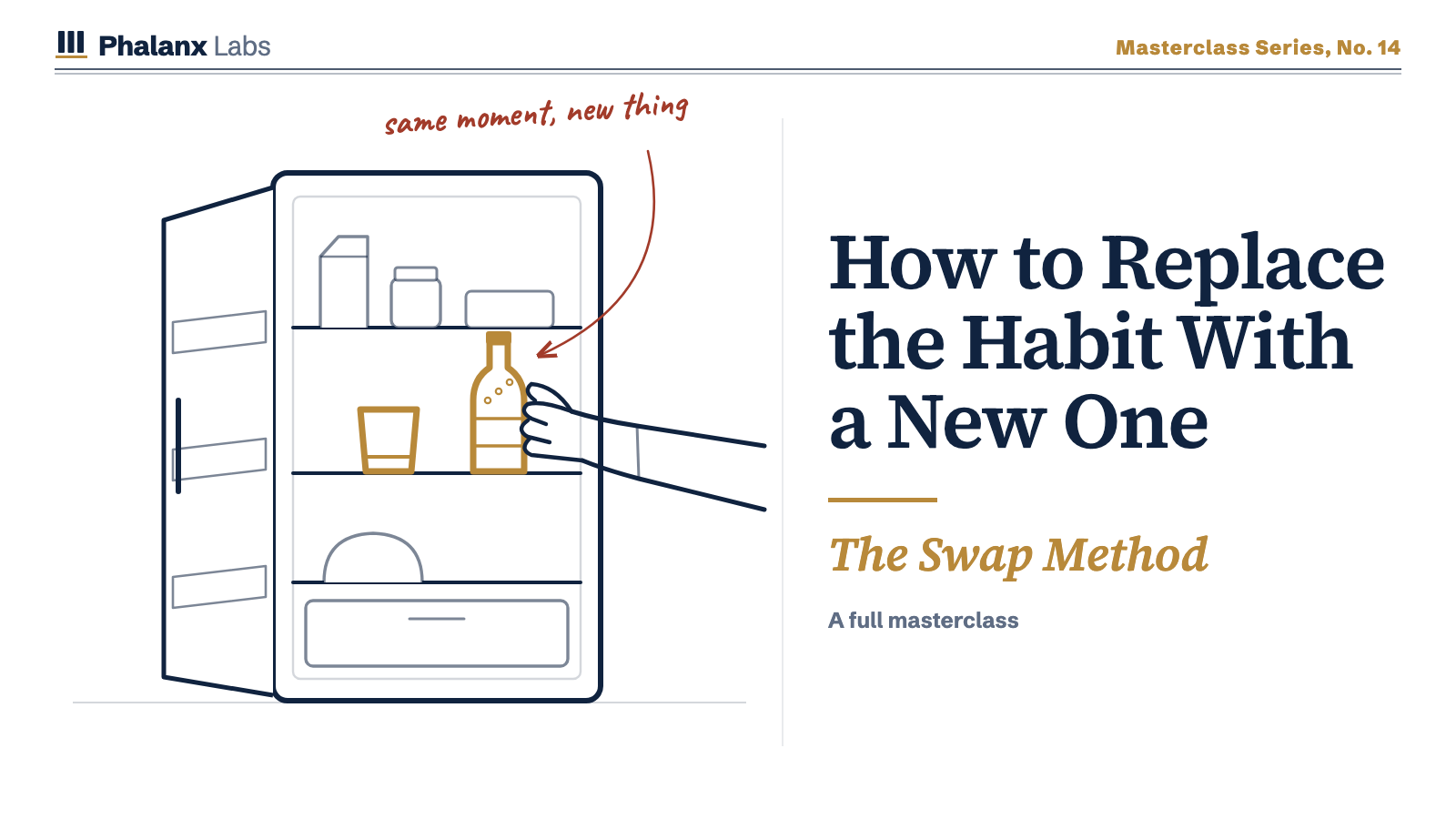
If you drank in the kitchen at 7pm, the sparkling water and the heavy glass go in the fridge, in the spot where the beer used to be. If you scrolled in bed, the book goes on your pillow and the phone charges in another room. If you vaped on your work break, your trainers sit under your desk and the walk starts the moment the break does.
When the moment comes, you shouldn't have to look for the swap. It should be right in front of you.
Step 5: Write the rule
Write one sentence: "When [the moment], I [the swap]."
"When I walk in from work, I change my clothes and take a hot shower."
"When I get into bed, I read for twenty minutes."
Put it somewhere you'll see it at that exact moment, like on the fridge or on your bedside table.
Step 6: Do it every time, even when it feels pointless
For the first week or two, the swap will feel like a bad deal. The habit gave you more, and faster, and your brain knows it.
Do it anyway, every single time the moment comes. You're teaching your brain that this moment now leads to something else. The more times it happens, the more natural it feels, until the swap is what you reach for without thinking.
If you miss one, don't make it a big deal. Just do the swap the next time the moment comes.
Step 7: Check the swap after two weeks
After two weeks, ask yourself two questions.
Is it doing the job? If you still feel a gap at that moment, the swap is doing the wrong job. Go back to Step 2 and look again. You might have picked a reward when what you needed was relief.
Is it turning into a new problem? If you're eating more, spending more or scrolling more, change it now, before it sets in.
Once the first moment feels steady, go back to your list and swap the next one.
Why does this work?
Because you're not fighting the moment anymore. You're giving it something else to do.
The time, the place and the feeling still show up every day, but now they lead somewhere new. Every time you do the swap, the link between that moment and the new action gets stronger, and the link to the old habit gets weaker.
When people in the US started drinking fewer sugary sodas, a lot of the time they started buying bottled water instead. It sat in the same fridge, in the same shop, and they could grab it on the same walk, so the habit of stopping for a drink stayed and only the thing in their hand changed.
Now, be honest with yourself..
A swap won't make the craving disappear. Some evenings the moment will come, you'll do the swap, and you'll still want the habit. That's normal, and it gets weaker the more you repeat it.
And if the job your habit does is covering something painful, like grief, anxiety or a marriage that's falling apart, a swap helps, but it doesn't fix that. That needs its own work.
If you drink heavily every day, talk to a doctor before you stop. Stopping suddenly can be dangerous.
Pick your moment tonight, and put the swap in place before that moment comes back tomorrow.
Try it out, it works.
This is part of what we set up with clients in our program. In phase 1, we rebuild the day around sleep, training and food, so there's less empty space for the habit to fill. In phase 2, we map every trigger and build a response for each one, and the client practices it until it's automatic.
Sources
- Wendy Wood, Good Habits, Bad Habits (Farrar, Straus and Giroux, 2019)
- Judson Brewer, The Craving Mind (Yale University Press, 2017)
The Behavior Control System
Our 90-day program, private and one-on-one, built around your life.
See our programsField Notes
One letter a week from the lab.