How to calm a craving in 60 seconds
When a craving is too strong to think straight, the fastest way through is to calm the body first, with cold water, slow breathing and tensing and letting go.
The method: The Body-Reset Method
Contents11 sections
- Who is this for?
- Step 1: Get it ready before you need it
- Step 2: Know when to use it
- Step 3: Cold water on your face (30 to 60 seconds)
- Step 4: Slow your breathing (60 seconds)
- Step 5: Tense and let go
- Step 6: If it's still strong, move hard
- Step 7: Then change what you're doing
- Step 8: Practice when you're calm
- Why does this work?
- Sources
(Works for porn, alcohol, weed, nicotine, scrolling, gambling, any habit. It's what we teach clients for the moments when a craving is too strong to think straight.)
Who is this for?
- The craving hits so hard that your heart is pounding and you can't think
- You know all the reasons not to do it, but in that moment none of them seem to matter
- You've tried to talk yourself out of it, and it never works when the craving is at its worst
- Deep down, you think you'd have more self-control if you were a stronger person
If this is you, read on.
Giving in when a craving is at its peak is not a weakness of will.
It's what happens when your body is already in a state of emergency and you're trying to calm it down with words.
Think about what a really bad craving feels like..
It usually comes after a hard day, an argument or some bad news, when you've been on edge for hours. Your chest is tight and your heart is going fast. Your hands won't keep still, and every thought you have seems to lead back to the habit.
So you try to reason with yourself. You remind yourself how bad you felt last time, and why you promised yourself you'd stop.
But it doesn't work, because by then your body is so worked up that it's very hard to think clearly at all.
What's actually happening is this. Your body has two systems that work against each other, like the gas and the brake in a car.
The first one revs you up. It speeds up your heart, sends blood to your muscles and gets you ready to fight or run. The second one calms you down. It slows your heart and brings you back to rest.
When you're stressed, the gas is pressed to the floor, and a body in that state wants to do something, fast.
That's why stress and relapse go together so often. Researchers who stressed rats just before giving them access to a drug found they were more likely to get hooked. And in rats that had stopped, stress made them more likely to go back to it. People are the same.
In that state, the habit looks like the quickest way to make the feeling stop, because for a few minutes, it does.
So if the craving is coming from your body, the fastest way to calm it down is through your body, not by arguing with yourself.
There's a set of skills therapists teach people who are so upset that they can't use any other skill. They work in seconds to minutes, and they don't need much thinking, which matters, because clear thinking is exactly what you don't have in that moment. The people who built them say they can bring a bad feeling down about as well as a drink or a hit does, without what comes after.
All of them work by pressing the brake.
This post is not about theory though. Here's exactly how to set it up.
Let's begin.
Step 1: Get it ready before you need it
Put a bag of ice and water, or a cold pack, in your freezer today. Put a second one at work if you can.
Write the steps below on a card or in your phone notes, with the word RESET at the top.
When the craving is at its worst, you won't remember the steps. You'll only remember that the card is there.
Step 2: Know when to use it
Rate the craving from 1 to 10.
If it's a 3 or a 4, you can probably sit with it. If it's a 7 or higher, and your heart is going fast and you can't think straight, that's when you reset your body first and think later.
Step 3: Cold water on your face (30 to 60 seconds)
This is the fastest one.
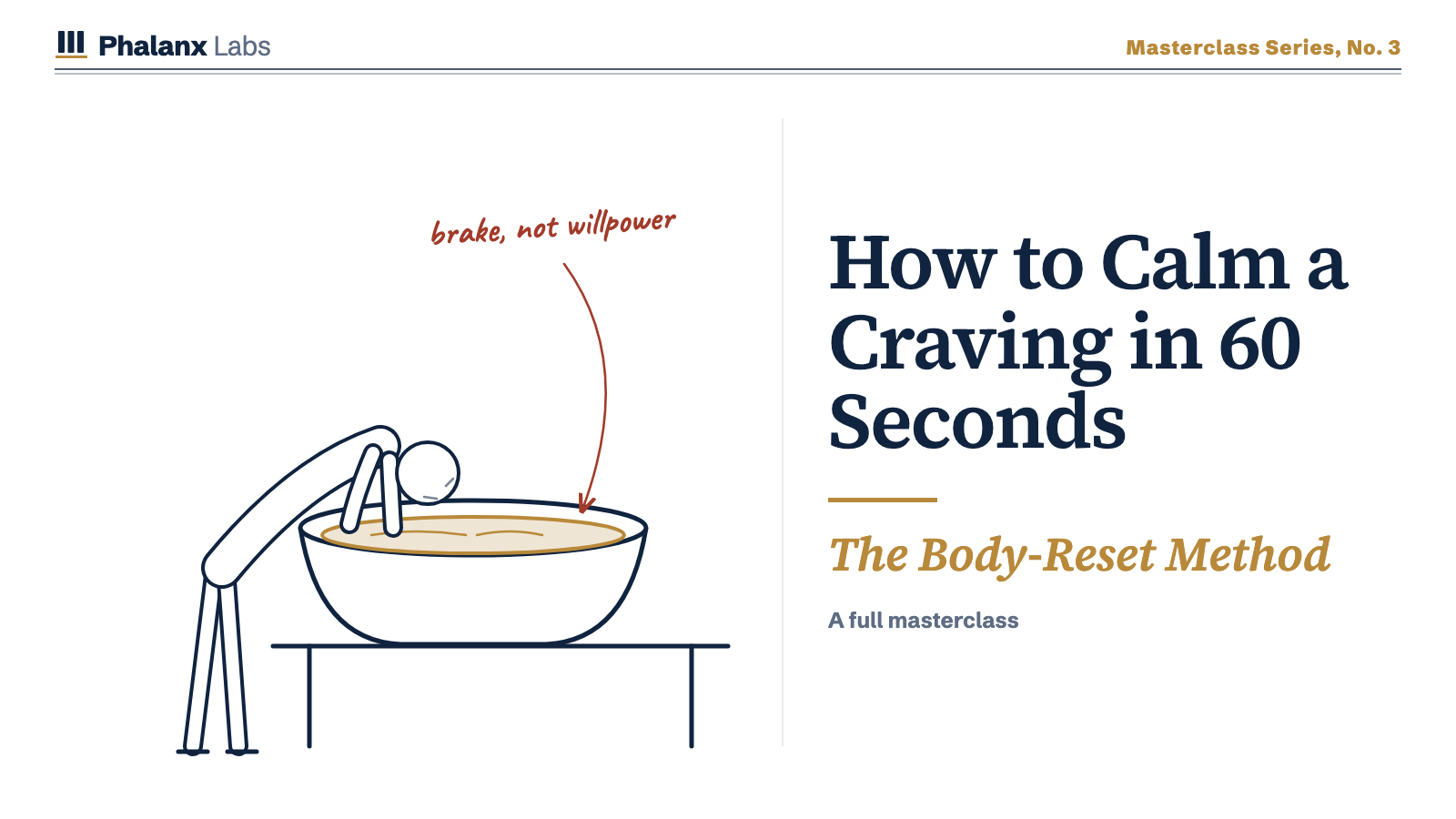
Fill a bowl with cold water. Bend over, take a breath, hold it, and put your face in the water up to your temples. Stay there for 30 to 60 seconds, or until it gets uncomfortable.
If you can't do that, hold the cold pack over your eyes and upper cheeks while you lean forward and hold your breath. Or splash cold water on your eyes and cheeks a few times.
Your body has an old reflex for being underwater. When cold water hits your face and you hold your breath, your heart slows down, even below its normal resting rate. That's the brake, pressed all at once.
Keep the water cold, but not icy. Very cold water can hurt your face.
Step 4: Slow your breathing (60 seconds)
Breathe in through your nose for 4 seconds. Breathe out slowly through your mouth for 8.
Do that five or six times. It takes about a minute.
Every time you breathe in, your heart speeds up a little. Every time you breathe out, it slows down. So when you make the out-breath longer than the in-breath, you're pressing the brake again and again.
Count the seconds rather than guessing, because most people breathe out far too quickly the first few times.
You can do this in a meeting or in the car, and nobody around you will notice.
Step 5: Tense and let go
Breathe in and clench both fists as hard as you can for 5 to 10 seconds. Feel how tight they are.
Then breathe out, let go all at once, and say the word "relax" in your head.
Do the same with your shoulders pulled up to your ears. Then your face, scrunched up. Then your whole body at once.
Muscles that you tense and then let go end up looser than if you'd just tried to relax them. And if you practice this every day, saying "relax" as you breathe out starts to calm your body on its own.
Step 6: If it's still strong, move hard
If you're still at a 7 or higher, go and move for 20 minutes. Run, cycle, do sprints, go up and down the stairs, anything that gets you properly out of breath.
A body that's revved up wants to do something. So give it something to do that isn't the habit.
Step 7: Then change what you're doing
This is the step most people skip, and it's the one that matters most.
The calm from the cold water doesn't last long. If you go straight back to the couch and start thinking about the habit again, the craving will come back.
So the moment you've reset your body, get up and do something else. Leave the room, call someone, make some food or start the task you've been putting off.
Step 8: Practice when you're calm
Do steps 3, 4 and 5 once a day for a week, when you don't have a craving.
It'll feel pointless at first. But it means that when the bad night comes, your body already knows what to do, and you're not trying something new for the first time at a 9 out of 10.
Why does this work?
Because a strong craving is mostly a body in a state of emergency, and you can't argue a body out of an emergency.
Cold water, slow breathing and tensing then letting go all press the brake directly. Your heart slows down and your body comes out of that fight-or-run state, and once it does, you can think again.
That gives you a gap between the craving and the habit, and in that gap you get your choice back.
Now, be honest with yourself..
This doesn't fix the reason you crave. It calms your body for long enough that you don't act on the craving, and that's all it does. If you go back to the same couch and the same thoughts, the craving comes back too.
If you have any heart condition, take medication that slows your heart, or have an eating disorder, talk to your doctor before you use cold water. It slows your heart down quickly.
And if you drink heavily every day, talk to a doctor before you stop. Stopping suddenly can be dangerous.
Try it out, it works.
This is part of what we set up with clients in phase 2 of our program. Once the habit is hard to reach, we map every moment the craving gets strongest, and we build a plan for each one so that the body calms down first and the habit never gets the chance.
Sources
- Marsha M. Linehan, DBT Skills Training Manual, 2nd edition (Guilford Press, 2015)
- Robert M. Sapolsky, Why Zebras Don't Get Ulcers, 3rd edition (Henry Holt, 2004)
The Behavior Control System
Our 90-day program, private and one-on-one, built around your life.
See our programsField Notes
One letter a week from the lab.