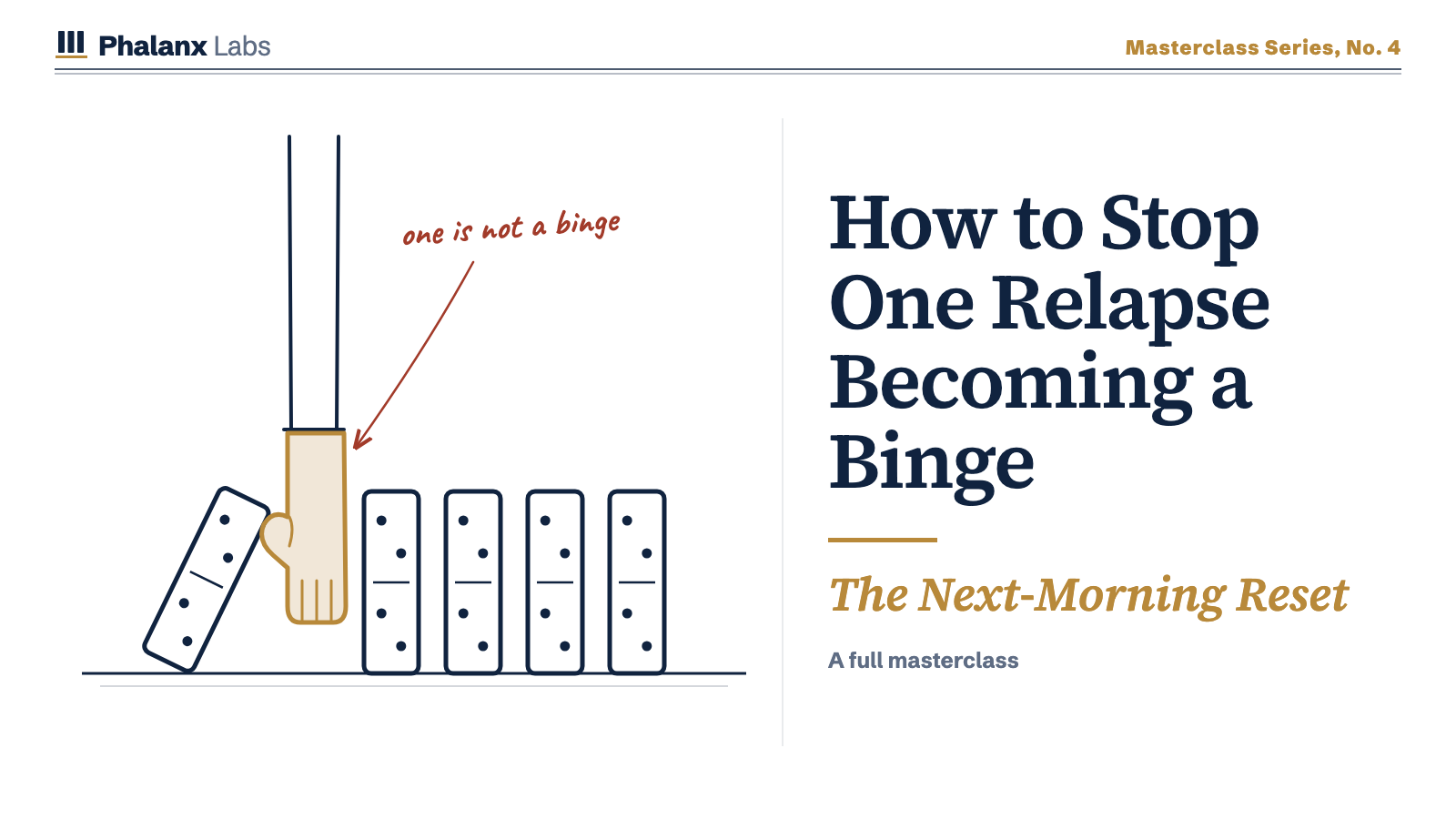
How to stop one relapse turning into a binge
It's what you tell yourself after one relapse that decides whether it stays one night or becomes a week, so you write the plan for it before you need it.
The method: The Next-Morning Reset
Contents12 sections
- Who is this for?
- Step 1: Write your reset card today
- Step 2: The moment it happens, catch the "might as well" thought
- Step 3: Get rid of what's left, tonight
- Step 4: Message one person
- Step 5: Get through the next hour
- Step 6: In the morning, write it down as a situation, not as who you are
- Step 7: Find the one link you can fix
- Step 8: Count it honestly
- Step 9: Recommit to stopping completely, today
- Why does this work?
- Sources
(Works for porn, alcohol, weed, nicotine, scrolling, gambling, any habit. It's the plan we set up with every client before they ever need it.)
Who is this for?
- You go weeks without it, give in once, and then lose the whole week after
- After one time, a voice says "you've already blown it, might as well"
- You wake up the next morning feeling like you're back at day one, so you stop trying
- Deep down, you think one relapse proves you'll never be able to stop
If this is you, read on.
Losing a whole week after one relapse is not a weakness of will.
It's what happens when you treat one bad night as proof of who you are.
Think about how it usually goes..
You've been doing well. Days, maybe weeks, without it. Then one night the craving wins and you give in.
And right after, before you've even put it down, a voice starts up. "Well, that's it. You've blown it. Might as well finish the night properly." Then the next morning: "You're back at day one. You always end up here. What's the point?"
So one time turns into the whole night. The night turns into the weekend, and before you know it you've lost a month.
Here's what most people never realize.
What costs you the month usually isn't the relapse. It's what you tell yourself about it afterwards.
Researchers who study relapse have looked at this closely. Right after you break a rule you set for yourself, you get hit with guilt, shame and the feeling that you've lost control. A lot of it comes from the gap between "I'm someone who's stopped" and what you just did.
And they found that how you explain the relapse to yourself decides what happens next.
Some people put it down to something about themselves, something that's true everywhere and that they can't change. "I'm weak." "I'm just an addict." Those people are more likely to keep going and slide all the way back.
Other people put it down to the situation, something that was true that night and that they can do something about. They're less likely to.
It's the same relapse either way. The only thing that changes is the story you tell yourself the next morning, and that story decides how the rest of the month goes.
There's a classic example that addiction counselors use. Someone is on a strict diet with no cake. At a friend's party, without thinking, she accepts a slice of birthday cake. Then she goes home and eats every bit of cake and candy in the house, because the rule's broken anyway.
But if that was her first slice of cake in a month, she hasn't failed at all. She's doing really well. It just doesn't feel like it.
And it goes one step further..
Your brain treats every choice you make as a prediction about the next one. So one relapse feels like proof that your willpower is weak. And once you believe your willpower is weak, it actually gets weaker.
Then you start drawing lines around it. "I can't stop once I've started." "I can never say no when I'm out with those friends." And inside those lines, you stop even trying. The habit takes over, and it feels like you never had a choice.
So beating yourself up harder won't help. The shame is part of what keeps the slide going.
You need a plan for the night it happens and the morning after, written BEFORE you need it.
This post is not about theory though. Here's exactly how to set it up.
Let's begin.
Step 1: Write your reset card today
Write it while you're calm, on a card in your wallet or in your phone notes. It answers 4 questions:
- Who will I message the moment it happens?
- What will I get rid of straight away?
- Where will I go, or what will I do, for the next hour?
- What will I say back to "might as well"?
For number 4, write your answer now, in your own words. Something like: "One time is not a binge. I can stop at one."
Read it once a week, so it's already in your head on the night you need it.
Step 2: The moment it happens, catch the "might as well" thought
Right after you give in, listen for it. It sounds like:
- "I've already blown it"
- "Might as well keep going now that I've started"
- "A little more won't make a difference"
- "I'll start again on Monday"
This thought is more dangerous than the relapse itself.
Say your answer from the card, out loud if you can.
Step 3: Get rid of what's left, tonight
Don't wait until the morning.
- Alcohol: pour the rest down the sink, the opened bottle and anything else in the house
- Weed or a vape: throw it in the outside trash, not a drawer
- Porn or scrolling: close everything, and put the phone on the charger in another room
- Gambling: log out, delete the app, and turn your self-exclusion back on
If it's still within reach an hour later, the "might as well" voice gets a second chance.
Step 4: Message one person
Send one message to the person on your card. It can be as short as "Had a bad night. Back on it tomorrow."
Shame makes you want to hide it. But shame and self-blame are exactly what tend to push people into more of the habit. Telling someone who won't judge you takes a lot of that power away.
Step 5: Get through the next hour
Don't sit there thinking about it.
Leave the room. Go for a walk. Take a shower. Make something to eat. Go to bed early. Whatever is on your card for this.
You're not trying to fix anything tonight. You're just letting time pass without doing it again.
Step 6: In the morning, write it down as a situation, not as who you are
This is the next-morning reset.
Before you look at your phone, take 5 minutes and write:
- What happened, in one or two plain sentences. "Tuesday, after the call with my boss, alone at home, around 9pm."
- What was different about that night
- One thing you'll do differently the next time that situation comes up
Watch out for two kinds of sentences.
The first is about who you are. "I'm weak." "I'll never be able to stop." Cross them out.
The second is a line around a situation. "I just can't say no when I'm with those friends." Cross that out too, and write what you'll do differently with those friends instead.
Step 7: Find the one link you can fix
What came before the relapse? The bad day, the empty evening, the drink that made the next decision easier?
You don't need the whole story yet. Finding out exactly why you relapsed is a whole post on its own, and we'll cover it in another post. For now, find one link in the chain and fix it today.
If the bottle came from the store on your way home, change the route. If it started with your phone in bed, the phone charges in the kitchen from tonight.
Step 8: Count it honestly
Don't tell yourself you're back at day one.
If you went 30 days and relapsed once, that's 29 good days out of 30. That's not zero. Remember the woman with one slice of cake in a month. She was doing well, and so are you.
Write it down that way if it helps.
Step 9: Recommit to stopping completely, today
Not on Monday. Not next month. Today.
The aim is still to stop completely, and this was the last time.
Think of a quarterback. On every play he runs full out for a touchdown. If he gets knocked down, he doesn't decide the game is over. He gets up and goes for the touchdown again on the next play.
Why does this work?
Because it takes away the two things that turn one relapse into a binge.
The first is the "might as well" thought. You've already answered it, in writing, before it shows up.
The second is the story that you're weak. You replace it with a plain description of a situation, and one thing you'll change.
And once you see it as something that happened in a situation you can change, you start trying new things the next time that situation comes around. That's how people actually get better at this.
Nobody learns to ride a bike without falling. The ones who learn are the ones who get back on.
Now, be honest with yourself..
This is not permission. If you catch yourself thinking "it's fine, I'll just do the reset tomorrow", that's the habit talking. The plan is there in case it happens. It's not a plan to let it happen.
And for some people, and some habits, one time can turn into a lot more, very fast. Sometimes more than they were doing before they stopped. If that's you, take this more seriously, not less, and ask for help.
If you drink heavily every day, talk to a doctor before you stop. Stopping suddenly can be dangerous. The same goes if a relapse has turned into several days of heavy drinking.
Try it out, it works.
This is part of what we build with clients in phase 2 of our program. We write the plan for a relapse before it ever happens, and if one comes, we go through it with them the next day and fix what led to it.
Sources
- G. Alan Marlatt and Dennis M. Donovan (eds.), Relapse Prevention: Maintenance Strategies in the Treatment of Addictive Behaviors, 2nd edition (Guilford Press, 2005)
- David Capuzzi and Mark D. Stauffer, Foundations of Addictions Counseling, 2nd edition (Pearson, 2014)
- Hanna Pickard, What Would You Do Alone in a Cage with Nothing but Cocaine? A Philosophy of Addiction (Princeton University Press, 2026)
- George Ainslie, Breakdown of Will (Cambridge University Press, 2001)
- K. Witkiewitz, S. Bowen, E. N. Harrop, H. Douglas, M. Enkema and C. Sedgwick (2014). Mindfulness-based treatment to prevent addictive behavior relapse: theoretical models and hypothesized mechanisms of change. Substance Use & Misuse.
- Marsha M. Linehan, DBT Skills Training Manual, 2nd edition (Guilford Press, 2015)
- Laura J. Petracek, The DBT Workbook for Alcohol and Drug Addiction (Jessica Kingsley Publishers, 2023)
- Anna Lembke, Dopamine Nation: Finding Balance in the Age of Indulgence (Dutton, 2021)
- Anna Lembke, The Official Dopamine Nation Workbook (Dutton, 2024)
The Behavior Control System
Our 90-day program, private and one-on-one, built around your life.
See our programsField Notes
One letter a week from the lab.