How to fill the empty evening
An evening with nothing in it is where a lot of relapses start, so you plan the empty hours with rewards you earn before they arrive.
The method: The Evening Plan
Contents10 sections
- Who is this for?
- Step 1: Find your empty hours
- Step 2: Make a list of 20 things
- Step 3: Write the plan the night before
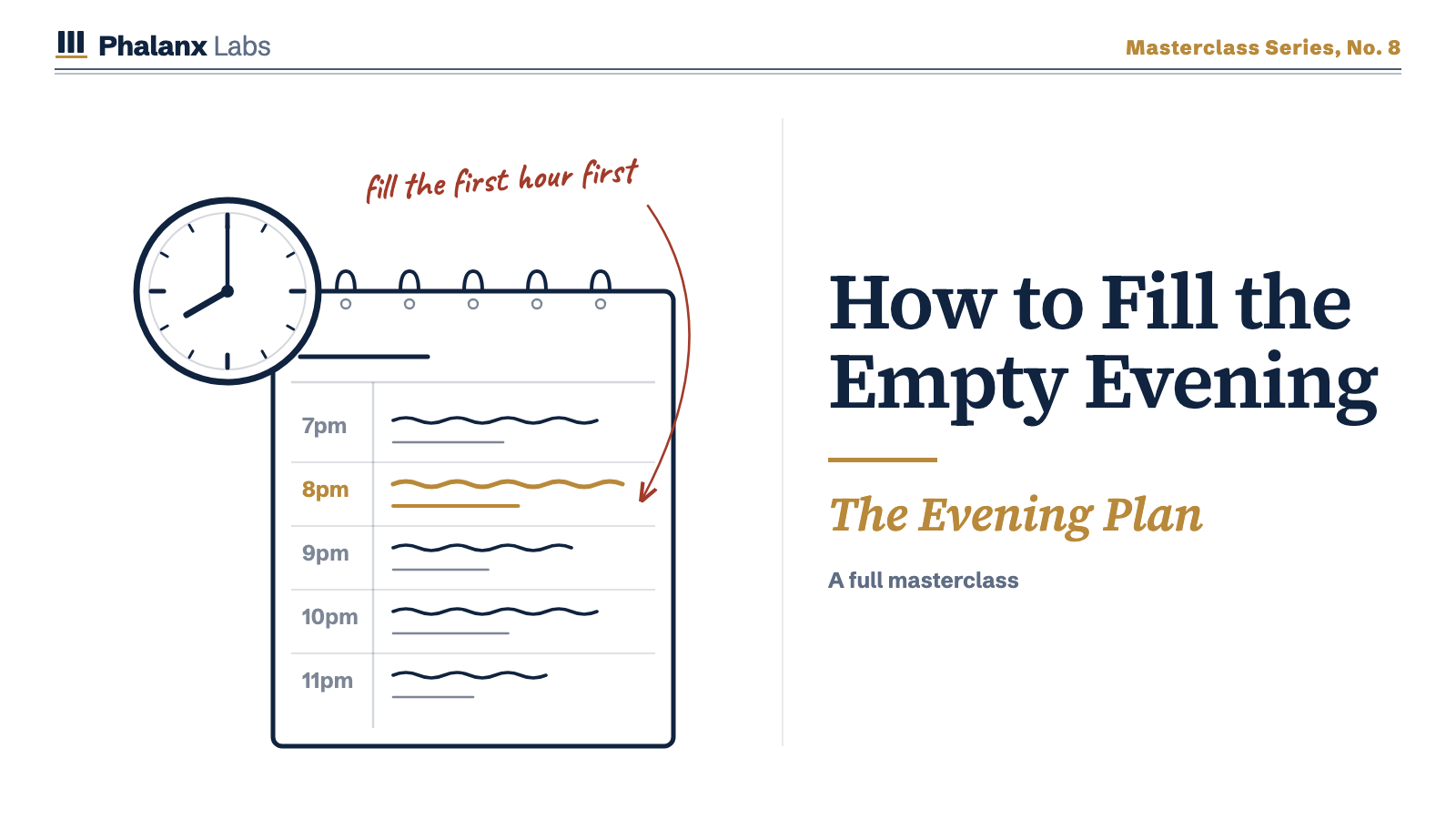
- Step 4: Fill the first hour first
- Step 5: Book the things that involve other people
- Step 6: Expect it to feel flat at first
- Step 7: Have a backup for the nights the plan falls through
- Why does this work?
- Sources
(Works for alcohol, weed, porn, nicotine, scrolling, gambling, any habit. It's one of the first things we build with every client.)
Who is this for?
- You get through the workday fine, then fall apart after 8pm
- You've stopped the habit, and now the evenings feel long, flat and pointless
- You tell yourself you'll "do something better" with the time, and end up on the couch with nothing planned
- Deep down, you think the problem is that you're weak
If this is you, read on.
Relapsing in an empty evening is not a weakness of will.
It's what happens when you take the habit out of your evening and leave a hole where it used to be.
Think about how your evening actually goes..
For years the habit was the plan. You got home and you knew exactly what the next few hours looked like, whether that was a drink, a joint, the laptop or the betting app. It was the thing you looked forward to all afternoon.
Then you stop, and when you get home there's nothing waiting for you. There's no plan and nothing to look forward to, so you sit on the couch, scroll, feel restless and flat, and watch the hours drag.
You tell yourself you'll read, or go to the gym, or call someone. But you never decided which one or when, so you don't. And around 9 or 10, with nothing else going on, the habit looks like the only good thing left in the day.
So you give in, and the next morning you decide it's because you don't want it badly enough.
What's really going on is that the habit was never only a habit. It was your evening's reward, and often your only one. When you take it away and put nothing in its place, your brain doesn't notice that your life got healthier. All it notices is that the evening has less in it now, so it keeps pointing you back to the one thing it knows works.
There's an experiment where some rats were kept alone in small cages, and others lived together in a big open space with other rats and things to climb and explore. Both groups could drink plain water or water with a drug in it. The rats alone in the cages took far more of the drug, and in some of the tests it was close to 20 times more. The rats with a life to live mostly ignored it, even when the drug was sweetened to make it hard to resist.
People are more complicated than rats, but research on people who beat an addiction points the same way. The people with more going on in their lives, more things and people that matter to them, are more likely to stop. And some of the most effective treatments don't just take the habit away. They help people build other things worth choosing.
So you can't fill an empty evening with willpower. You fill it with a plan and with things that actually reward you, and you make that plan BEFORE you get home.
This post is not about theory though. Here's exactly how to set it up.
Let's begin.
Step 1: Find your empty hours
Look back at the last 2 weeks and write down when the habit happened. Go by when it really happened, not when you think it usually does.
For most people it's the same 2 or 3 stretches every week: the first hour after they walk in the door, the time after dinner, and late at night when everyone else is asleep. On weekends there's often a big one in the afternoon too.
These are the hours you're planning for. The rest of the day can stay as it is.
Step 2: Make a list of 20 things
Sit down for 15 minutes and write down 20 things you could do in an evening. Mix three kinds:
- Things that feel good right away: a long shower, a film you've been meaning to see, cooking a proper meal, music, a walk
- Things that make you feel capable: a workout, fixing something in the house, learning a few pages of something, a project you've let slide
- Things with other people: a call to a friend, dinner with family, a class, a game with your kids, a sports team
Most people only write the first kind. Those are fine, but the second and third kinds are what make an evening feel worth something. A lot of the time, the habit was standing in for exactly those two feelings, being capable and being close to people.
If you get stuck at 8, that's normal. Think back to what you enjoyed before the habit took over your evenings.
Step 3: Write the plan the night before
Every night before bed (or in the morning, if that's easier), take your list and fill tomorrow's empty hours. Write down what you'll do, when and where.
"7pm, gym on 4th Street. 8:30pm, cook dinner, the chicken recipe. 9:30pm, call my brother."
Write it like that, not "maybe go to the gym". When a plan has a time and a place you tend to do it, and "I'll find something" almost never happens.
Put at least one thing from each of the three kinds into every evening.
Step 4: Fill the first hour first
The first hour after you get home is where a lot of relapses start. You walk in tired, you drop your bag, and your body heads straight for the old routine.
So the first hour gets the most solid thing on the plan, something that gets you out of the house or keeps your hands busy. Go straight from work to the gym, go for a walk before you even go inside, or start cooking the moment you're in the kitchen.
Don't sit down "for a minute" first, because that minute is how the old evening starts.
Step 5: Book the things that involve other people
A plan you made with yourself is easy to drop when you're tired. A plan with someone else is much harder to drop.
Join the class that meets on Tuesdays and Thursdays. Set a weekly call with a friend. Tell your partner you're cooking dinner on Wednesday. Pay for the sessions in advance if that's what it takes.
Aim for at least two evenings a week where someone is expecting you.
Step 6: Expect it to feel flat at first
For the first couple of weeks, the new evening will feel boring next to the habit. That's normal. Your brain has been getting a big, easy reward every night, and a walk or a book can't compete with that straight away.
Do them anyway. These things do reward you, but your brain needs a few weeks to start noticing them again.
So don't judge the plan by how it feels in the first week.
Step 7: Have a backup for the nights the plan falls through
Some nights it won't work out. Your friend cancels, or you're just too tired to go.
So keep three backups written at the bottom of your list, things you can do at home, on your own, that take less than 5 minutes to start. A shower, a walk around the block, or a podcast while you clean the kitchen.
When the plan falls through, pick one straight away instead of sitting there waiting to see how you feel.
Why does this work?
Because the habit didn't only fill your evening, it was the reward in it.
When you plan the evening ahead of time, you stop leaving your most tired hours to chance. And when you fill those hours with things that make you feel good, capable and close to people, the habit stops being the only good thing on offer.
That's what the rats in the open space had. They didn't have more willpower than the rats in the cages. They just had other things to do.
Now, be honest with yourself..
This won't make the cravings disappear. Some nights you'll still want it, and you'll have to deal with that craving when it comes. But a planned evening means far fewer nights where you're sitting alone with nothing to do and nothing to look forward to.
And if you drink heavily every day, talk to a doctor before you stop. Stopping suddenly can be dangerous.
Write your list of 20 tonight, and plan tomorrow evening before you go to bed.
Try it out, it works.
This is part of what we build with clients in phase 1 of our program. Alongside the sleep and the daylight, we plan the evenings, replace the easy reward of the habit with rewards you earn, and track it every day, because an evening with nothing in it is where a lot of relapses start.
Sources
- Bruce K. Alexander, The Globalization of Addiction (Oxford University Press, 2008)
- Gene M. Heyman, Addiction: A Disorder of Choice (Harvard University Press, 2009)
- Laura J. Petracek, The DBT Workbook for Alcohol and Drug Addiction (Jessica Kingsley Publishers, 2023)
- Lane Pederson, The Expanded Dialectical Behavior Therapy Skills Training Manual (PESI Publishing, 2012)
The Behavior Control System
Our 90-day program, private and one-on-one, built around your life.
See our programsField Notes
One letter a week from the lab.