How to beat the “just this once” thought
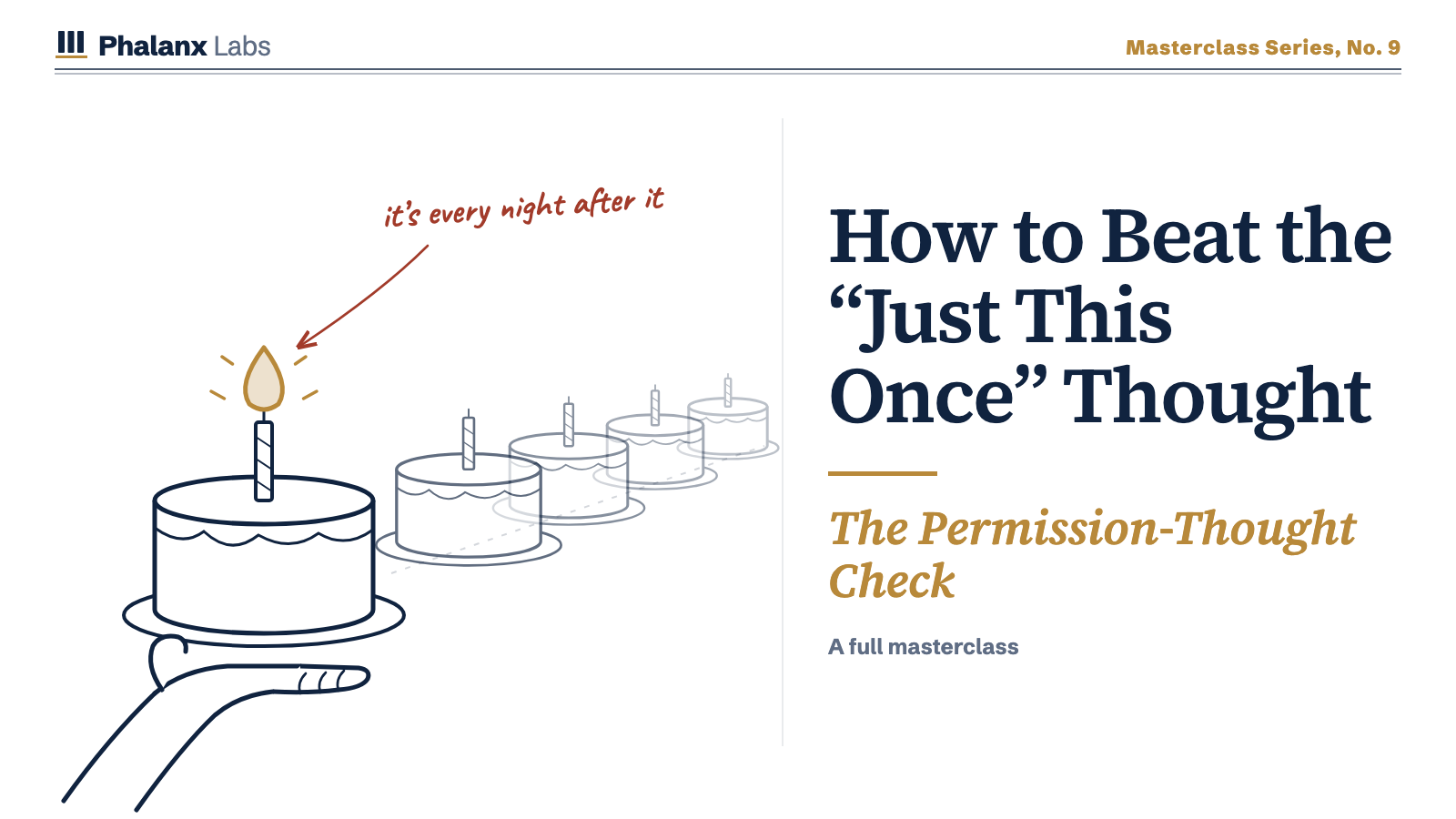
“Just this once” doesn't feel like a craving, it feels like a sensible exception, and seeing tonight's choice as one in a series changes what you choose.
The method: The Permission-Thought Check
Contents10 sections
- Who is this for?
- Step 1: Write down your permission thoughts
- Step 2: Name it when it shows up
- Step 3: Ask "What happens if I say this every time?"
- Step 4: Play it forward past the first 10 minutes
- Step 5: Draw a bright line
- Step 6: Write your answer in advance
- Step 7: Watch for the small set-ups
- Why does this work?
- Sources
(Works for alcohol, weed, porn, nicotine, gambling, scrolling, any habit. It's one of the main thought skills we teach clients.)
Who is this for?
- You've gone days or weeks without the habit, then lost it all to "just this once"
- You only give in on special occasions, and somehow there's a special occasion every week
- You tell yourself you'll start properly again tomorrow, and tomorrow you hear the same thought
- Deep down, you think the problem is that you're weak
If this is you, read on.
Giving in to "just this once" is not a weakness of will.
It's what happens when you treat tonight as a one-off decision, while your brain treats it as a guide to what you'll do every night after it.
Think about how it usually goes..
You've been doing well, maybe for a couple of weeks, and then something comes up. It's your birthday, or a friend is in town, or you've had a brutal day and you feel like you've earned something. And a calm, reasonable thought shows up: "Just this once. It's a special occasion. I'll be back on track tomorrow."
It doesn't really feel like a craving at all. It feels more like a sensible exception, and after a good run, what's the harm in one night?
So you give in. The next day a new reason turns up: you've already broken the run, so this week doesn't count anyway, or work was bad again. Within a week you're back where you started, and you can't work out how one exception turned into the old habit.
What's happening is that "just this once" is a permission thought. It never tries to tell you the habit is good for you. All it says is that tonight is different, and there's always a reason tonight is different: a birthday, a wedding, a bad day, a good day, a friend you haven't seen in a year.
Researchers who study self-control point out that people rarely give up their rules outright. They make an exception instead. And an exception for tonight always looks cheap, because you're comparing one night of the habit with one night of progress, and one night of progress doesn't look like much. So tonight wins.
But that isn't really the choice you're making. Whatever you do tonight is your brain's best guess about what you'll do next time. If "it's a special occasion" works tonight, it'll work at the next special occasion too, and there will be another one soon. So what you're actually choosing tonight is a rule for every night like this one.
There's an experiment that shows this. Students were offered a choice between a smaller amount of money now and a larger amount a week later, once a week for five weeks. When they chose week by week, they took the quick money far more often. When they had to choose for all five weeks at once, they picked the larger, later amount far more often. They were the same people making the same choices, and seeing them as one series was enough to change what they chose. When some students were simply told that today's choice was a good predictor of their future choices, they did better too.
Counselors see the other side of this all the time. A man who'd stopped drinking takes a new route home on a sunny day and walks past his old bar. He goes in "just for old time's sake", and he agrees to "just one drink" so his old friends will stop being angry with him. By the end of the night the bar has stopped serving him, and he tells himself he had no choice. The "just one drink" was only the last step. The first one was taking the walk past the bar.
So you don't beat this thought by arguing harder in the moment. You beat it by seeing it for what it is, and by having your answer ready BEFORE it shows up.
This post is not about theory though. Here's exactly how to set it up.
Let's begin.
Step 1: Write down your permission thoughts
Sit down for 10 minutes and write down every sentence you've told yourself right before you gave in. Use the exact words.
Most people's list looks something like this:
- "Just this once."
- "It's a special occasion."
- "I've had a hard day, I deserve it."
- "I've already messed up today, so I might as well."
- "I'll start properly on Monday."
- "One won't hurt."
You'll probably find you have about 5 of them, and they've been doing almost all the work for years. Keep the list in your phone notes where you can see it.
Step 2: Name it when it shows up
When one of those sentences shows up, say it out loud or in your head: "That's a permission thought."
You don't argue with it yet. When you name it, you stop hearing it as your own good judgment, and you hear it for what it is: the same old sentence that turns up right before the habit, every time.
Step 3: Ask "What happens if I say this every time?"
This is the main check. Take the thought and turn it into a rule.
"It's a special occasion" becomes "I give in at every special occasion." Then count how many special occasions you had last month, with every birthday, every Friday, every good or bad day at work and every friend who was in town.
"I deserve it after a hard day" becomes "I give in on every hard day." How many hard days did you have last week?
Once you say it as a rule, most permission thoughts turn out to be the old habit with an excuse attached, and you can see that the decision was never only about tonight.
Step 4: Play it forward past the first 10 minutes
The permission thought only ever shows you the first 10 minutes, the relief you're after. It never shows you the rest.
So play the night forward on purpose. What happens after the first one? What time do you get to sleep? How do you feel at 7am? What do you tell yourself the next evening, when "I've already broken my run" shows up?
Write the answers under each permission thought on your list, so you don't have to work them out with a craving in your head.
Step 5: Draw a bright line
"No more than two drinks." "Only at weekends." "Only on special occasions." Rules like these leave room for an argument every single time. Is this really a special occasion? Is two really the limit, or would three be fine tonight?
"None" leaves you nothing to argue about, because it's either zero or it isn't.
Researchers who study willpower make the same point. A rule never to drink holds up better than a rule to have two a day, because the line between none and some is obvious, and the line between two and three isn't.
So for the time you're breaking the habit, make the rule zero, with no list of exceptions and no special occasions.
Step 6: Write your answer in advance
Under your list, write one or two sentences that you'll answer every permission thought with. They should say who you are now and what you've decided.
For example: "I've decided I'm done with this. There's no special night where that stops being true."
When the thought shows up, you don't need to win a debate. You name it, and you answer it with the sentence you already wrote.
Step 7: Watch for the small set-ups
A lot of "just this once" moments are set up hours earlier by small decisions that look harmless at the time. You take the route home past the bar, keep one bottle in the cupboard "for guests", leave your phone by the bed "for the alarm", or agree to "just stop by" the party.
At the end of each day for the next 2 weeks, ask yourself: did I make any decision today that made it easier to give in later? Write it down. After a while, you'll start to notice these decisions while you're making them.
Why does this work?
Because the permission thought only works as long as tonight looks like a one-off.
Naming it takes away the feeling that it's your own good judgment talking. Turning it into a rule and playing it forward shows you the real price, which is every night like this one and the morning after each of them. And once the line is zero and your answer is already written, there's nothing left to negotiate at the moment you're least able to negotiate.
Now, be honest with yourself..
This won't stop the thought from showing up. It'll keep coming for a while, especially on birthdays, holidays and bad days. But it loses most of its power once you can see it coming and you already know what you'll say back.
And if you drink heavily every day, talk to a doctor before you stop. Stopping suddenly can be dangerous.
Write your list tonight, and add your answer under it.
Try it out, it works.
This is part of what we do with clients in phase 2 of our program. We map the permission thoughts each client uses, write the answer to each one, and practice it against their real triggers until it's automatic, so "just this once" stops getting the final say.
Sources
- George Ainslie, Breakdown of Will (Cambridge University Press, 2001)
- K. N. Kirby and B. Guastello (2001). Making choices in anticipation of similar future choices can increase self-control. Journal of Experimental Psychology: Applied.
- David Capuzzi and Mark D. Stauffer, Foundations of Addictions Counseling, 2nd edition (Pearson, 2014)
- Anna Lembke, The Official Dopamine Nation Workbook (Dutton, 2024)
- Anna Lembke, Dopamine Nation: Finding Balance in the Age of Indulgence (Dutton, 2021)
- G. Alan Marlatt and Dennis M. Donovan (eds.), Relapse Prevention: Maintenance Strategies in the Treatment of Addictive Behaviors, 2nd edition (Guilford Press, 2005)
- Marsha M. Linehan, DBT Skills Training Manual, 2nd edition (Guilford Press, 2015)
The Behavior Control System
Our 90-day program, private and one-on-one, built around your life.
See our programsField Notes
One letter a week from the lab.