How to fix your sleep so the cravings drop
Poor sleep makes every craving louder, and the habit you use to get to sleep makes the sleep worse, so a fixed sleep routine comes before anything else.
The method: The Sleep Reset
Contents12 sections
- Who is this for?
- Step 1: Pick one wake-up time and never move it
- Step 2: Get daylight in your eyes within an hour of waking
- Step 3: Cut caffeine 8 to 10 hours before bed
- Step 4: Go to bed only when you're sleepy
- Step 5: The bed is for sleep and sex. Nothing else
- Step 6: If you can't sleep, get up
- Step 7: Dim the house after sunset
- Step 8: Leave your problems on paper, before bed
- Step 9: Plan the bad night in advance
- Why does this work?
- Sources
(Works for alcohol, weed, porn, nicotine, scrolling, pills, any habit. It's the first north star every client gets in our program.)
Who is this for?
- You lie in bed with your head racing, and the habit is the only thing that switches it off
- You wake up at 3am and can't get back to sleep
- You go to bed early or sleep in on the weekend to "catch up", and still wake up wrecked
- Deep down, you think the problem is that you're weak
If this is you, read on.
Giving in at night is not a weakness of will.
A lot of the time, it's what a tired, stressed brain does when it hasn't had real sleep in weeks.
Think about how it goes..
You can't switch off at night, so you use the habit to knock yourself out. A drink, a joint, porn, an hour of scrolling until your eyes close on their own.
It works, in the sense that you fall asleep. But the sleep you get is poor. Alcohol, for example, helps you drop off and then wakes you up again later in the night.
So you wake up tired. You drag yourself through the day on coffee. By the evening you're drained, irritable and stressed, and the habit looks like the only relief on offer.
Then the night comes, you can't switch off, and you do it again.
Your habit is wrecking your sleep, and the bad sleep is feeding your habit.
This matters more than most people think. When you sleep deeply, your body turns its stress system down. The stress hormones drop. When you don't get that sleep, they don't drop, and they actually go up.
So a run of bad nights means you start every day already stressed. And stress is one of the most common reasons people go back to a habit.
But most people try to fix it in a way that makes it worse.
When people sleep badly, they do what seems sensible. They go to bed earlier, stay in bed later and nap in the afternoon. Then they lie there for an hour trying to fall asleep, or scroll in bed until they feel sleepy.
Researchers who treat insomnia found that these are exactly the things that keep bad sleep going. You give yourself more time in bed than your body can sleep, so the sleep spreads out thin and broken. And your brain learns that bed is a place where you lie awake, scroll and worry.
The treatment that works best without pills does the opposite. It fixes when you get up, it cuts the time you spend awake in bed, and it makes your bed a place for sleep again. On average it cuts the problem roughly in half, and people keep improving for months after.
That's what you're going to do.
This post is not about theory though. Here's exactly how to set it up.
Let's begin.
Step 1: Pick one wake-up time and never move it
Choose the time you'll get up every day, and keep it 7 days a week. Weekends too.
This is the anchor for everything else. It's the one part of sleep you can control completely.
Keep it even after a terrible night. Especially after a terrible night. If you slept 4 hours, you still get up at the same time. The tiredness you feel that evening is what makes the next night better.
Step 2: Get daylight in your eyes within an hour of waking
Go outside for it, because light through a window is much weaker.
- Bright day: 10 minutes
- Cloudy day: 20 minutes
- Very overcast: 30 minutes or more
Do it again before sunset if you can. Morning light tells your body clock when the day started, and that decides when you'll feel sleepy that night.
Step 3: Cut caffeine 8 to 10 hours before bed
If you sleep at 11pm, your last coffee is around 1pm. Tea, cola, energy drinks and pre-workout count too.
Caffeine early in the day can still hurt your sleep that night, so if mornings are your only coffee, keep it there.
Step 4: Go to bed only when you're sleepy
Sleepy is different from tired. Tired is when you feel drained. Sleepy is when your eyes are closing and your head starts to nod.
Don't go to bed early to "catch up". That's how you end up lying awake.
If you're sleeping badly right now, it's fine to go to bed a bit later than usual for the first couple of weeks. You'll sleep less at first, but deeper, and you'll start falling asleep faster.
Step 5: The bed is for sleep and sex. Nothing else
No phone, no laptop, no TV, no working, no eating, no scrolling in bed.
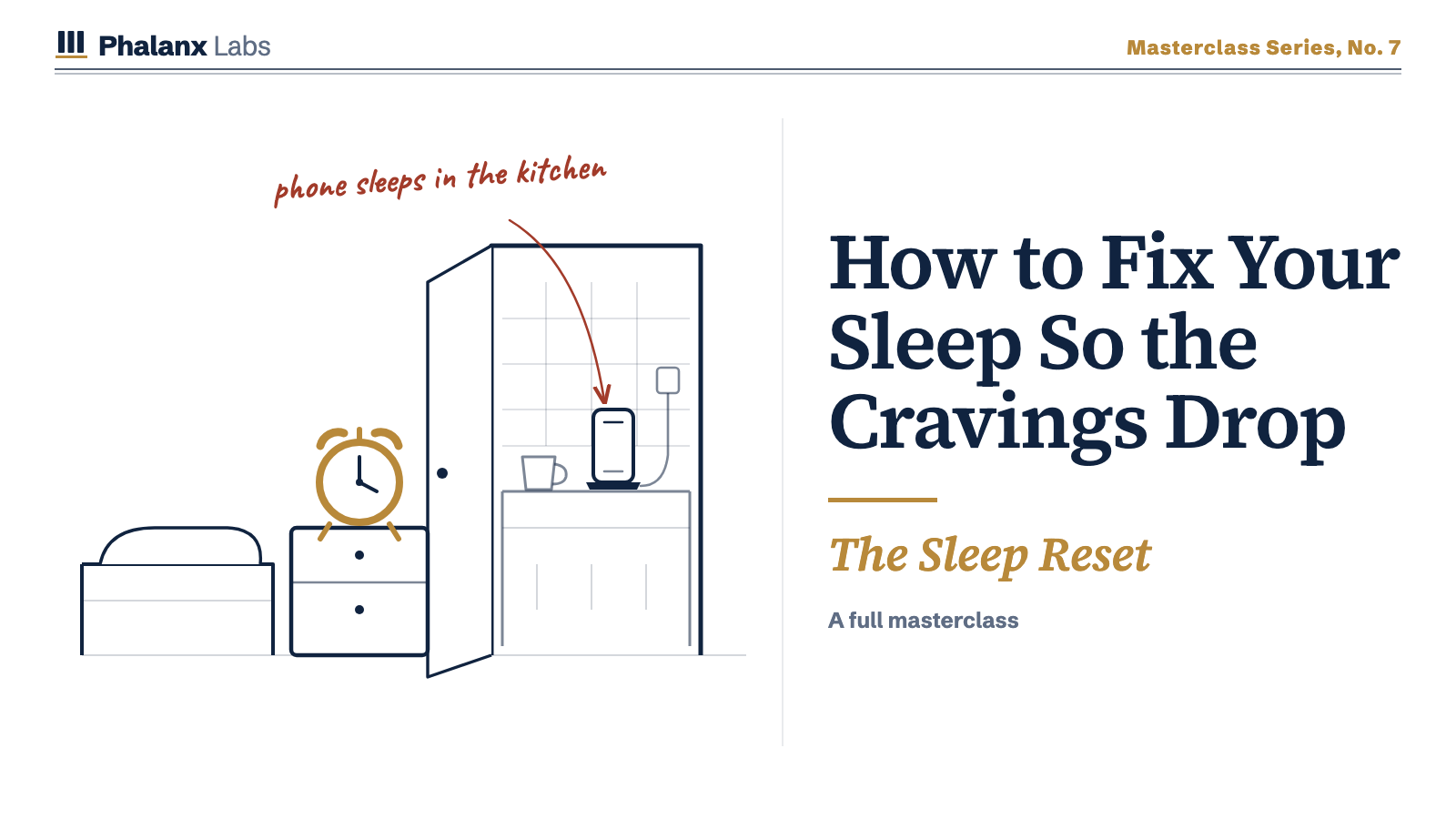
The phone charges in another room overnight, and a cheap alarm clock wakes you up.
This step helps in two ways. It teaches your brain that bed means sleep, and it takes away the phone in bed, which is where the habit starts for a lot of people.
Step 6: If you can't sleep, get up
If you're lying awake for more than 15 to 20 minutes, or you're getting frustrated, get out of bed and leave the room.
Sit somewhere with a dim light and do something boring, like reading something dull or folding laundry. No screens.
Go back to bed only when you're sleepy again. If you're awake again, get up again.
Turn the clock away from you too, because watching it tick past 2am only makes you angrier and more awake.
Step 7: Dim the house after sunset
Once the sun is down, use only as much light as you need to get around. Switch to lamps instead of ceiling lights, and put night mode on every screen.
Keep the bedroom dark and cool.
Step 8: Leave your problems on paper, before bed
A lot of sleepless nights are really worry nights.
So give the worry its own time, early in the evening. Sit down for 10 minutes, write down what's bothering you and tomorrow's plan, and close the notebook.
When it comes back in bed, you can tell yourself it's already written down.
Step 9: Plan the bad night in advance
The night you can't sleep is one of the riskiest moments you'll have. You're lying there, you're wired, and you know exactly what would knock you out.
So decide now what you'll do instead.
- Get up (Step 6)
- Put on a guided relaxation recording (search "yoga nidra" or "NSDR"), lying on the couch, not in bed
- Slow breathing, with the breath out longer than the breath in
The one thing you don't do is use the habit as your sleeping pill. That's the loop you're trying to break.
Why does this work?
Because your body builds up a pressure to sleep all day, and these steps stop you wasting it.
A fixed wake-up time and less time awake in bed mean that pressure is high when you lie down, so you fall asleep faster and stay asleep. Light in the morning tells your body when night should come. And every night you only sleep in your bed, your brain links bed with sleep again instead of with lying awake.
Better sleep means less stress the next day. Less stress means fewer evenings where the habit looks like the only relief.
Now, be honest with yourself..
The first week or two can feel worse, because you'll sleep a bit less while your body adjusts. That's normal. Stick with it.
If you snore loudly, stop breathing in your sleep, or have a history of seizures or bipolar disorder, see a doctor before you cut your time in bed.
And if you drink heavily every day, or you're taking sleeping pills, talk to a doctor before you stop. Stopping suddenly can be dangerous.
Start tomorrow morning. Pick the wake-up time tonight.
Try it out, it works.
This is the first north star every client gets in phase 1 of our program. We set a fixed sleep and wake time and track it every day, alongside the daylight, the walking and the evening routine, because nothing else we do holds up on bad sleep.
Sources
- Michael L. Perlis, Carla Jungquist, Michael T. Smith and Donn Posner, Cognitive Behavioral Treatment of Insomnia: A Session-by-Session Guide (Springer, 2005)
- Robert M. Sapolsky, Why Zebras Don't Get Ulcers, 3rd edition (Henry Holt, 2004)
The Behavior Control System
Our 90-day program, private and one-on-one, built around your life.
See our programsField Notes
One letter a week from the lab.