How to find out exactly why you relapsed
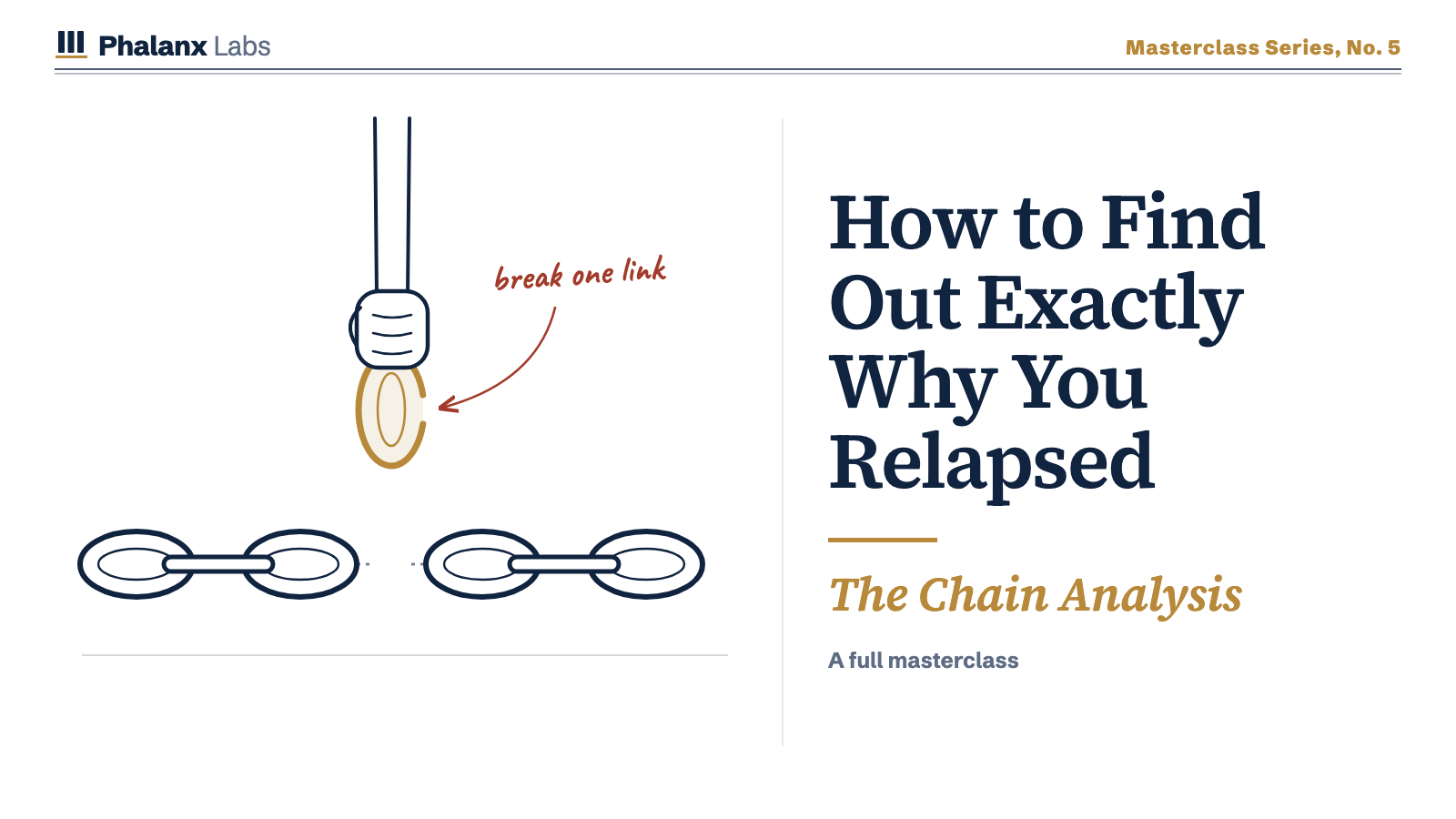
A relapse feels like it all happens at once, but it's a chain of links, and once you can see the links you can break the ones that matter.
The method: The Chain Analysis
Contents14 sections
- Who is this for?
- Step 1: Do it the next day, on paper, when you're calm
- Step 2: Write down exactly what happened
- Step 3: Find what set it off
- Step 4: Find what made you vulnerable that day
- Step 5: Write every link, in order
- Step 6: Find the links that matter most
- Step 7: Write what it did for you
- Step 8: For each key link, write what you'll do instead
- Step 9: Write a plan for the vulnerable days
- Step 10: Repair what actually got damaged
- Step 11: Keep every one, and lay them side by side
- Why does this work?
- Sources
(Works for porn, alcohol, weed, nicotine, scrolling, gambling, any habit. It's what we go through with every client after a relapse.)
Who is this for?
- You relapse and honestly can't say why. It "just happened"
- You keep making the same promise, "I'll be stronger next time", and it keeps breaking in the same way
- You replay the moment you gave in over and over, and it tells you nothing
- Deep down, you think the problem is that you're weak
If this is you, read on.
Relapsing "for no reason" is not a weakness of will.
It's what happens when you only ever look at the last ten seconds.
Think about what you usually do the morning after..
You remember the moment you gave in. The bottle in your hand, or the phone in bed. And you ask yourself the same question every time. "Why didn't I just stop?"
You don't have an answer. So you decide you need more willpower, you promise to be stronger tonight, and you change nothing else.
A week later it happens again, in almost exactly the same way.
Here's what most people never realize.
When researchers looked at what was going on in people's lives right before they relapsed, the craving itself was rarely the main thing. Bad moods, arguments and pressure from other people came up far more often than cravings did.
So the relapse often starts well before the craving shows up.
And it goes deeper than that..
A habit you've repeated hundreds of times feels like it happens all at once. One moment you're fine, the next it's done. But it never actually happens all at once. It's a chain of small links, one leading to the next. Maybe a thought, then a feeling, then a small decision that seems harmless at the time.
You can't see the links because you've run through them so many times. But if you break any one of them, the chain stops.
Think about how plane crashes get investigated.
When a plane goes down, investigators don't stop at the obvious answer. They take the engines apart piece by piece, they go through every second of the flight data, and they keep going until they find the exact thing that went wrong. Then they turn what they found into a few short lines on the pilots' checklist.
Most jobs never look into their failures like this. Aviation does, and that's how the same problem gets caught the next time it comes up.
In one case, investigators found that ice could build up in the fuel lines on long, cold flights and choke the engines. Later that year, the same thing started happening on another plane, high over the mountains. The pilots got out the checklist, did what it said, and the engine came back. The passengers didn't even notice.
That's what you're going to do with your relapse.
Instead of punishing yourself for it, you're going to investigate it.
This is called a chain analysis.
This post is not about theory though. Here's exactly how to do it.
Let's begin.
Step 1: Do it the next day, on paper, when you're calm
Not that night, and not when you're still angry with yourself. Pick a time the next day, sit down with a pen and paper, and give it 20 minutes.
Pick one relapse. The most recent one is best, because you'll remember the details.
Step 2: Write down exactly what happened
Be specific. Not "I relapsed again". Write what you did, how much, for how long, where you were and what time it was.
"Tuesday, about 9:30pm, on the couch. Four beers, then I went out and bought two more."
It's hard to look at it this plainly. Do it anyway. You can't fix something you're keeping vague.
Step 3: Find what set it off
This is the thing that happened, outside of you, that started the chain. Not "I had a craving". What happened just before the craving?
- A call with your boss that went badly
- An argument with your partner
- Walking into an empty house
- Seeing the bottle in the fridge, or a picture on your feed
- Getting paid
If you can't find it, keep asking "and what happened just before that?" until you hit something that happened to you.
Step 4: Find what made you vulnerable that day
These are the things that were already true before anything set you off. They're why the same call with your boss is nothing on a Monday and a relapse on a Friday.
Go through this list and write down every one that fits:
- Sleep: how many hours, the night before and the nights before that
- Food: did you skip a meal, or eat junk all day?
- Stress: what was weighing on you that week?
- People: any tension or conflict with someone?
- Being alone: were you on your own all evening?
- The body: were you sick, in pain, hungover, run down?
- A long stretch without anything good in your day
Most people find two or three. That's normal.
Step 5: Write every link, in order
Now go from what set it off to the relapse, one link at a time. Write each one on its own line. A link can be:
- a thought ("I've earned it today")
- a feeling (angry, bored, lonely, flat)
- something you felt in your body (tight chest, restless, tired)
- something you did (drove the long way, opened the app "just to check")
- something someone else did or said
Keep asking "what happened next?" Then go back and ask "what happened just before that?" for every gap.
Here's what one looks like:
- Slept five hours on Monday night
- Skipped lunch because of back-to-back calls
- Boss picked my work apart in front of the team
- Felt humiliated, then angry
- Thought "I've had a terrible day, I deserve something"
- Drove the route that goes past the store
- Thought "I'll just get a few, it's been a hard week"
- Bought them
- Got home, house empty, partner out
- Opened one, then the rest
Your first one will feel slow, and you'll miss links. That's fine. It's a skill, and it gets faster every time you do it.
Step 6: Find the links that matter most
Go down your list and ask this about every link: "If this one hadn't happened, would I still have relapsed?"
The ones where the honest answer is "probably not" are your key links. Circle them. There are usually two or three.
In the example above, the skipped lunch, the drive past the store and the empty house are all key links. The bad meeting might not even be one, because bad meetings happen every week, and most weeks you get through one without drinking.
Step 7: Write what it did for you
Write what happened straight after, and what happened later.
Straight after: relief, calm, numb, the day finally switched off.
Later: shame, a lost morning, the argument at home, the promise to yourself broken again.
Don't skip the first part. Be honest about what the habit gave you in that moment. If it was the only way you had to switch off after a day like that, you've just learned something important. That relief is the job your plan has to do some other way.
Step 8: For each key link, write what you'll do instead
One replacement for every link you circled. Make it specific enough that you could do it while tired.
- Skipped lunch: a meal goes in the calendar on call-heavy days, and there's food in the desk drawer
- The drive past the store: a different route home, every day, for the next few months
- The empty house: on nights alone, the evening is planned before you leave work, and you call someone at 8pm
- "I deserve something": write down three other things that actually feel like a reward, and keep the list on your phone
Step 9: Write a plan for the vulnerable days
Look back at Step 4. Pick the vulnerability that showed up and decide what you'll change.
If it was sleep, that's a plan for your nights. If it was being alone, that's a plan for the evenings you're on your own. If it was a hard week at work, that's a plan for Fridays.
You can't stop bad days from happening. But you can stop so many of them piling up on the same day.
Step 10: Repair what actually got damaged
Figure out what was really harmed, and repair that.
If you were short with your kids that night, the repair is an apology and some time with them, not a present. If you missed a deadline, the repair is the work. And repair yourself too: eat properly today, and get to bed on time tonight.
Step 11: Keep every one, and lay them side by side
Keep every chain analysis you write. After three or four, put them next to each other.
You'll see the same links keep coming back. Maybe it's always a Friday, or always a night you skipped dinner, or always after you've seen one particular person. That's your pattern, and now you know exactly where to put your effort.
Why does this work?
Because a habit you've practiced for years feels like one single moment, and you can't fix a single moment except by trying harder. The questions pull that moment apart into the small links it's actually made of.
Once you can see the links, you don't need to win at the last second anymore. You just need to break one link, earlier, when it's still easy.
And you stop fixing the wrong thing. Most people throw all their effort at the final ten seconds, when they're at their weakest. The chain shows you the places where a small change does far more.
Now, be honest with yourself..
This is not comfortable. You'll be looking straight at the thing you'd rather forget. And it won't stop a craving in the moment. What it does is show you where to put everything else: what to make hard to reach, which evenings to plan, which thought to have an answer ready for.
And if you drink heavily every day, talk to a doctor before you stop. Stopping suddenly can be dangerous.
Do your first one today, on your last relapse. It takes about 20 minutes.
Try it out, it works.
This is part of what we do with clients in phase 2 of our program. Every time a client relapses, we go through the chain with them, link by link, find the links we can break, and change the plan that same week. After a few of these the same two or three links keep showing up, and that's exactly where the work goes.
Sources
- Marsha M. Linehan, DBT Skills Training Manual, 2nd edition (Guilford Press, 2015)
- Laura J. Petracek, The DBT Workbook for Alcohol and Drug Addiction (Jessica Kingsley Publishers, 2023)
- Atul Gawande, The Checklist Manifesto (Metropolitan Books, 2009)
The Behavior Control System
Our 90-day program, private and one-on-one, built around your life.
See our programsField Notes
One letter a week from the lab.