How to talk yourself into change
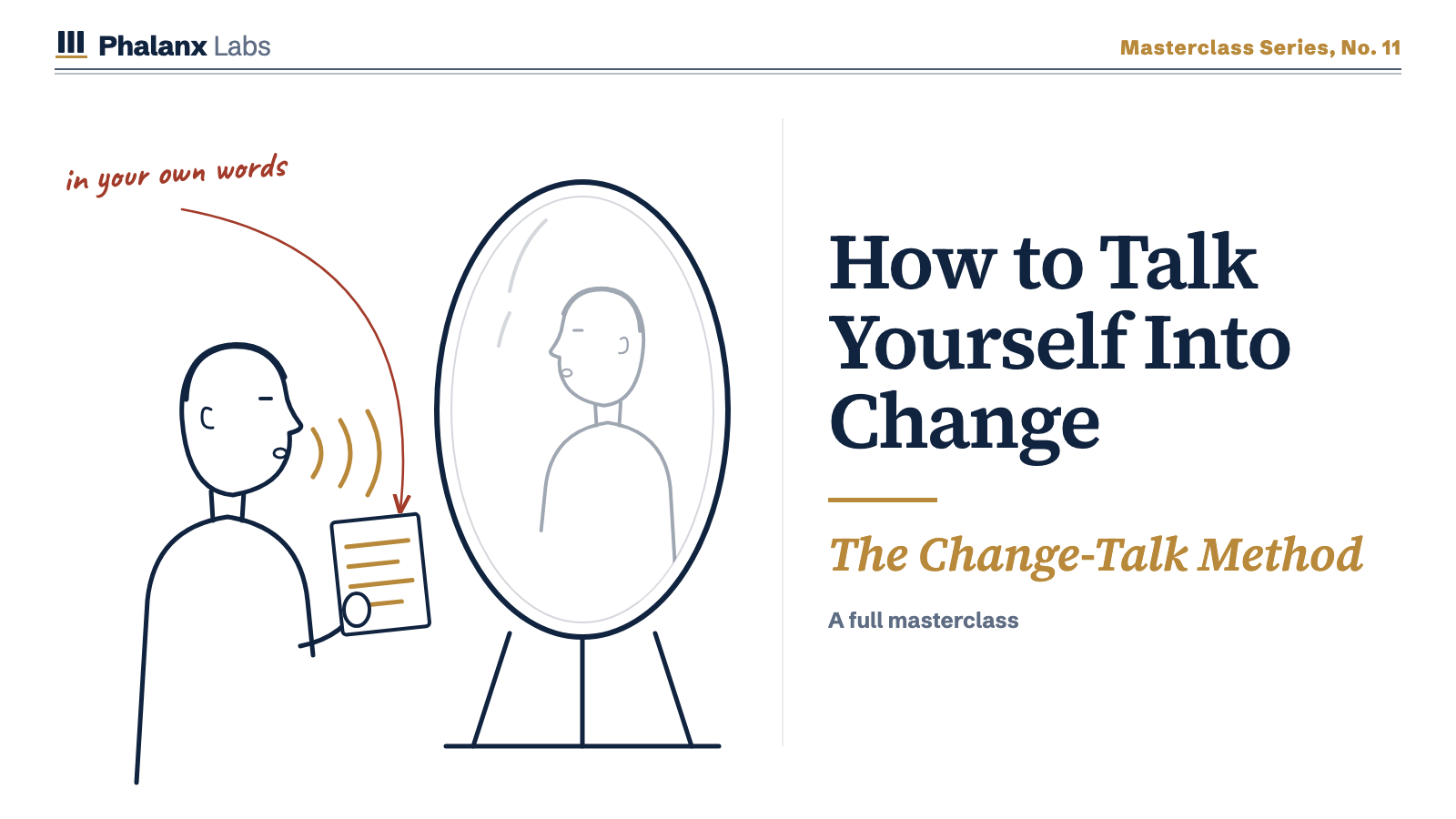
People tend to believe what they hear themselves say, so the morning lecture can talk you out of change, and your own reasons, in your own words, can talk you into it.
The method: The Change-Talk Method
Contents10 sections
- Who is this for?
- Step 1: Stop the morning lecture
- Step 2: Ask the 0 to 10 question, the right way round
- Step 3: Write your reasons in four kinds of sentences
- Step 4: Read them out loud
- Step 5: Look back, then look forward
- Step 6: Hold the habit up against what matters to you
- Step 7: When you're ready, say "I will"
- Why does this work?
- Sources
(Works for porn, alcohol, weed, nicotine, scrolling, gambling, any habit. It's one of the first things we work on with clients, before we touch the habit itself.)
Who is this for?
- You lecture yourself every morning about the habit, and by the evening you're doing it anyway
- Someone close to you keeps telling you to stop, and somehow it makes you want it more
- You know every reason you should stop, and none of them seem to move you
- Deep down, you think the problem is that you're weak
If this is you, read on.
Losing the argument with yourself is not a weakness of will.
It's what happens when the way you argue for stopping makes the other part of you defend the habit.
Think about how it usually goes..
You wake up after a bad night and the lecture starts. "You're pathetic. You have to stop. Look what this is doing to you." And almost straight away, another voice answers. "It's not that bad. It's been a rough week. Everyone does something."
By the evening, the second voice has won again.
Counselors who work with people trying to change have watched the same thing happen for decades. When a helper pushes someone to change something they have mixed feelings about, the person takes the other side. The doctor says "you need to cut down" and the patient says "it's not that bad." The harder the helper pushes, the harder the person defends.
And there's a second part to it, which is the part that matters for you. People tend to believe what they hear themselves say. So every time the person argues back, he's talking himself a little further out of change.
Now think about your morning lecture.
When you lecture yourself, you're doing both jobs at once. One part of you pushes like the doctor, and the other part defends the habit like the patient. So every morning, you end up rehearsing the case for the habit in your own head.
Researchers who recorded these conversations found that the mix of what people said was a good guide to whether they'd actually change. The more someone talked about wanting to change, being able to, and needing to, the more likely the change was to happen. The more they talked about reasons to stay the same, the less likely it was.
There's an old idea in psychology that says you find out what you believe the same way other people find out what you believe: by hearing yourself talk.
So instead of a harder lecture, you ask yourself questions where the only possible answer is a reason to change, in your own words.
This post is not about theory though. Here's exactly how to set it up.
Let's begin.
Step 1: Stop the morning lecture
For the next week, catch every sentence you say to yourself that starts with "you need to", "you have to", "you should" or "you're pathetic".
When you catch one, stop. Don't finish the speech. You'll replace it with the questions below.
Step 2: Ask the 0 to 10 question, the right way round
Take a piece of paper and write: "How important is it to me to stop, from 0 to 10?"
Write the number down. Let's say it's a 4.
Now ask: "Why is it a 4 and not a 0?"
Write down everything that comes up. "Because I'm tired of waking up foggy." "Because my son asked me why I'm always on my phone." That answer is your own reason to change, in your own words.
Never ask "Why is it only a 4 and not a 10?" The answer to that question is a list of reasons to keep going, and you'll believe it as you write it.
Then do the same for confidence: "How sure am I that I could stop if I decided to, from 0 to 10? Why not lower?" And then: "What would it take to move that up by one?"
Step 3: Write your reasons in four kinds of sentences
Under your numbers, write sentences that start like this:
- "I want..." (what you want instead)
- "I could..." (what you've done before that shows you can)
- "...because..." (the specific reasons)
- "I need to..." (what has to change)
Write them the way you'd say them out loud, not the way a doctor would. "I want to remember the end of the night." "I could do it before, I went six weeks once." "I need to stop lying to my wife about where the money went."
Aim for at least 10 sentences.
Step 4: Read them out loud
Every morning, in place of the lecture, read your list out loud. It takes about a minute.
You can also record yourself reading it as a voice memo and play it in the car.
What matters is that you hear the reasons in your own voice, because that's what this whole method runs on.
Step 5: Look back, then look forward
Write a few lines about a time before the habit took over. What were your evenings like? What did you care about? What did people say about you?
Then write about one year from now, after you've stopped. You wake up on a Saturday. What time is it? How do you feel? What do you do with the evening? Who's there?
Be specific. "I'd feel better" doesn't count. "I'd be up at 7 and take the kids to the park without a headache" does.
Step 6: Hold the habit up against what matters to you
Write down the 5 things that matter most to you. It could be being a good father, your health, your work, or being someone people can trust.
Next to each one, write whether the habit helps it, makes no difference, or gets in the way.
Do this out of curiosity, the way you'd look at a bank statement, and don't use it to beat yourself up.
Step 7: When you're ready, say "I will"
Once your reasons are on paper, write one sentence that starts with "I will" and has a time in it.
"I will not buy any on the way home this week." "I will charge my phone in the kitchen from tonight."
Don't force this one. If you're not ready to write it yet, go back to Steps 2 to 6 for a few more days, and it'll come.
Why does this work?
Because you stop arguing with yourself in the one way that makes you defend the habit.
A lecture gives the other part of you something to push back against. A question like "why not a 0?" can only be answered with a reason to change. And when the reason comes out of your own mouth, in your own words, you believe it in a way you never believe a lecture.
Now, be honest with yourself..
This won't stop a craving on a bad night, and it doesn't replace a plan for your triggers. What it does is get you to the point where you actually want to follow that plan, and keep wanting to when the first rush of motivation wears off.
And if you drink heavily every day, talk to a doctor before you stop. Stopping suddenly can be dangerous.
Do Steps 2 and 3 tomorrow morning. It takes 15 minutes.
Try it out, it works.
This is how we start with clients in phase 1 of our program. Before we change anything, we get each client's own reasons out of him, in his own words, and write them down. Then we come back to them every week, so when the motivation dips, the reasons are still there in his voice.
Sources
- William R. Miller and Stephen Rollnick, Motivational Interviewing: Helping People Change and Grow, 4th edition (Guilford Press, 2023)
- P. C. Amrhein, W. R. Miller, C. E. Yahne, M. Palmer and L. Fulcher (2003). Client commitment language during motivational interviewing predicts drug use outcomes. Journal of Consulting and Clinical Psychology.
The Behavior Control System
Our 90-day program, private and one-on-one, built around your life.
See our programsField Notes
One letter a week from the lab.